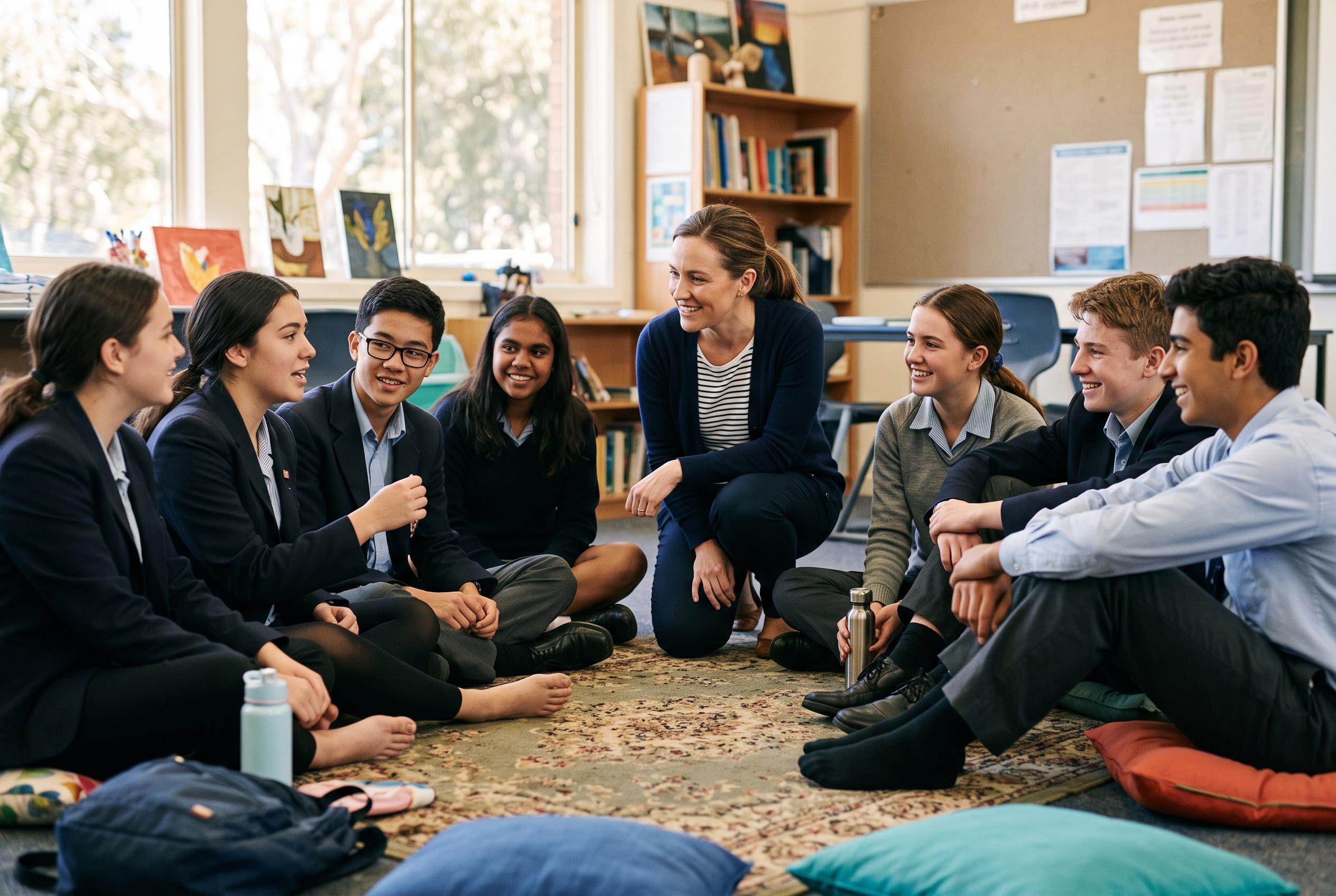

R U OK? promotes embedding regular, supportive conversations in school routines to bridge the gap between needing help and seeking it, moving beyond single awareness days to foster genuine wellbeing among young Australians.
R U OK? is increasingly arguing that student wellbeing should be built through ordinary, repeated conversations rather than a single awareness day. In material published on 11 September 2025, the charity said (ruok.org.au) that 94% of 16 to 24-year-olds had supported someone at least once in the previous month and 57% were asking others “are you OK?” more regularly than a year earlier. On its current education pages, R U OK? says (ruok.org.au) it is preparing a broader rollout of its Student Connection Champions programme in Term 4 2026, with participating schools due to begin in 2027. The message is no longer simply to remember one date in September, but to make checking in part of daily school life.
That push is aimed at a stubborn gap between needing support and seeking it. Research commissioned by R U OK? from YouthInsight and published on 15 December 2022 found (ruok.org.au) that seven in ten Australians aged 12 to 25 did not ask for help when going through a difficult time, even though 70% said they would have a meaningful conversation with a close friend and preferred to do so face to face. The same research found that only 42% would discuss mental health concerns with family members, and the same proportion would do so in a group of friends (ruok.org.au). ABC News returned to the issue on 4 April 2023, reporting that R U OK? was launching a youth-focused programme because so many young Australians remained reluctant to reach out during mental health struggles (abc.net.au). For schools, that means peers are often the first people to notice when something is wrong.
R U OK? has tried to humanise those figures through people whose lives were altered by a simple conversation. Kate Jones, an educator from Aberdeen in New South Wales and a community ambassador for the charity, said (ruok.org.au) one quiet exchange with an R U OK? team member while she was grieving her husband helped her begin processing that loss before, 18 months later, her son died by suicide. The organisation has also highlighted the experience of 19-year-old ambassador Mahir Manut, who said a teacher’s check-in changed his life and urged hesitant young people to ask themselves “what’s the worst that could happen?” (ruok.org.au). Those accounts are being used to make the case that students do not need to be experts to make a difference.
The practical advice being taught is deliberately simple. ABC Education has long framed the model as four steps: ask, listen, encourage action and check in (abc.net.au). Its classroom-style explainer suggests conversation starters ranging from “Are you OK?” and “Is everything OK?” to “How are things?” and “What’s been happening?” (abc.net.au). It also stresses that listening patiently, taking what a friend says seriously and returning to the conversation later are as important as the opening question itself (abc.net.au). In other words, the skill lies less in delivering the perfect line than in staying present once the conversation begins.
That becomes most important when the answer is no. Writing for UNSW in September 2018, Jill Newby and Chien Hoong Gooi advised readers not to rush into trying to solve everything immediately, but instead to listen actively, ask open questions and validate what the other person is experiencing (unsw.edu.au). Their guidance said people should think about whether urgent help is needed, encourage professional support where appropriate and, if possible, arrange to check in again after the initial conversation (unsw.edu.au). The same piece pointed readers towards a GP as the first professional stop for discussing treatment options and referrals (unsw.edu.au). That is a useful corrective to the fear many teenagers have that asking a question means taking responsibility for fixing a friend’s life.
Universities have also been testing what it looks like when the campaign is turned into concrete activity rather than a slogan. UNSW’s plans for R U OK? Day in 2023 included a campus event with Jessica Rowe, Black Dog Institute chief scientist Samuel Harvey and psychiatry professor Kimberlie Dean, alongside free ten-minute massages at Kensington and Paddington from 10am to 2pm, a Virtual Gratitude Tree and downloadable backgrounds for Teams and Zoom (inside.unsw.edu.au). The university also promoted Black Dog Institute training called Recognise and Respond: Suicide Prevention for Everyday Life, a self-paced online course of about an hour designed to help staff and students feel more confident supporting someone who may be at risk of suicide (inside.unsw.edu.au). The broader lesson is that institutions are increasingly pairing awareness with rehearsal, training and routine contact.
R U OK?’s newer school material points in the same direction. The Student Connection Champions programme is described by the charity as a free, peer-to-peer initiative in which Year 9 or Year 10 pupils lead Year 7 students through practical activities designed to build belonging and conversation confidence (ruok.org.au). The organisation says students are “not expected to take on the role of a professional” and should instead learn to listen, show care and connect a friend to a trusted adult such as a teacher or school counsellor (ruok.org.au). Its education hub now includes lesson material for Year 7 on different ways to ask the question, for Year 8 on signs someone may not be OK, and for Year 9 on when to connect with someone (ruok.org.au). That amounts to a more structured answer to the long-running problem identified in the earlier YouthInsight research.
Katherine Newton, R U OK?’s chief executive, said when the 2022 research was released that young people “won’t always tell us they need support”, and that asking how they are really going should become an everyday part of relationships (ruok.org.au). Taken together, the charity’s survey data, the school-facing explainers and the university examples all point to the same conclusion: the value of “are you OK?” lies not in the phrase itself, but in whether young people are shown how to use it well. For teachers and school leaders, the challenge is to make that confidence commonplace.
Disclaimer: This content is for informational purposes only and is not intended to be a substitute for professional medical judgment, advice, diagnosis, or treatment.