

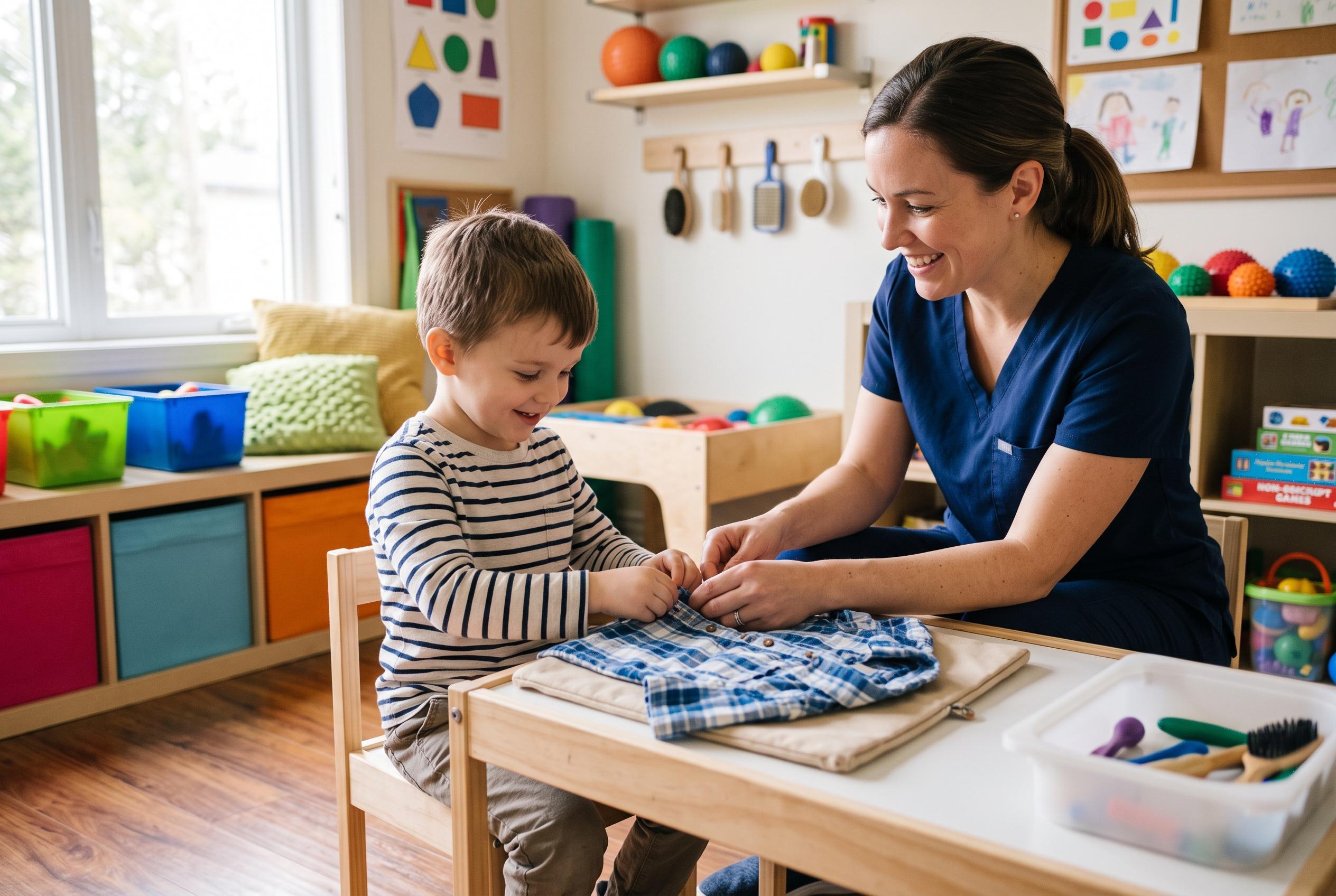

From dressing and eating to managing sensory input and joining in at school, occupational therapy helps children build the skills and confidence needed for everyday life.
Occupational therapy for children is often misunderstood as little more than help with handwriting, but that is only one small part of the picture. According to the Teach Mama article, the real focus is on the everyday tasks that shape a child’s day: getting dressed, eating, playing, learning and joining in with others. Cleveland Clinic likewise says paediatric occupational therapy is designed to support developmental milestones and daily life skills, with plans tailored to each child’s needs.
In practical terms, that can mean helping a child manage buttons, zips, cutlery or the steps of a morning routine. The Teach Mama article describes how tasks that look simple from the outside can be demanding for young children because they require hand strength, coordination and sequencing. Pediatric Therapy Finder says therapists often work on the underlying skills that make these activities possible, rather than only the task itself, so a child can build independence in small, manageable steps.
Occupational therapy also looks at how a child’s body moves through space. UC Health says OT can support motor skills, sensory processing and emotional regulation, while Pine Rest notes that it may help children with routines, transitions and responses to sensory input. That can be relevant in the classroom, on the playground or anywhere a child needs balance, posture and coordination to stay engaged. The Teach Mama article makes the same point more plainly: when a child is using all their energy simply to sit upright or manage movement, there is less left for attention and learning.
Sensory differences can be especially important. Some children are overwhelmed by noise, light or touch, while others actively seek movement or pressure. Both UC Health and Pine Rest say these responses can affect behaviour, concentration and participation, and are often better understood as signs of sensory processing challenges than as wilful misbehaviour. The Teach Mama article suggests that adjustments such as a quieter space, ear defenders or a short burst of movement before a difficult task can make a meaningful difference.
OT can also support play, friendships and emotional confidence. Cleveland Clinic says therapy may improve social and emotional development as well as self-care and fine motor skills, while St Jude and Ginger Healthcare both note that it can help children take part in age-appropriate activities, including learning and social engagement. The Teach Mama article argues that if a child is struggling with daily routines, losing confidence or finding ordinary tasks much harder than peers, parents should seek advice. The aim is not perfection, but greater ease, independence and participation in everyday life.
Disclaimer: This content is for informational purposes only and is not intended to be a substitute for professional medical judgment, advice, diagnosis, or treatment.



