

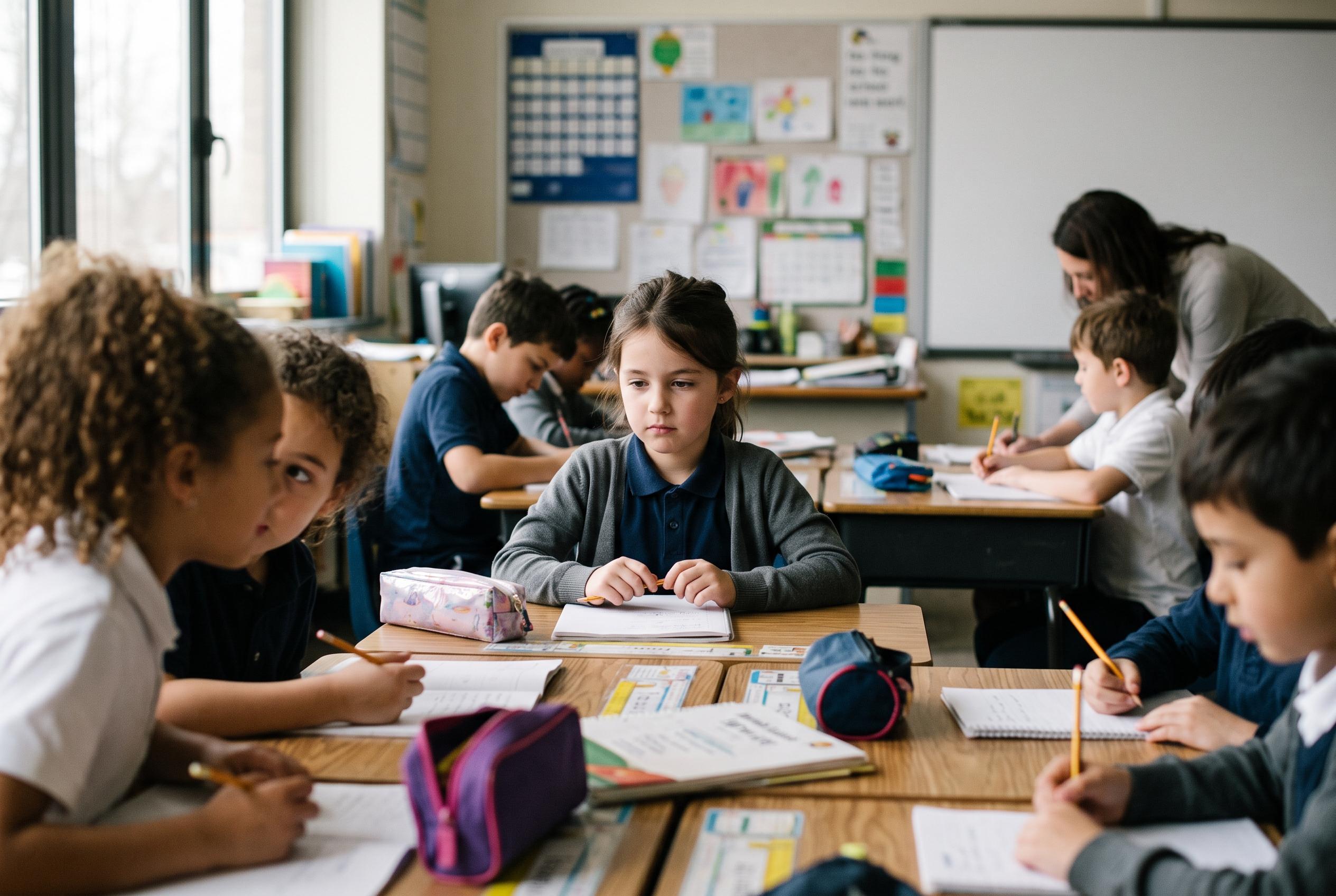

Quiet, still behaviour is often praised in classrooms, but it can hide the exhausting effort some autistic children make to suppress traits that help them regulate and learn.
In classrooms, the smallest behaviours can carry the biggest assumptions. A child who sits still, folds their legs neatly and keeps their hands quiet is often praised for settling in well. But as Dr Joanna Grace argues in Parenta, that kind of “good sitting” may sometimes conceal something more complicated: a child working hard to mask autistic traits in order to look like everyone else.
Grace describes visiting a school that took pride in its inclusive approach. Children who needed fidgets were allowed to use them, and the classroom had adapted around that need rather than treating it as a disruption. Yet she was struck by a boy whose previous school had not met his needs and who, after being gradually discouraged from using the resources that had helped him regulate, was now held up as an example of excellent behaviour. The praise, she suggests, may have been aimed less at learning than at conformity.
That distinction matters because autistic masking, sometimes called camouflaging, can be costly. Research summaries from Simply Psychology and Healthline describe it as the effort autistic people make to hide traits such as stimming, avoid standing out and copy neurotypical social behaviour. Over time, that effort can be exhausting and is associated with anxiety, depression, burnout and, in severe cases, suicidal thoughts. The pressure to conceal differences can be especially intense for autistic girls and women, which can also contribute to missed or delayed diagnosis.
Grace’s point is not that fidgets are always necessary or that classroom routines should disappear. It is that adults should ask what they are actually rewarding. If a child is concentrating while using a fidget, rocking gently or moving in a way that helps them stay regulated, that may be a sign of comfort and attention rather than poor behaviour. The real question, she suggests, is whether the child is learning, or merely performing the appearance of stillness.
For parents and carers, the broader lesson is a practical one: inclusion should make room for difference, not just manage it. A classroom where children are allowed to sit, move and focus in different ways may look less uniform, but it is far more likely to support genuine learning. As Grace writes, the aim should not be to make every child look the same, but to create a place where every child can belong.
Disclaimer: This content is for informational purposes only and is not intended to be a substitute for professional medical judgment, advice, diagnosis, or treatment.



