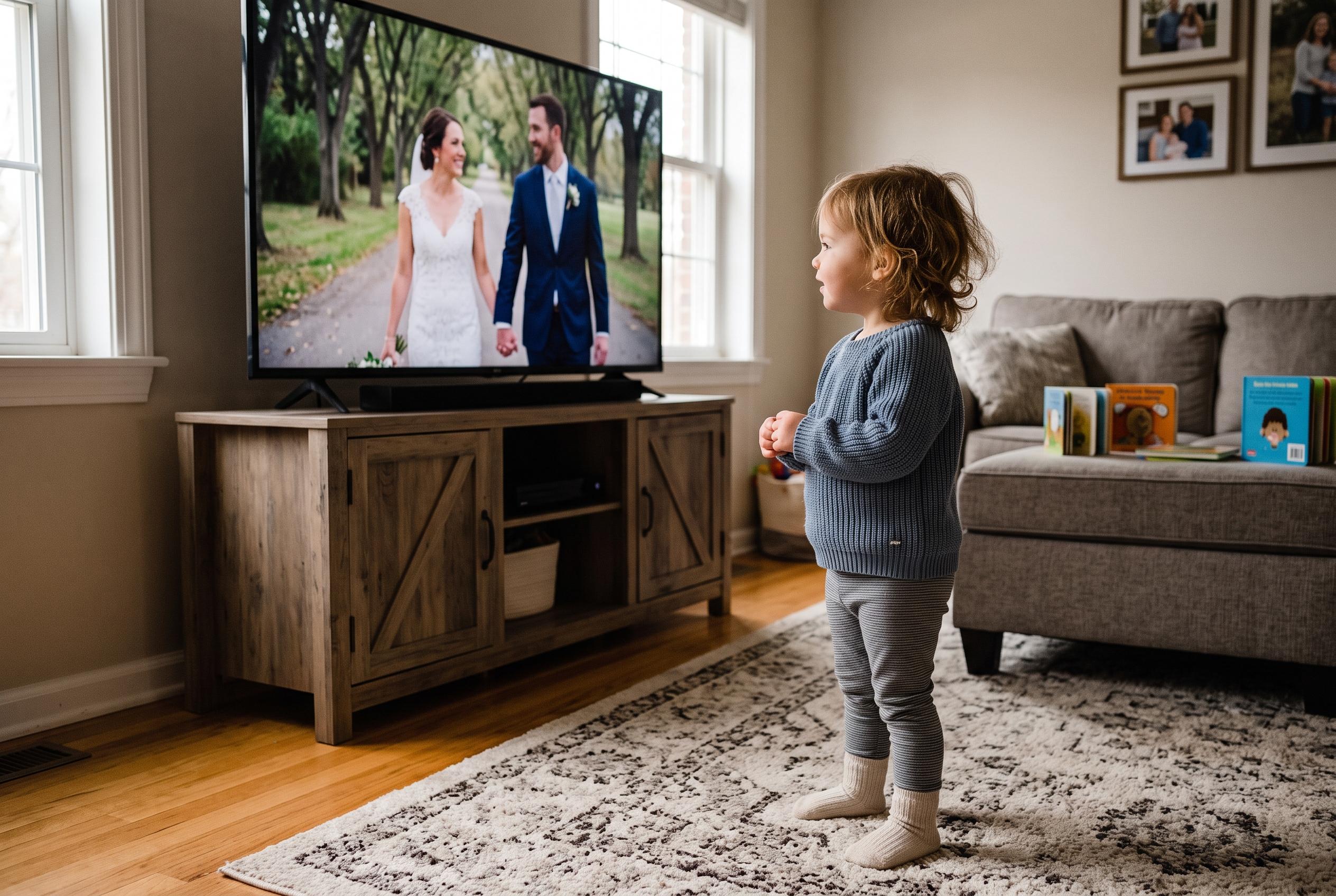

A viral clip of a toddler watching her parents’ wedding video highlights the profound impact of parental stability on children’s emotional and developmental outcomes, backed by recent research findings.
A viral clip of a 3-year-old girl watching her parents’ wedding video has struck a nerve because it captures something many adults recognise but rarely name: children often read their security through the relationship between their parents. In the video, the child’s tears and delight seem to mirror a sense that love is being shown to her, even though she is not the direct focus of anyone’s attention. That idea has long been central to child-development arguments made by family scholars such as Katy Faust and marriage researcher Pat Fagan, who say children absorb affection indirectly when they see a mother and father caring for one another.
That insight is more than sentiment. A report from the American Enterprise Institute and the Institute for Family Studies, based on US government data, found that children raised by intact, married parents generally fared better than children in stepfamilies, cohabiting households or single-parent homes. According to the report, children outside intact married homes were less likely to earn strong grades, more likely to have behavioural contact from school and more likely to be diagnosed with depression. Even after accounting for race, income and parental education, family structure remained one of the strongest predictors of child outcomes.
The broader research record is not perfectly uniform, but it does point in the same direction. A review in the journal Social Problems found that children living with two biological married parents tend, on average, to have better educational, social, cognitive and behavioural outcomes than peers in other family forms, although the differences were often modest. Other studies, including Canadian research comparing intact, step- and lone-parent households, have likewise found that family type can matter more than low income when it comes to emotional and behavioural difficulties.
That does not mean every child outside a married two-parent home is destined to struggle, or that a stable marriage automatically solves every problem. Researchers have also shown that factors such as parental warmth, household conflict, income and social support can strongly shape children’s lives. But the central point remains difficult to dismiss: when parents are committed to one another and to their children, that stability often gives children a clearer foundation for health, learning and emotional development. The little girl in the viral video may not have the language for any of this, but her reaction seemed to capture the simplest version of the truth: children want to feel that the people who brought them into the world are still standing together.
Disclaimer: This content is for informational purposes only and is not intended to be a substitute for professional medical judgment, advice, diagnosis, or treatment.