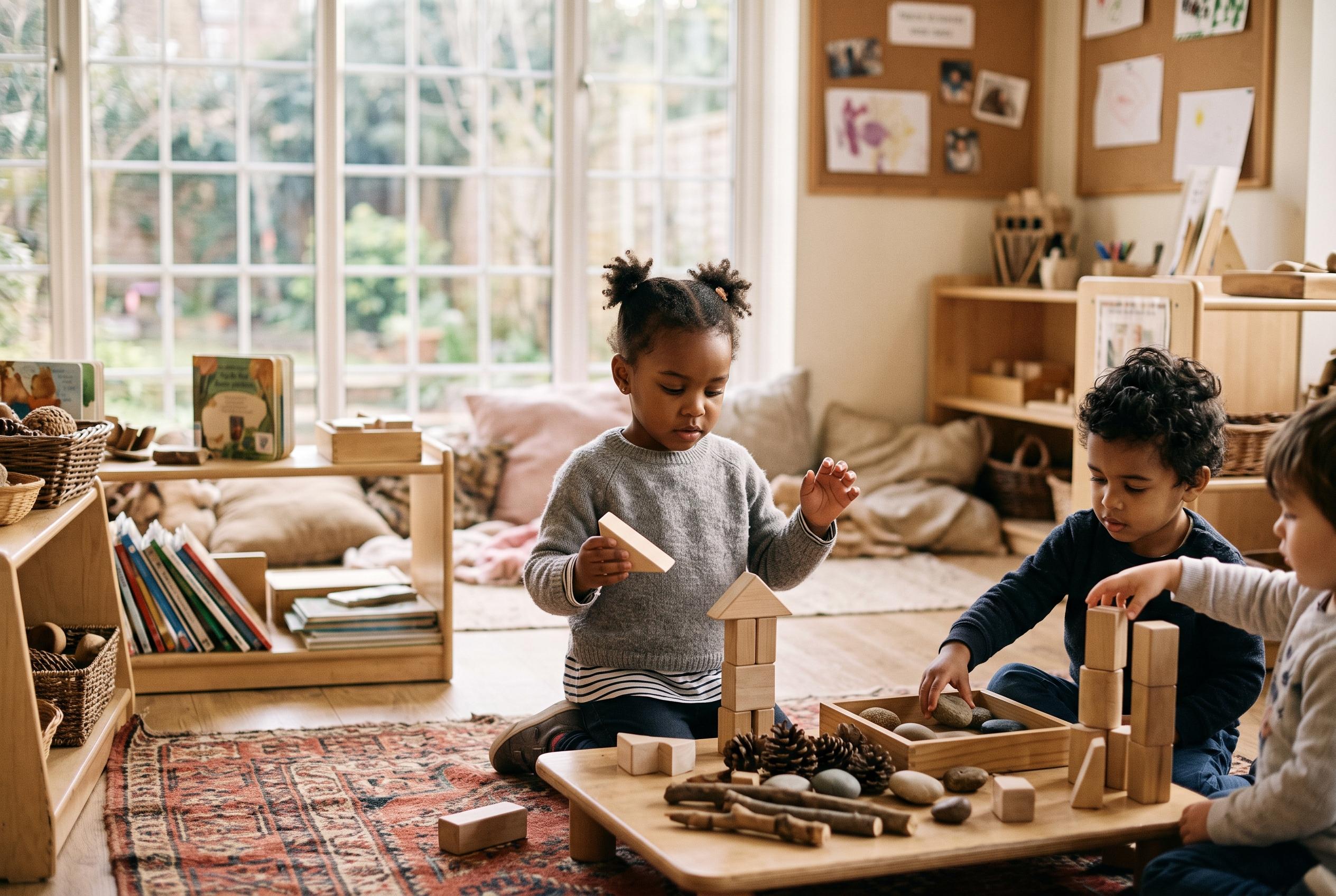

Research shows that children’s responses to errors , from pausing to trying again , reveal crucial developmental progress in their cognitive and emotional growth, reshaping how nursery education supports young learners.
In a nursery classroom, some of the most important lessons appear when a child gets something wrong. A paper fold slips out of shape, a bead will not pass through the thread, a crayon line strays off course. To an adult, these moments can seem minor. For a child, they are often where learning becomes visible: in the pause, the second attempt, the request for help, the decision to carry on.
That matters because early education is often judged by the finished result. A completed drawing, a neat number or a tidy craft can look like proof of understanding. But the more telling evidence may lie in the process. Did the child follow the steps? Did they remember what came next? Did they notice the mistake and try another way? According to material from the source article, that shifting response to difficulty can be more revealing than the final product itself.
Developmental science gives that idea wider weight. Young children are still building executive function, the mental skills that support memory, focus, self-control and flexible thinking. Research on preschoolers has shown that these abilities grow through practice and experience, and that adults are often needed at first to model, guide and then gradually step back as children become more capable on their own. In a nursery, that can look as ordinary as a child keeping two instructions in mind, or stopping long enough to correct a mistake rather than abandoning the task.
The challenge for teachers is knowing when to help and when to hold back. Too much intervention can rob a child of the chance to work things out; too little can turn a manageable task into frustration. Harvard’s development research describes this balance as scaffolding: giving enough support for a child to stay engaged, then reducing help as competence grows. The point is not to leave children to struggle alone, but to keep them in the space where effort can still lead to progress.
Mistakes, in that sense, are useful information. Early childhood educators often see them as signs of what a child does not yet understand, but they can also show exactly where thinking has broken down. A child who misfolds paper may have grasped the first instruction but not the spatial relation in the next step. A child who loses track of a sequence may understand each part but struggle to hold it in working memory. Recent research on kindergarten children suggests that practice with feedback can improve error monitoring, while broader studies on corrective feedback show benefits for literacy, maths and problem-solving when the guidance is age-appropriate and well timed.
That is why the form of correction matters. A vague response tells a child little. A precise prompt can turn an error into a clue. “Try again” may encourage persistence, but “What could you change this time?” asks the child to think about their own method. Research from early childhood education sources suggests that this kind of feedback helps children become more autonomous and more willing to take risks, while also building resilience.
Repetition plays a role as well, not simply because it helps children remember, but because it lets them compare one attempt with the next. A child who cuts along a line several times may begin to adjust how they hold the paper. A familiar song may become easier to sing, but it also frees attention for what comes next. Over time, repeated experience can make an unfamiliar action feel manageable, and then independent. That gradual shift is one of the clearest signs that learning is taking hold.
The wider lesson is that progress in early childhood is not only about what children can finish. It is also about how they meet difficulty. A child who once waited for an adult to solve every problem may begin to look again, ask a better question or try a new strategy. A child who used to give up may stay with the task a little longer. These changes can be easy to miss if adults focus only on the end result. But in the daily life of a nursery classroom, they may be the real markers of growth: the moment a child begins to see a mistake not as failure, but as something that can be used.
Disclaimer: This content is for informational purposes only and is not intended to be a substitute for professional medical judgment, advice, diagnosis, or treatment.