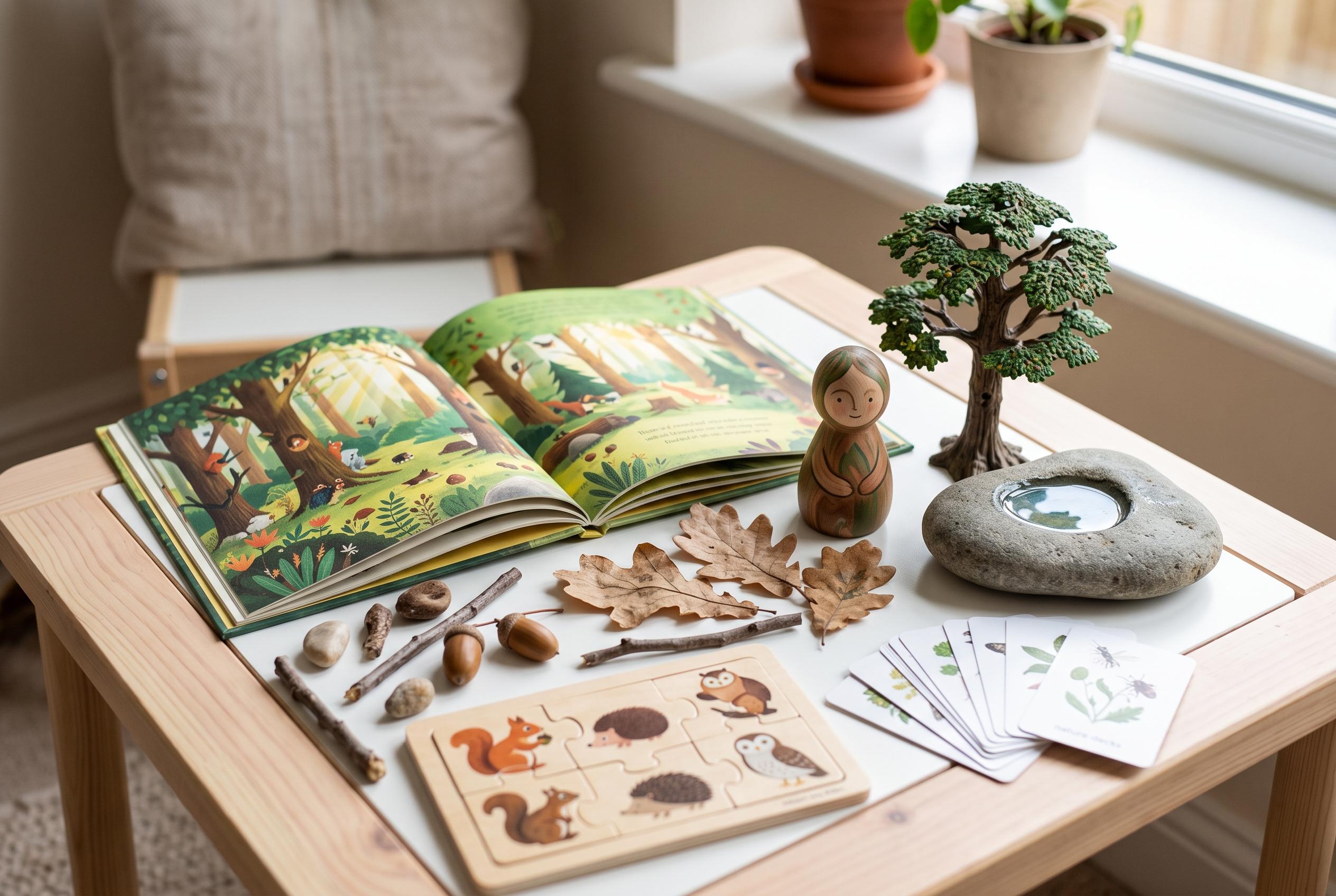

A deep dive into how children’s early tendency to attribute motives to the natural world reveals insights into their evolving understanding of reality, and how this pattern persists into adulthood.
A child of 3 or 4 walking home beneath a full moon may stop, look up and insist that it is keeping pace with her. That small scene, familiar to many parents, points to a deep feature of early childhood thinking: the tendency to treat the natural world as though it has motives, feelings and intentions. Jean Piaget, the Swiss psychologist who shaped modern developmental theory, made that observation the basis for one of his best-known ideas about how children think.
Piaget called the habit animism and placed it within the preoperational stage of development, which he said runs from about age 2 to age 7. In his account, children at this age have language, imagination and symbolic play, but have not yet built the kind of logical framework that separates living things from objects that merely move or make noise. A moon that seems to follow, a wind that seems angry or a sun that appears to go to sleep all fit neatly into that early way of making sense of experience.
The idea has endured because it captures something children really do. A young child is not simply being fanciful when she says the moon likes her or that clouds are in a hurry. She is using the explanation that makes most sense to her: things act the way they do because they want to. That same habit can be seen in a rolling ball, a slamming gate or a favourite toy that is spoken to as if it can listen. According to summaries of Piaget’s work, animism fades gradually rather than disappearing at once, narrowing over time from almost anything that moves to animals and objects that appear to act on their own.
Later developmental research has not left Piaget untouched. More recent studies have shown that some of the abilities he placed at later ages can emerge earlier, and that his original observations were shaped by a small sample of children in Geneva. But the broad pattern has held up well, and introductions to developmental psychology still describe the preoperational stage in much the same terms: symbolic play, egocentrism, centration and animism all sit together in a period when children are busy learning how minds and objects differ.
That is why the moon matters so much in this story. Celestial bodies and weather are especially likely to invite animistic thinking because they move without an obvious cause, cannot be touched and seem to act independently of the child’s wishes. Adults do something related when they see faces in sockets or sense personality in a car or household device. The impulse never fully disappears; it becomes more restrained. For children, though, it is part of the work of growing up. Pretend tea, a blanket turned into a cape and a moon with feelings are all steps towards understanding that other people have inner lives and that the world itself does not.
By about age 7 or 8, most children begin to settle on a more literal account. The wind no longer has a temper, the sun no longer goes to bed and the moon becomes a distant object governed by physical laws rather than a companion on the walk home. Yet the earlier view leaves a trace. In memory, it survives as the sense that certain things were once alive with purpose: a tree that seemed watchful, a chair that felt unfriendly or a moon that followed just long enough to be a friend.
Disclaimer: This content is for informational purposes only and is not intended to be a substitute for professional medical judgment, advice, diagnosis, or treatment.