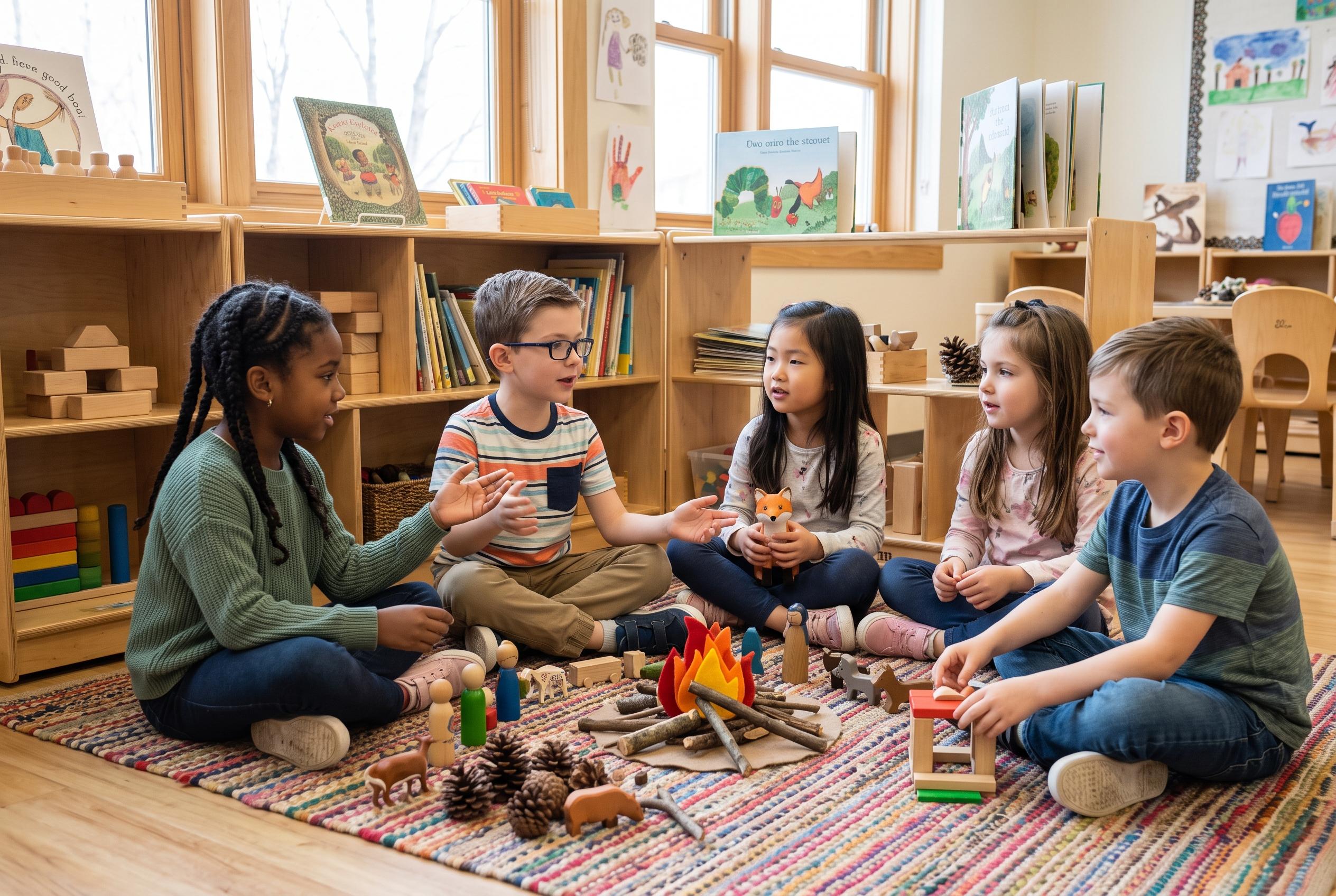

Research shows that children’s frequent self-talk is a normal part of development and perspective-taking, not narcissism. Adults’ self-reference in conversation often stems from emotion or habit, highlighting the importance of modelling and understanding in social growth.
A child who seems to narrate every move is usually not showing an early sign of narcissism, but simply doing something deeply human: talking about themselves. Research cited by The Artful Age notes that adults, too, devote roughly a third to 40% of everyday speech to their own experiences, thoughts and feelings, and that self-disclosure can feel rewarding in its own right, even enough for people to give up small amounts of money for the chance to do it.
That matters because constant self-reference can look more extreme than it is. In young children, the behaviour is often best understood as part of development rather than character. Studies of theory of mind, the ability to understand that other people have thoughts and beliefs different from one’s own, show that preschoolers make a major leap in early childhood as they learn to see beyond their own perspective. Henry Wellman’s meta-analyses, drawing on 178 studies, found a broadly similar developmental pattern across countries.
In other words, a 3- or 4-year-old who keeps saying “look at me” or “I did this” is not necessarily being self-absorbed. They are usually operating from the viewpoint that is most fully available to them: their own. The more advanced skill of balancing their perspective with somebody else’s emerges gradually, not all at once, and it is not reasonable to expect that capacity to be fully in place before preschoolers have had time to practise it.
For adults, the same habit is more often explained by ordinary forces: excitement, anxiety, loneliness or plain conversational habit. The word narcissism is a poor fit unless there is a broader, persistent pattern, and even then it is not something that can be diagnosed from a chatty dinner table performance. The better response in children is not shaming, but modelling turn-taking, asking questions back and naming feelings so they can slowly learn how other minds work. That sort of repeated, ordinary attention is what helps perspective-taking come online.
Disclaimer: This content is for informational purposes only and is not intended to be a substitute for professional medical judgment, advice, diagnosis, or treatment.