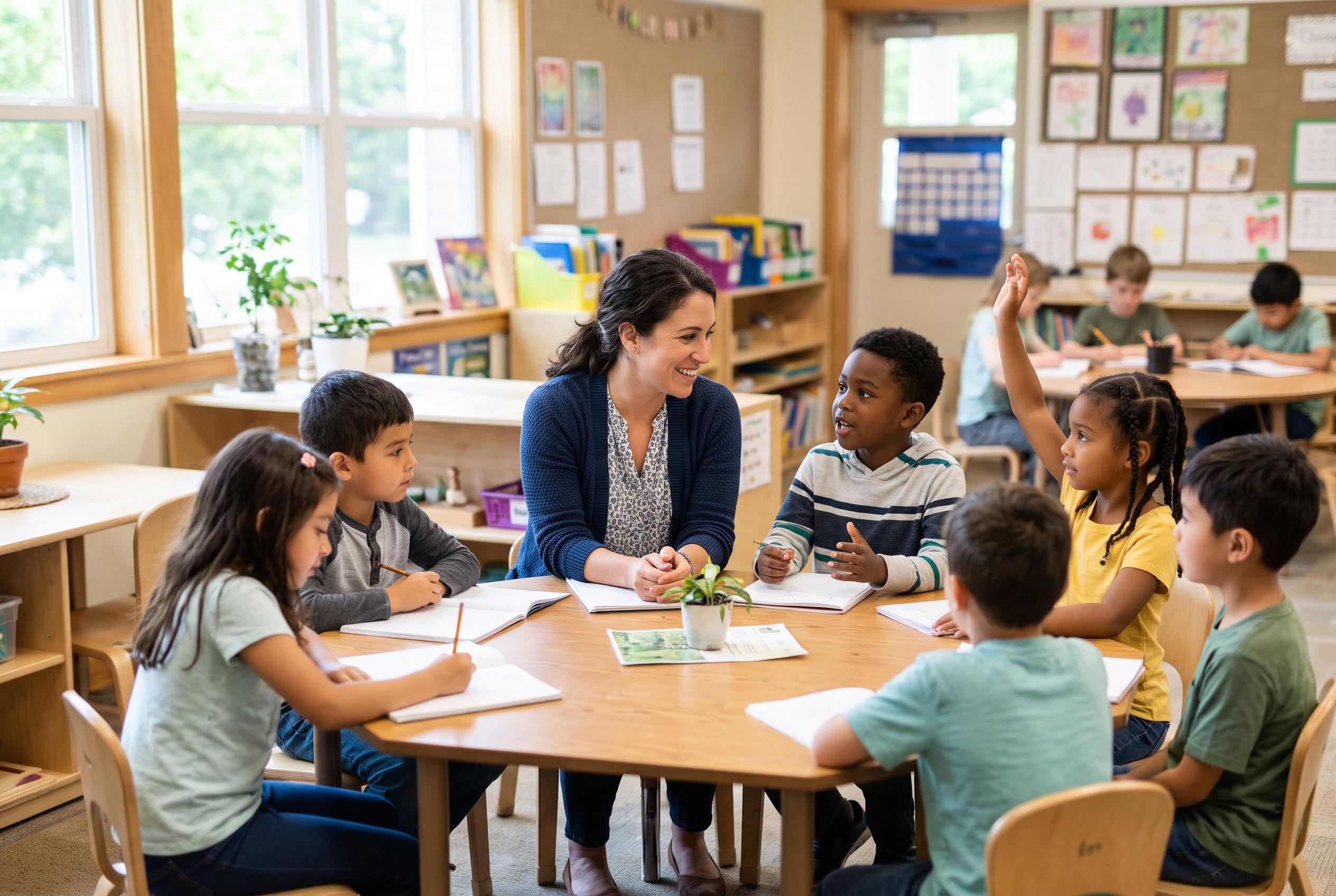

Research suggests the most effective classrooms balance adult-led structure with children’s ideas, using shared responsibility rather than rigid control or complete autonomy.
The central argument is simple but useful: in teaching, the best answer is not always adult control or child autonomy. Sometimes the more effective route is a shared one, where the adult keeps responsibility for safety and structure, while the child helps shape what happens next. The idea may begin in a yoga class, but it reaches far beyond movement. It is really about how educators respond when a carefully prepared plan meets a child’s entirely different idea of what the lesson should be.
That matters because collaboration is not the same as handing over the reins. Research on cooperative learning has long suggested that outcomes depend less on the label attached to a method than on how it is carried out. A study published in Springer found that the quality of implementation depends heavily on whether teachers actually use the core elements of cooperative learning, including shared responsibility, individual accountability and purposeful group processing. In other words, a collaborative approach only works when adults remain active designers of the experience.
A separate action-research project in primary education found that collaborative teaching could reduce negative behaviour, increase interest in lessons and support teachers’ professional growth. A broader review of co-teaching, published in SAGE journals, described similar gains: more varied perspectives, better differentiated instruction, extra feedback and more attention for pupils. But it also warned of pitfalls, including confusion among students and uneven workloads between teachers. The point is not that collaboration automatically improves education. It is that it can be powerful when the roles are clear and the work is genuinely shared.
The lead essay’s strongest contribution is its insistence that adults should not confuse structure with rigidity. A child’s contribution is not decorative, and a good idea from a child can change the activity in a meaningful way. That is especially important in settings for children who may need flexibility, communication support or a different route into participation. The article argues that a lesson can keep its boundaries while still changing shape in response to the people in the room. That is a practical distinction, not a philosophical luxury.
The wider research literature supports that view. A systematic review of collaborative learning in primary schools, drawing on hundreds of studies published over many years, found that approaches such as peer tutoring, jigsaw activities and project-based collaboration can improve academic results as well as social and emotional skills. Another review found that teacher guidance, including questioning, prompting, feedback and gradual transfer of control, plays a critical role in whether collaboration succeeds. Those findings echo the essay’s warning that support is not the same as surrender, and that the adult’s role is often to make participation possible rather than to dominate it.
There is also a helpful humility in the article’s closing message. Collaboration does not mean every disagreement ends in harmony, and it certainly does not mean children should carry adult burdens. It means a teacher is willing to be changed by what a child brings, while still holding the conditions that keep everyone safe. That is why the “third option” is less a compromise than a method of working: neither side gets everything, but both sides shape something real.
Disclaimer: This content is for informational purposes only and is not intended to be a substitute for professional medical judgment, advice, diagnosis, or treatment.