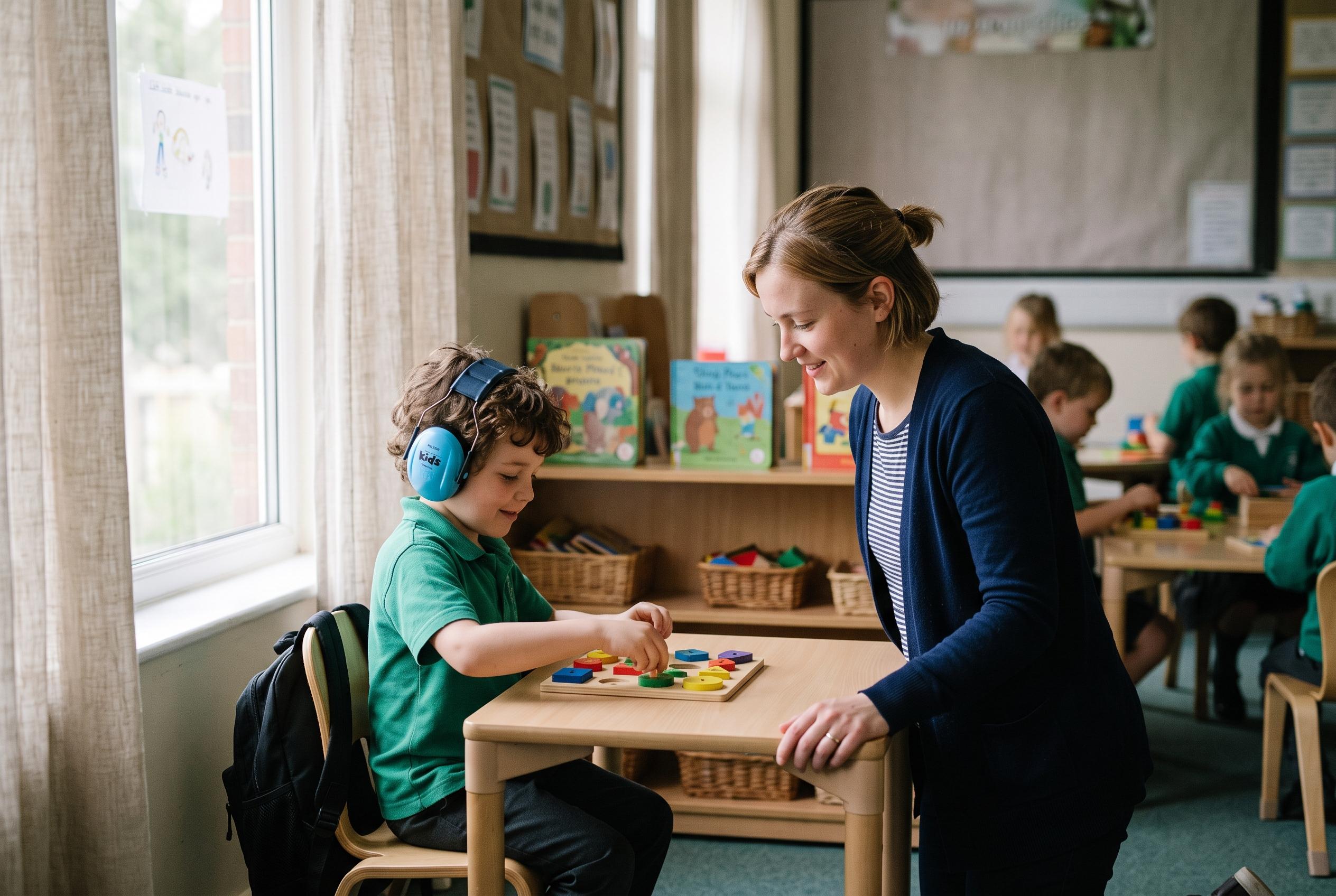

Emerging guidance stresses the importance of treating sensory aids such as headphones and quiet spaces as necessary support tools for overwhelmed children, reshaping how educators and parents approach sensory sensitivities and fostering inclusive environments.
Medical advice, school guidance and occupational therapy resources increasingly make the same point: headphones, ear defenders, quiet spaces and other sensory aids should be treated as support, not as something a child must earn. For children who are overwhelmed by noise, light, touch or crowded places, those tools are often the reason they can stay in the room, listen, speak and recover. Cleveland Clinic, in guidance updated on 20 March 2025, includes headphones, fidget toys and planned sensory breaks in the kind of routine sensory supports that may help school-age children function day to day. Children’s Health gives similar advice, saying that when overload hits, the first move should be to reduce the trigger where possible.
That distinction matters because adults often see the behaviour before they understand the cause. A child who covers their ears, bolts from a room, refuses a scratchy jumper or stops answering questions can look oppositional when they may in fact be flooded by sensory input. Corin Weinstein, a licensed psychologist at Children’s Health and a clinical assistant professor at UT Southwestern, put it plainly: “It’s not that your child is trying to be difficult when they aren’t able to tolerate a bright, noisy place or itchy clothing.” She said the child’s nervous system may be overwhelmed, or they may not know how to process what they are feeling. Children’s Health notes that these sensitivities can be linked to autism, but can also appear on their own.
Noise offers one of the clearest examples of why this should not be framed as a reward. HealthyChildren.org, the American Academy of Pediatrics family site, says some children with autism, ADHD, sensory processing disorders or learning differences are disturbed by sounds that do not trouble others. It adds that noisy classrooms and childcare settings can affect learning, while infants and children who are still learning to talk may find it harder to understand speech in loud environments. Its advice is practical rather than punitive: choose quieter restaurants, think about neighbourhood noise, and for children with ASD or ADHD consider noise-cancelling headphones or hearing-protection earmuffs to reduce outside noise.
The same theme runs through family-facing guidance at home and out in public. Children’s Health says that if a child is overwhelmed in a crowded shop, adults may need to leave the shop or provide headphones so the child can reset. Catalight, in advice published on 6 August 2024 for families of children with autism or other developmental disabilities, says sensory overload can cause anxiety and meltdowns and recommends noise-cancelling headphones, a quiet retreat space and clear communication with relatives so they understand the child’s sensitivities and keep noise down where they can. It also advises reducing bright light exposure and, if necessary, using sunglasses indoors. Notably, when Catalight discusses rewards, it does so in a different context: encouraging a child to try a new food texture, not withholding relief from a sensory trigger that is already causing distress.
In school, the case for treating these measures as accommodations is even stronger. Understood’s classroom guidance says pupils with sensory processing challenges may need a quiet work space or calm-down area, seating away from doors, windows or buzzing lights, and alternatives such as wobble stools, stand-up desks or weighted tools approved by occupational therapists. It specifically recommends earplugs or noise-muffling headphones, a non-verbal signal for breaks, advance warning before bells or fire alarms, and permission to ask for time out in order to self-regulate. The same resource extends beyond behaviour management into access to learning, suggesting speech-to-text, less handwriting and reduced visual clutter on the page. The underlying idea is simple: support is there to make participation more possible, not to be removed the moment a child struggles.
An NHS occupational therapy advice sheet on noise sensitivity makes the point in especially concrete terms. It recommends letting children use ear defenders, noise-cancelling headphones or earbuds when they are struggling with noise levels during assemblies, break times or meals, saying that having them available can provide security and reassurance. At the same time, it warns against constant use and says sound should be reduced rather than blocked altogether, partly for safety. The same advice sheet suggests preparing children before noisy environments, seating them away from chatty classmates, being alert to low-level background sounds such as ticking clocks, and teaching them how to set boundaries with peers. It even offers a script a child might use to explain that a game is fun but the sound is hurting their ears.
None of this means adults should ignore behaviour that harms other people or damages property. Expectations still matter. A child may still need to apologise, repair something they broke or leave an activity safely. But the guidance across these sources suggests that accountability works better when the child keeps access to the support that helps them regulate. Cleveland Clinic notes that sensory processing disorder is not an official medical diagnosis, but says clinicians still use therapy and practical supports when sensory differences interfere with everyday life. It adds that occupational therapists may tailor strategies over time as children grow and their environments change, and warns that unmanaged sensory difficulties can increase the risk of behavioural problems, social isolation and depression.
For parents and carers, the practical lesson is to plan before the difficult moment rather than turning comfort into leverage during it. Pack the headphones if a venue is likely to be loud. Identify a quieter corner before the event starts. Go to the cinema, shop or restaurant at less busy times if that makes success more likely. Tell teachers, relatives and other adults what signs to look for. If coping tools make it easier for a child to stay, communicate and recover, then they are doing the work of an accommodation. The child should not have to perform obedience first in order to access the very support that may make cooperation possible.
Disclaimer: This content is for informational purposes only and is not intended to be a substitute for professional medical judgment, advice, diagnosis, or treatment.