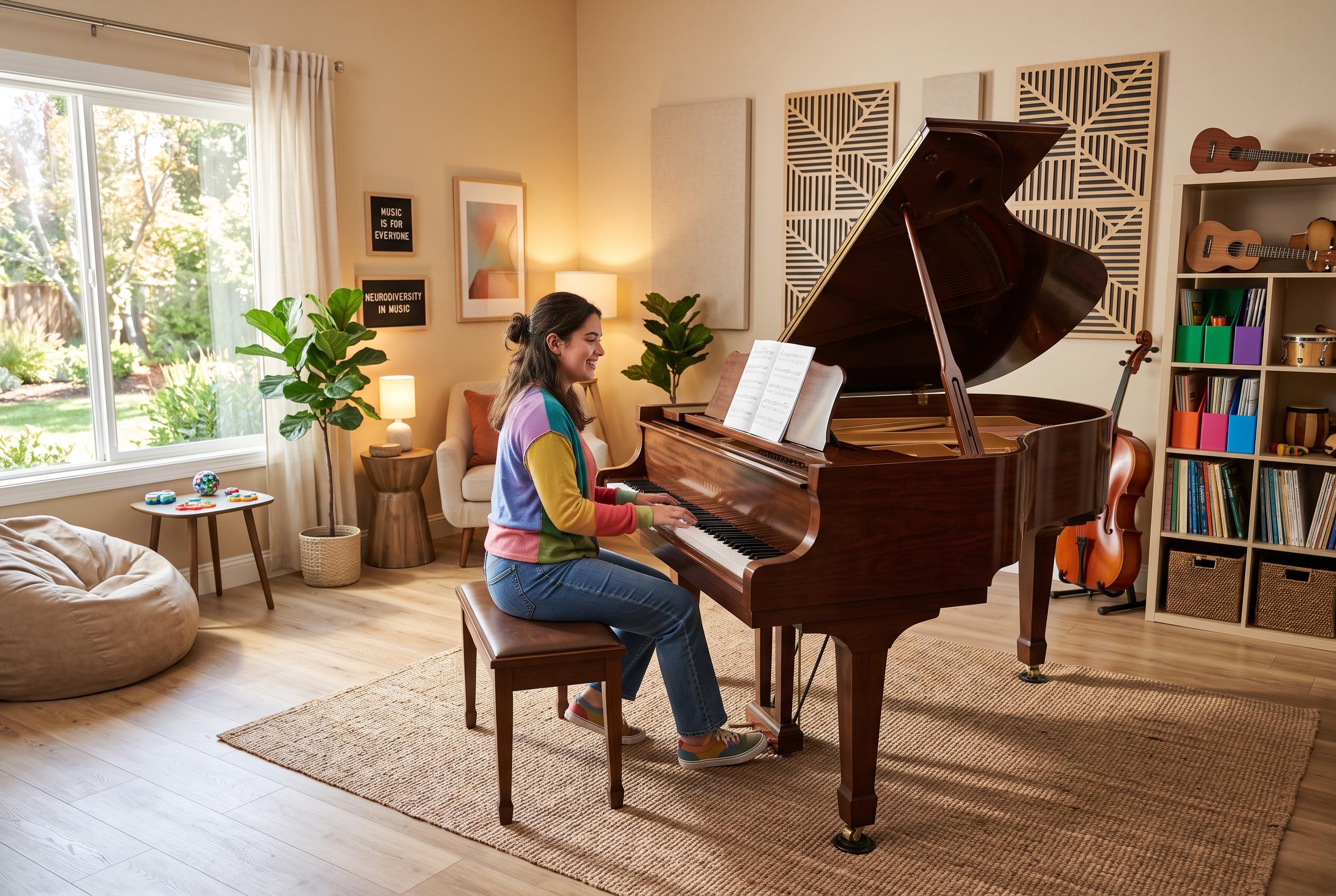

For pianists with ADHD, competitive performance environments pose unique challenges, prompting calls for more inclusive and creative alternatives that value individuality over rankings.
Competitive piano events can be exhilarating, but for pianists with attention deficit hyperactivity disorder they can also be uniquely punishing. Andrew Eales, writing for Pianodao, argues that the pressures built into festivals and competitions can collide with the very traits ADHD affects most: planning, sustained focus, emotional regulation and self-organisation. While the article is framed around ADHD, it also notes that many neurotypical musicians struggle with the same environment, especially when competition has become part of their musical identity from childhood.
That pressure begins long before anyone walks on stage. As Eales notes, preparation for a competition demands reliable routines, travel planning, regular practice and even basic self-care, all of which can be difficult when attention and motivation fluctuate. The result is often an uneven cycle of intense concentration followed by distraction or burnout. For some performers, the competitive format can spark hyperfocus and sharpened energy. For others, it can quickly become overwhelming, draining confidence rather than building it.
The psychological stakes are high because performance anxiety is already common among musicians. Research summarised by Nature and several recent reviews describes music performance anxiety as a mix of excessive worry, negative self-evaluation and heightened physical arousal, with symptoms that can disrupt attention and motor control. Studies in PMC and MDPI have found that treatments such as cognitive behavioural therapy, relaxation techniques and biofeedback can help, but also stress that no single approach works for everyone. Another review argues that support is most effective when it is tailored to the performer and the environment around them.
Eales links that wider research to the specific vulnerabilities of ADHD. Competitive playing depends heavily on working memory, emotional control and the ability to recover quickly from mistakes, all of which can be more fragile under pressure. A small slip can trigger a spiral: the mistake creates anxiety, the anxiety breaks concentration and the next error follows almost immediately. The article also points out that pressure can sometimes have the opposite effect, helping some ADHD musicians perform exceptionally well because urgency and novelty boost engagement. That variability, rather than simple nerves, is one of the defining challenges.
The social side of competitions can be just as difficult. They are not only musical events but arenas of comparison, ranking and judgement. Eales says that for ADHD performers, that can intensify feelings of isolation, especially when social cues are hard to read or when another player’s success feels personal. He also describes how criticism can be internalised, turning a disappointing result into a broader judgment about worth. For musicians whose self-image has long been shaped by praise mixed with criticism over inconsistency or disorganisation, the emotional blow can linger well beyond the event itself.
One of the most difficult features is the possibility of rejection, whether through elimination, low placement or sparse feedback. Eales discusses rejection sensitivity, a pattern often associated with ADHD in which criticism or exclusion can feel devastatingly personal. In competition, where most entrants leave empty-handed, that response can be especially intense. Recent music psychology research also suggests that performance anxiety is not always purely debilitating: depending on how a musician interprets the moment, pressure can either undermine or sometimes sharpen performance. But for many ADHD pianists, the overriding problem is not a lack of ability. It is the strain of constantly managing unstable attention and heightened emotion in a setting built to expose both.
Eales’s conclusion is not to abolish competitions, but to stop treating them as the default route to musical legitimacy. He argues for more inclusive alternatives: unranked concerts, improvisation, chamber music, collaborative projects and performance spaces that value individuality rather than comparison. His wider point is that musicianship should not be measured only by prizes. For pianists with ADHD, and for many others too, the healthiest musical culture may be one that makes room for creativity, belonging and performance without fear.
Disclaimer: This content is for informational purposes only and is not intended to be a substitute for professional medical judgment, advice, diagnosis, or treatment.