

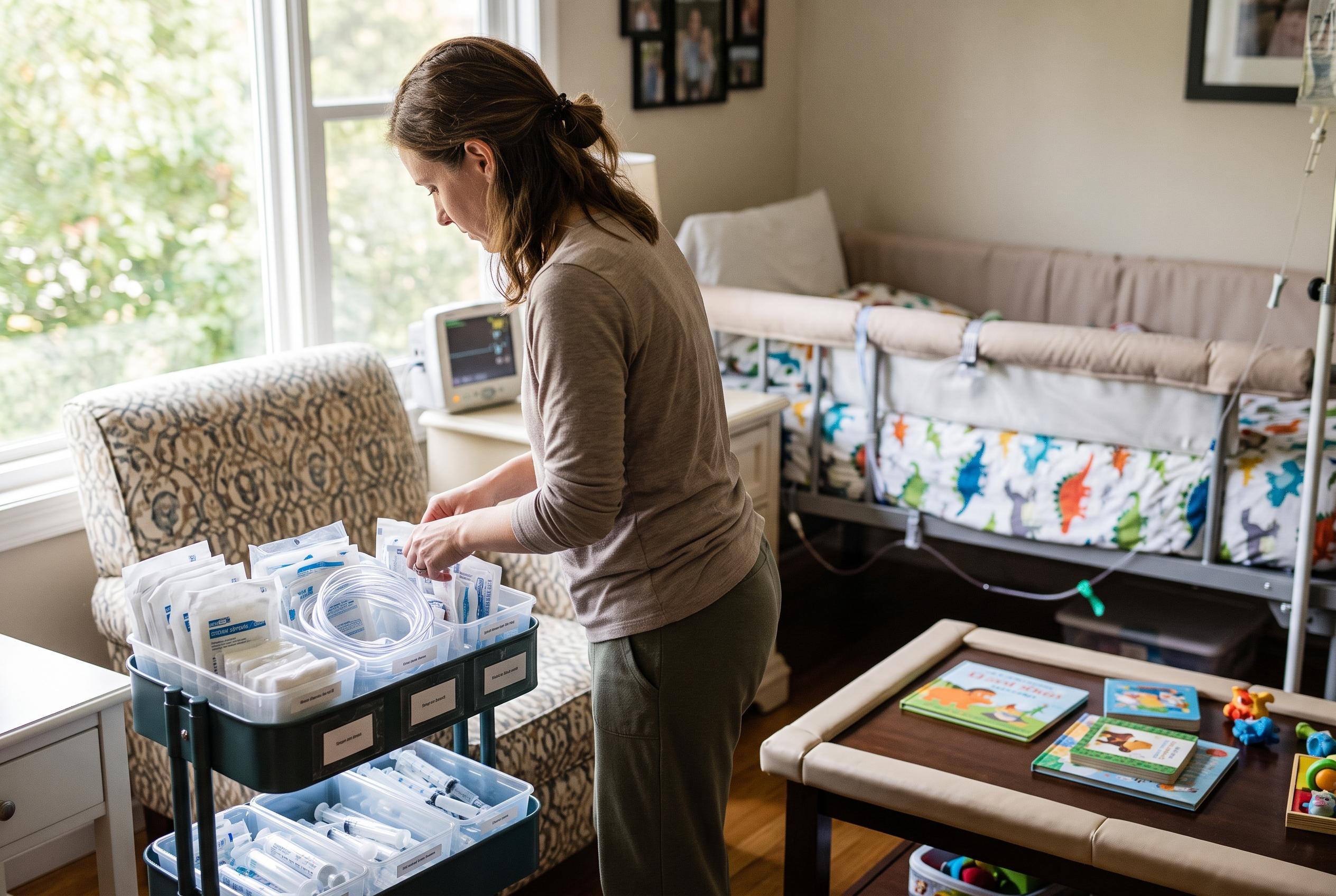

Families caring for medically complex children are creating their own solutions to faulty equipment, missing supplies and daily safety risks, researchers say, highlighting the need for better support from clinical teams.
Parents caring for medically complex children often become problem-solvers out of necessity, creating home-grown fixes for broken equipment, missing supplies and unpredictable care routines, according to research from Ann & Robert H. Lurie Children’s Hospital of Chicago published in Pediatrics. The study says roughly one in 20 children in the United States under 18 lives with medical complexity, including conditions such as cerebral palsy and a reliance on tube-related medical technology, which leaves families handling much of the care at home.
Peter Walsh, the study’s lead author and a behavioural research coordinator in the Foster Health Lab at the Stanley Manne Children’s Research Institute, said the work shows how much ingenuity parents bring to daily care. “Our findings highlight parental ingenuity and resourcefulness in developing strategies to tackle safety challenges that often arise during their child’s at-home care, such as medical supply issues or malfunctioning devices,” Walsh said. But he also argued that families should not have to solve recurring safety problems alone, saying stronger communication between parents and care teams could help identify common risks earlier and spread practical solutions to other families during training.
The study drew on a national sample of 21 parents of children with medical complexity who spoke English or Spanish. Over one week, they completed twice-daily surveys and sent text messages about tube-related care, with some also sharing photos or audio recordings. Later interviews gave researchers a fuller picture of the routines families follow. The most common problems involved supplies, such as trouble getting tube-related items, medication or equipment; devices that did not work as expected, including feeding pumps that ran inconsistently or syringes that broke; and problems that families had come to accept as part of everyday care, such as feeding tubes wrapping around a child overnight.
Researchers found that parents often developed structured ways to reduce the risk of harm, but those strategies were not always shared with clinicians. Carolyn Foster, senior author of the study, said proactive support was needed so families did not have to start from scratch each time a problem arose. Foster, who directs the Health@Home Initiative at the Manne Research Institute and is an assistant professor of paediatrics at Northwestern University Feinberg School of Medicine, said care plans should be simplified where possible and adjusted to each family’s needs. She also said parents need clear guidance on whom to contact when home care goes wrong.
The findings add to a wider body of research showing how much home care for medically complex children depends on family adaptation. A separate study published in Pediatrics earlier found that families often need to alter the layout and use of their homes to make room for mobility needs, medical equipment and everyday access. Another report from the same Chicago institution in February said parents frequently encounter safety risks when obtaining and using at-home devices, reinforcing the case for earlier conversations between families and providers about equipment, training and practical support. The latest work was backed by the Agency for Healthcare Research and Quality, part of the U.S. Department of Health and Human Services.
Disclaimer: This content is for informational purposes only and is not intended to be a substitute for professional medical judgment, advice, diagnosis, or treatment.



