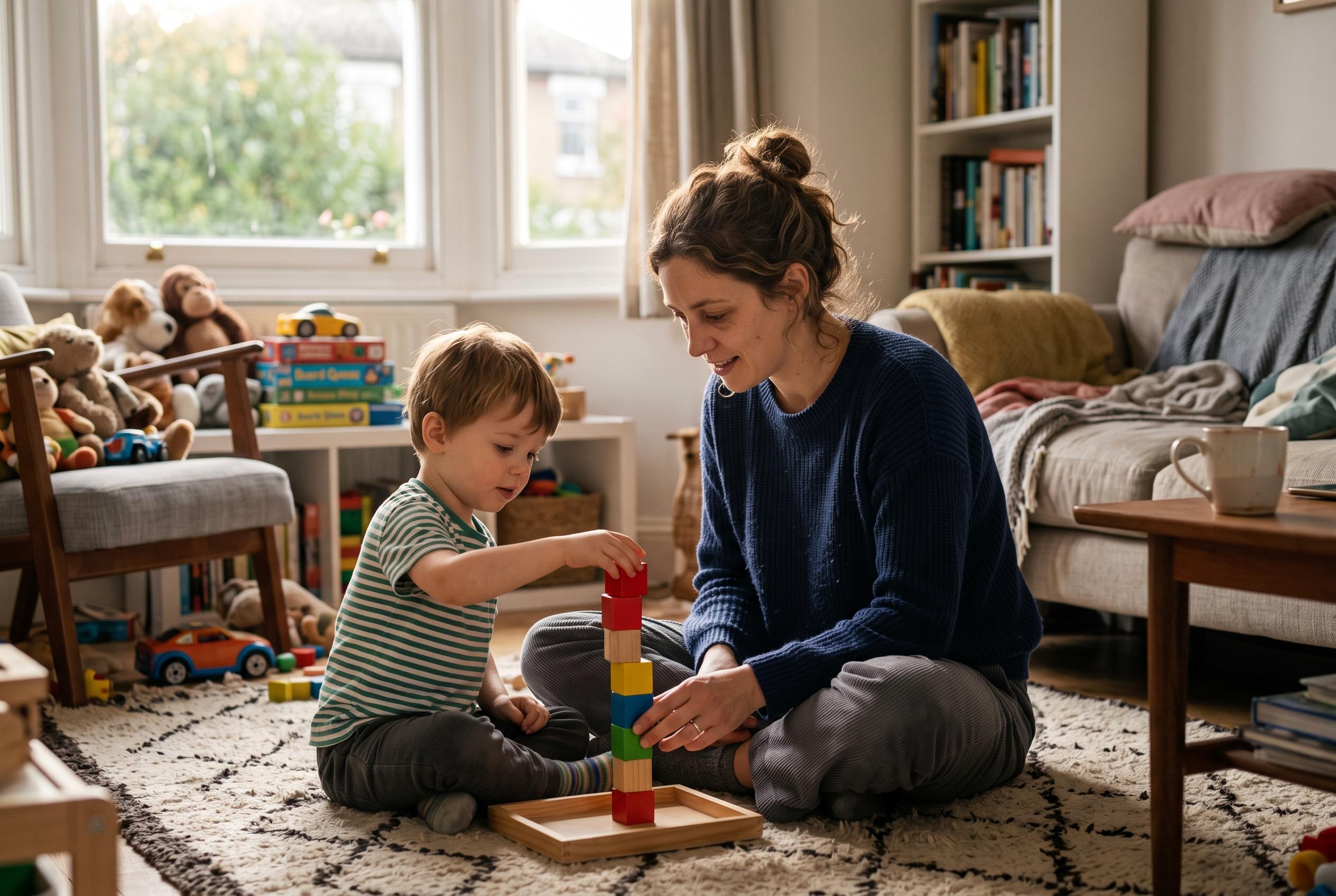

Julie Morgenstern advocates for short, purposeful moments of full presence and the creation of simple routines to help exhausted parents foster genuine connections with their children amid busy schedules.
For parents who feel they are always behind, Julie Morgenstern’s most useful argument is also her least grand: children do not necessarily need heroic slabs of attention to feel secure, but they do respond to short, deliberate moments of full presence at the natural handovers in a day. The organiser’s advice, echoed in interviews around the publication of her parenting book, is to stop improvising those transition points. If a child is waking up, returning from school or settling for bed, the task is not to half-listen while doing something else, but to arrive properly for a few minutes and then move on.
That idea grew out of a problem Morgenstern says she knew first-hand. In an interview with Grok Nation, she said parents “universally suffer from the feeling of time scarcity”, and described her own experience of raising a daughter alone from the age of three until high-school graduation. The promise she offered was not that adults could be fully available all day, because they plainly cannot, but that being genuinely present for a defined portion of the day is both realistic and meaningful. WHYY’s Radio Times framed the same pitch in 2019 as an attempt to find “the happy middle ground for both parents and kids” in households where everybody’s schedule feels overpacked.
Morgenstern’s larger contribution is to give parenting a job description. Rather than treating it as an endless, guilty blur, she splits it into four responsibilities towards the child , provide, arrange, relate and teach , and four responsibilities that keep the adult functioning: sleep, exercise, love and fun. In Grok Nation, she called the alternative “job ambiguity”, adding that when people do not know what their job is, the job feels infinite. Kirkus, reviewing Time to Parent before its September 2018 release, highlighted the same structure and quoted Morgenstern’s warning that parents must “continuously and seamlessly transition among all eight roles, and that’s tougher than it looks.”
The distinction she draws between relating and teaching is especially sharp. Many conscientious parents assume that correcting, advising and instructing count as connection, when children may experience them very differently. Morgenstern told Grok Nation that “When you teach a child they are a student of you. When you relate, you are the student of the child.” She said clients often discover that they are defaulting to Teach mode when a child is actually asking for Relate mode: shared attention, conversation, play, or simply being alongside one another without a lesson attached. That mismatch, she suggested, is often what sits behind the complaint that a family spends plenty of time together and still feels disconnected.
Her answer, characteristically, is systems. In an interview with The Washington Post, Morgenstern said parents should “automate the key areas and create systems to deal with things”, building routines that are clear enough to run even when the adults are tired or somebody else has to step in. She urged families to make those routines “simple and self-instructing, so anyone can do it”, whether that is a child, a neighbour or a relative helping out. One example was dinner: instead of deciding afresh every evening, choose 10 meals the household already likes, make the shopping list in advance, and store ingredients with a card explaining how each meal is prepared.
That practical streak extends to the calendar. Morgenstern told The Washington Post that parents should look ahead not just to tomorrow, but to “tomorrow plus two days beyond”, so pressure points can be spotted before they turn into domestic chaos. The same interview argued that some families would be better served by limiting each child to one or two extracurricular activities in a semester, rather than five. In Time magazine, she made the broader case that time should be treated as a real, finite resource: “Time is actually not intangible; it is concrete and measurable.” The aim, she said, is not to cram in everything, but to decide what has the greatest impact and put it somewhere specific. A task floating on a list is easy to admire and even easier to defer.
That mindset carries extra force because Morgenstern did not arrive at it as a naturally orderly person. In The Guardian, she described her younger self as someone who lived “out of piles” and was “always late for everything, a real time optimist”. She feared order would “squelch my creativity”, until parenthood exposed the cost of that romantic view. Recalling one failed attempt to leave the house with her daughter, she said there were 18 things to remember and each was in a different place. The conclusion, as she put it, was blunt: “I have to get organised. I can be the hero of my own story, but I can’t do this to another human being.”
What makes the advice endure is that it does not pretend family life can be perfected. It assumes instead that most parents are juggling paid work, logistics, emotional labour and their own depleted reserves, and that the only sane response is to be intentional about a few moments and repeatable about the rest. The result is less a doctrine of balance than a method for deciding what must feel personal and what can safely become routine. For families worn down by the sense that they are forever reacting, that may be the more useful promise: not more hours in the day, but a better claim on the ones that matter most.
Disclaimer: This content is for informational purposes only and is not intended to be a substitute for professional medical judgment, advice, diagnosis, or treatment.