

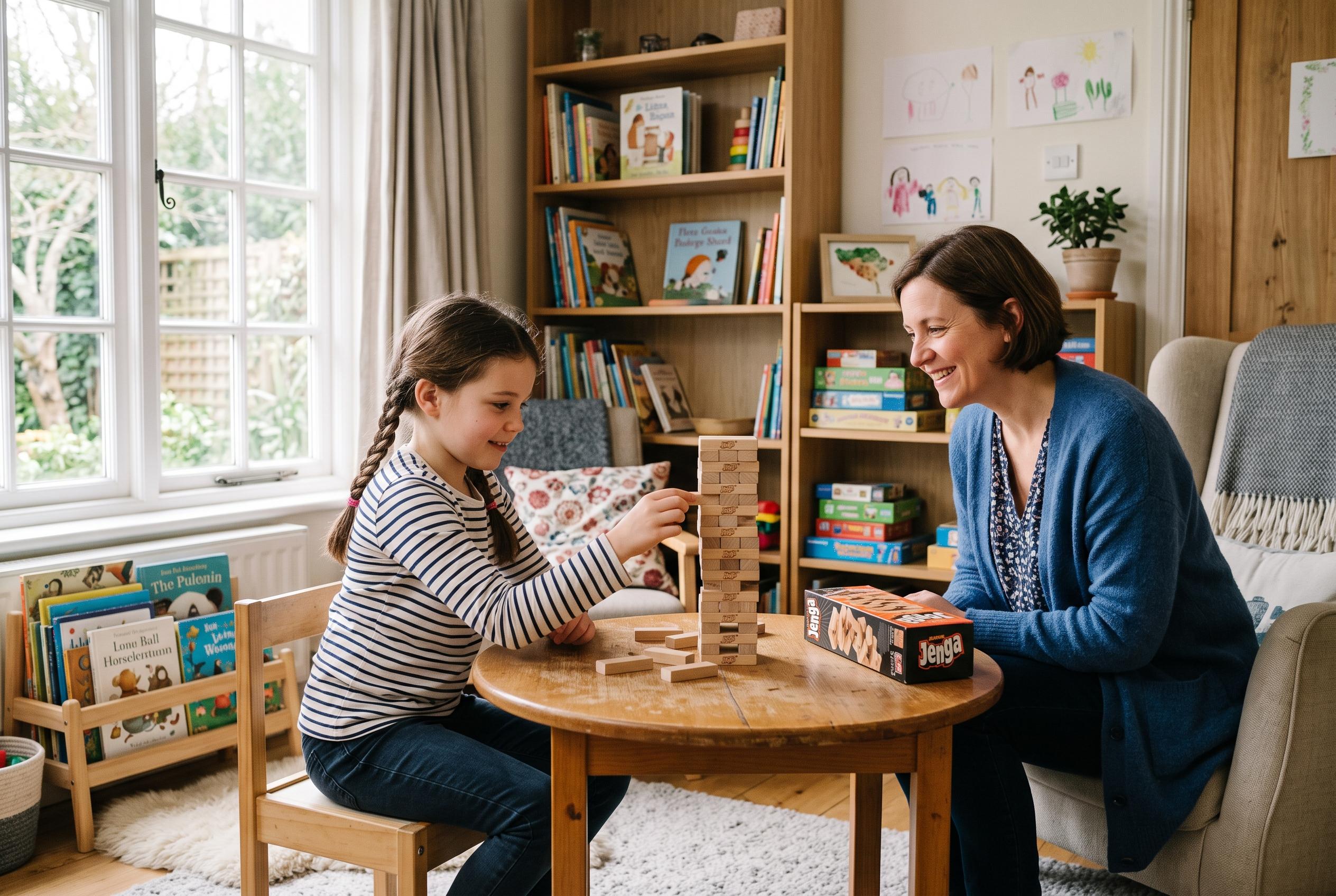

From Jenga to Uno, familiar games give counsellors a low-pressure way to help children practise emotional regulation, flexibility, communication and repair.
Counsellors and therapists often keep a familiar set of board games within reach, and with good reason: the right game can do far more than fill time. It can create a low-pressure setting in which children practise waiting, losing, repairing, taking turns and talking about feelings without the conversation ever feeling forced. The appeal of these games is practical as well as clinical, because they are usually already available, easy to adapt and immediately recognisable to children who may be wary of formal discussion.
That basic idea is backed by a wider therapeutic market built around play. COMPASS for Courage, for example, centres exposure-based cognitive behavioural therapy and social effectiveness training in a structured programme for anxious children, while Mentalyc and other therapy resources highlight board games that prompt children to name feelings, talk about school and family, and practise coping skills in a more natural way. Childswork/Childsplay and similar suppliers also frame therapeutic games as tools for building self-awareness, resilience and communication, which reflects the same premise: play can make difficult material easier to approach.
The strongest versions of these games are not simply entertainment with questions added. They work because the game itself becomes the lesson. A child who freezes before moving a piece, laughs when a tower wobbles or becomes angry after a setback is already giving a clinician information. In that sense, the game is not the whole intervention; it is the frame that reveals how a child handles frustration, uncertainty, rules, competition and repair.
One of the most versatile examples is Chutes and Ladders. Its randomness makes it especially useful for children who struggle with disappointment, because success and setback arrive without warning and cannot be controlled through strategy. The board can be used to practise flexible thinking by reversing the rules, to rehearse coping skills after a fall, or to explore what it feels like to be almost at the end and then lose ground. The game also lends itself to conversations about gratitude, resilience and the fact that a setback is not the same as failure.
Jenga offers a different kind of therapeutic value because its tension is physical as well as emotional. Children can feel the risk in their bodies as the tower grows less stable, and that makes it a strong tool for exploring nervous-system awareness. Counselors can ask children to notice tight shoulders, held breath or shaky hands before they pull a block, then use that moment to teach slowing down, taking a breath or naming an emotion. Some of the most useful adaptations involve adding prompts to the blocks, asking the group to choose a repair ritual after a collapse, or encouraging children to use the non-dominant hand so they can experience what it feels like when a task becomes awkward and unfamiliar.
Candy Land is useful for a different reason: it removes skill from the equation. Children who are used to trying to manage every outcome often find the game surprisingly difficult because they cannot predict what comes next or control the result through effort alone. That makes it a strong fit for work on locus of control, patience and positive self-talk. Counselors can pair each colour with a feeling, ask children to describe what that feeling looks like in the body, or use the game to talk about comparison, disappointment and the limits of planning when life does not cooperate.
Some of the richest opportunities come from games that create a clear emotional response in the body. Don’t Break the Ice can be used to discuss cumulative stress, because each block removed changes the whole system a little more until the fall becomes inevitable. Trouble, with its popper mechanism, creates immediate sensory feedback that can be paired with breathing exercises, impulse-control practice and simple body awareness. Operation can provoke genuine anxiety in real time, which makes it useful for noticing what happens when a child feels watched, rushed or afraid of making a mistake. In each case, the game becomes a safe rehearsal space for real-world regulation.
Other familiar games bring social dynamics to the surface. Uno is especially rich because action cards create instant experiences of power, fairness and frustration. A Skip or Reverse can open up discussion about control and perspective, while Draw 4 can lead to conversations about apology, self-advocacy and the way children react when they feel singled out. Sorry and Trouble also invite work on repair, accountability and the gap between saying sorry and actually making amends. Board games with direct conflict are often useful not because they are gentle, but because they create small, manageable ruptures that can be named and repaired in the room.
The same principle applies to games like Connect 4, Labyrinth and similar strategy games that appear simple on the surface. These games reveal how children respond when a plan is blocked, when control shifts or when a move made by someone else changes the whole board. That makes them useful for perspective-taking, flexibility and problem-solving. Labyrinth in particular has the added advantage of constantly changing the route, which mirrors the experience of children coping with grief, anxiety or major transitions. The path moves, the goal stays, and the child has to keep going.
What emerges across all of these examples is a simple but important clinical truth: the best therapeutic games do not avoid frustration, they organise it. They let children practise the skills they need while they are emotionally engaged, physically active and often unaware that they are doing therapy at all. For many children, that is precisely why the games work. The lesson lands because it arrives through play.
Disclaimer: This content is for informational purposes only and is not intended to be a substitute for professional medical judgment, advice, diagnosis, or treatment.



