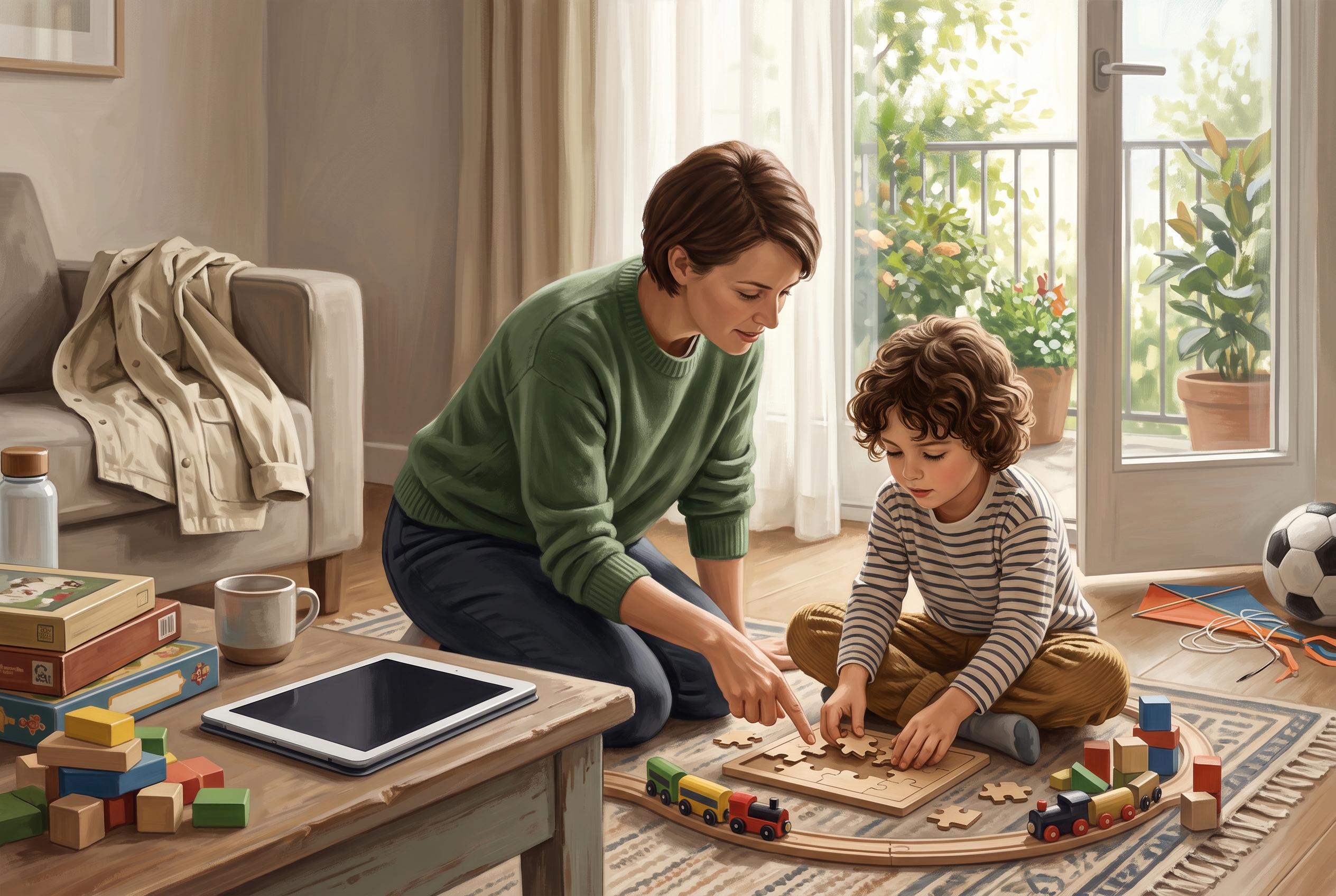

Health professionals highlight concerns over increased screen use disrupting children’s development, urging families to foster balanced routines with face-to-face interactions and outdoor activities.
A child staring at a phone while eating, travelling or drifting off to sleep is now so familiar that it barely raises concern. Yet health experts warn that when screens begin to replace play, sleep, movement and face-to-face interaction, family life can quickly become shaped around the device rather than the other way round.
The problem is not simply how long a child spends on a screen, but how that time is used. According to the Mayo Clinic and Cleveland Clinic, excessive screen exposure can be linked with sleep disruption, behavioural difficulties and slower language, cognitive and social development. But the evidence is not straightforward: a child watching educational material with a parent is not in the same position as one left alone for hours in a stream of short videos.
Researchers and paediatric specialists say the sudden removal of a device can trigger anger, distress and strong resistance, especially when a child has built daily routines around it. That does not necessarily mean the child is experiencing a clinical form of withdrawal. More often, it reflects the loss of a powerful source of stimulation, a broken habit or a lack of other ways to cope with boredom and frustration.
Part of the difficulty lies in the design of digital platforms themselves. They deliver rapid changes of image and sound, bright colours, constant motion and immediate reward. That can make books, classroom tasks and ordinary toys feel slow by comparison. Experts note that dopamine is often described too simplistically as a pleasure chemical; in reality, it is tied to anticipation, motivation and learning. The point is that many apps are built to keep users engaged for longer than they intended.
The health guidance is clear for very young children. The World Health Organisation advises no sedentary screen time for babies under one year, and says children aged two to four should have no more than one hour a day, with less being better. The Mayo Clinic and Children’s Health say children under two should have little or no screen exposure, while older children need personal limits and a balance that protects sleep, exercise, schoolwork and social life.
For families, the most effective approach is usually gradual rather than abrupt. The Mayo Clinic Health System recommends realistic goals, clear expectations, phone-free zones and more face-to-face interaction. Experts also advise setting specific screen-free times, keeping phones away from the dinner table and bedrooms, and ensuring the device is charged elsewhere overnight. But limits will only hold if they are paired with something genuinely engaging in return: outdoor play, music, sports, friends, books and time with parents. Adults, too, have to set the tone. A child is unlikely to accept rules about screen use if the household runs on constant scrolling.
Disclaimer: This content is for informational purposes only and is not intended to be a substitute for professional medical judgment, advice, diagnosis, or treatment.