

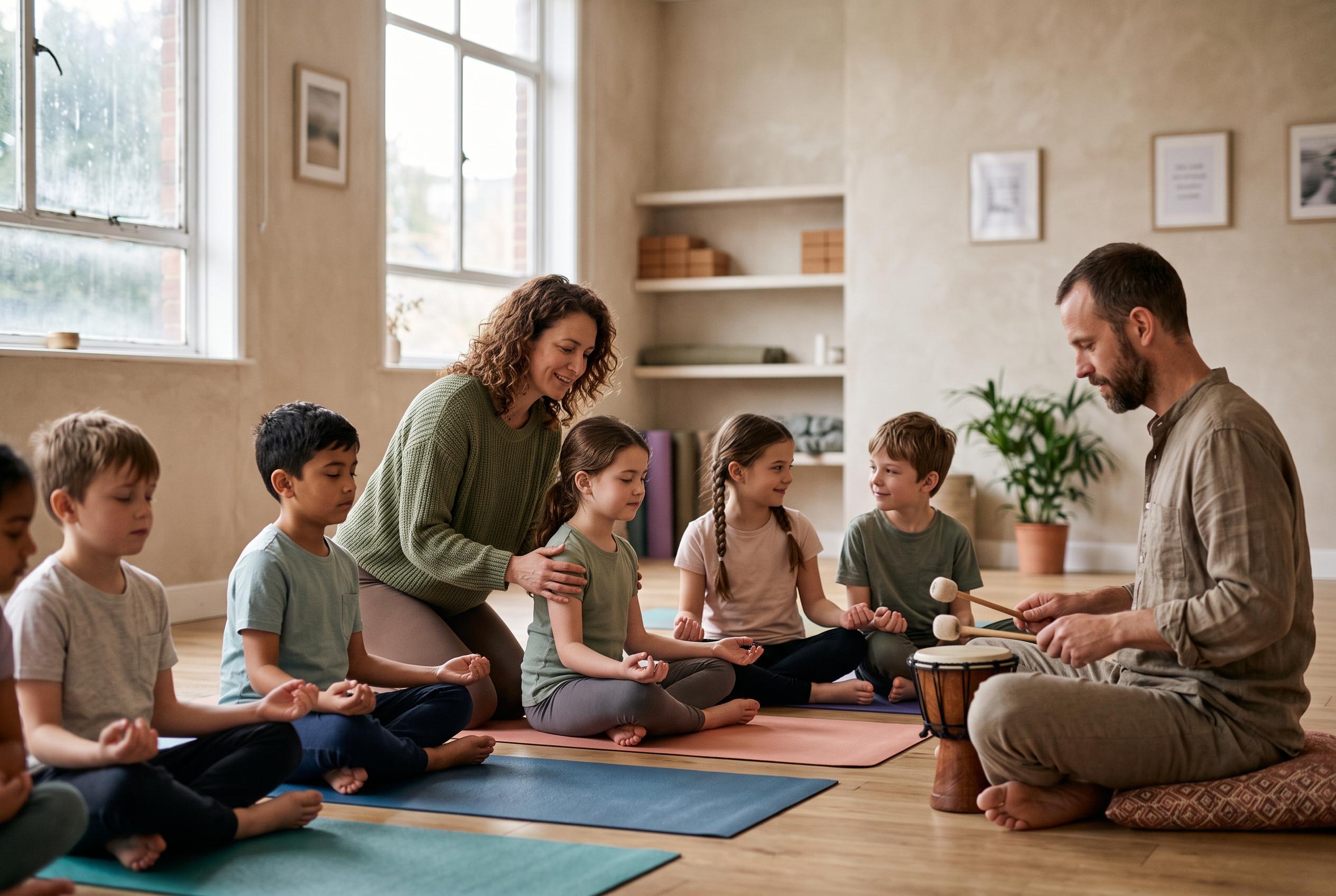

A growing movement utilises yoga, music and experiential activities to teach children social and emotional skills, fostering kindness and empathy amid screens and stimulation overload.
A child’s comment after a yoga class, that it had taught them “to be kind”, captures the heart of a growing movement in children’s wellbeing: learning is no longer being defined only by grades or classroom content, but by the ability to notice feelings, manage them and respond to others with care. In an age shaped by screens, pressure and constant stimulation, many parents and educators are looking for spaces where children can slow down and practise the social and emotional skills that ordinary routines often leave out.
That need sits behind a programme run by Fundación Columbia, which brings together emotional education, social skills, yoga for children, music-based yoga and mindfulness. Josefina Zucchini and Sofía Giorello, who coordinate the initiative, describe its approach as experiential rather than clinical: children are not asked to analyse themselves in the abstract, but to learn through movement, play and shared activities. The idea is that role-playing, storytelling and guided exercises give children a safe distance from difficult experiences, making it easier for them to recognise feelings such as anger, frustration or sadness and attach words to them.
The organisation says the same challenges keep appearing across its workshops and in psychological practice: low tolerance for frustration, impatience, difficulty waiting and a growing dependence on stimulation from devices. To counter that, the sessions are designed to create pauses. One of the simplest tools children are encouraged to use in conflicts is also one of the most effective: stop, breathe, identify what happened and listen to the other person. Rather than trying to eliminate disagreement, the goal is to give children more ways to move through it without turning immediately to impulse.
Yoga classes for children take that same principle into the body. Breathing exercises, postures and relaxation are used to help calmer regulation, especially for children who arrive overstimulated or restless. Mariela Frenkel, who teaches the yoga component, says the practice is also meant to foster compassion and empathy, qualities she sees as teachable rather than innate. Her anecdote about a child describing yoga as something that makes people kinder reflects a broader belief in the programme: emotional intelligence, like literacy or numeracy, improves with repeated practice.
Music plays a similar role in the initiative’s work. In the music-based yoga sessions, children sing, move, listen, experiment with sound and even learn through silence. Florencia Haladjian, who facilitates that part of the programme, says music gives children a wider language than words alone, allowing them to explore intensity, rhythm, repetition and pause as ways of expressing emotion. The approach is not simply artistic; it is also about attention, turn-taking and listening to oneself and to others.
That emphasis is backed by research. A year-long study from the University of Cambridge found that children who took part in regular group music-making became more empathic than those in comparison groups, suggesting that shared musical activity may strengthen emotional understanding beyond the music room. Separately, a study published in the Journal of Pediatric Nursing found that combining music, yoga and massage could improve preschool children’s social-emotional development and quality of life. Taken together, the evidence supports what these programmes are trying to do: help children grow not only into students, but into people who can recognise their own feelings, relate to others and live with a little more kindness.
Disclaimer: This content is for informational purposes only and is not intended to be a substitute for professional medical judgment, advice, diagnosis, or treatment.



