

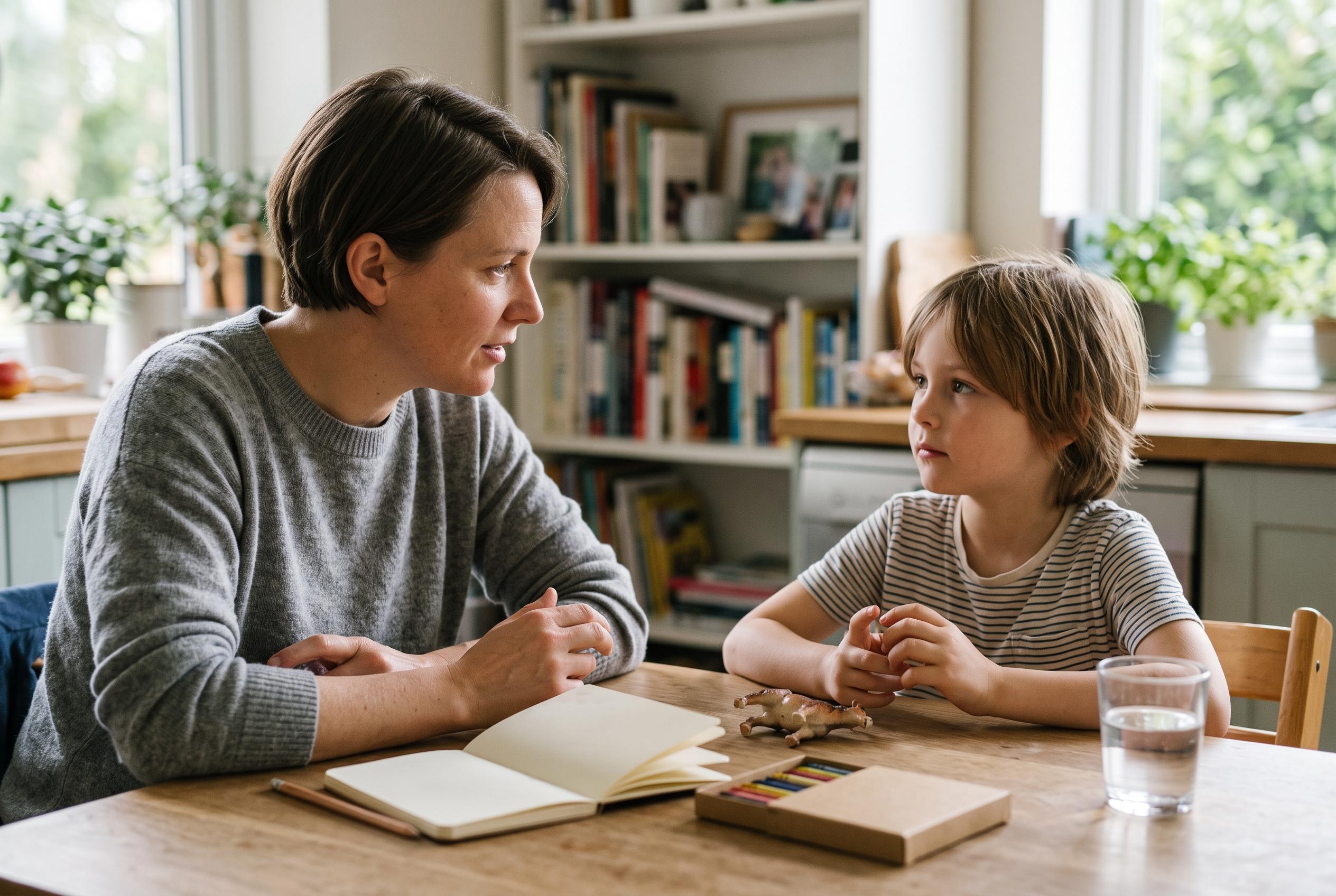

Developmental research reveals that children’s deception is a complex sign of growing social, cognitive, and moral skills, offering insights into their understanding of others and self-control.
Parents often treat a child’s lie as a red flag, but developmental research suggests it can also be a sign of growth. A child who denies taking a cookie, or who offers a clumsy explanation when caught, is not only breaking a rule; they are also trying to manage another person’s beliefs, control their own behaviour and juggle what they know with what they are willing to reveal. Psychology Today’s discussion of children’s deception frames lying as a window into social, cognitive and moral development rather than simply bad behaviour.
The ability to lie convincingly does not appear overnight. Research on early deception shows that even very young children can begin to produce false denials, often around the age of two or three, but these early efforts are usually simple and easy to see through. As children get older, lie-telling becomes more sophisticated because it depends on perspective-taking, which is the ability to understand that another person can hold a belief that differs from reality. Studies have found that children with stronger theory of mind skills, meaning a better grasp of other people’s thoughts and intentions, are more likely to tell plausible lies and less likely to contradict themselves.
By the school years, children’s deception becomes more varied. A longitudinal study published in the Journal of Experimental Child Psychology found that children’s lying patterns shift across different situations and that they can be fairly consistent over time in how they tell both prosocial lies, meant to spare someone’s feelings, and antisocial lies, meant to avoid trouble or gain an advantage. Another study found that children aged four, five and seven differed in how they lied and detected lies, with theory of mind, executive function and language all playing a role in those patterns. In other words, lying is not just a moral issue; it is also tied to memory, self-control and language development.
That does not mean children become habitual deceivers as they grow. Most remain broadly honest, and older children often become better at judging when honesty matters and when other social concerns matter more. Research has shown that children may learn to hide disappointment about an unwanted gift to protect the giver’s feelings, even when that means sacrificing their own honest reaction. Another study of children’s expectations about confession and lying found that their ideas about emotions are linked to whether they confess or keep quiet, suggesting that feelings such as guilt, fear and concern for others help shape moral choices.
For parents and caregivers, the practical lesson is not to dismiss lying, but to interpret it carefully. Children’s falsehoods can reveal when they are testing boundaries, trying to protect themselves or learning how to balance honesty with kindness, loyalty and self-preservation. Seen in that light, a lie is not only a misbehaviour to correct; it is also evidence that a child is learning how other people think, how social rules work and how to navigate the complicated world around them.
Disclaimer: This content is for informational purposes only and is not intended to be a substitute for professional medical judgment, advice, diagnosis, or treatment.



