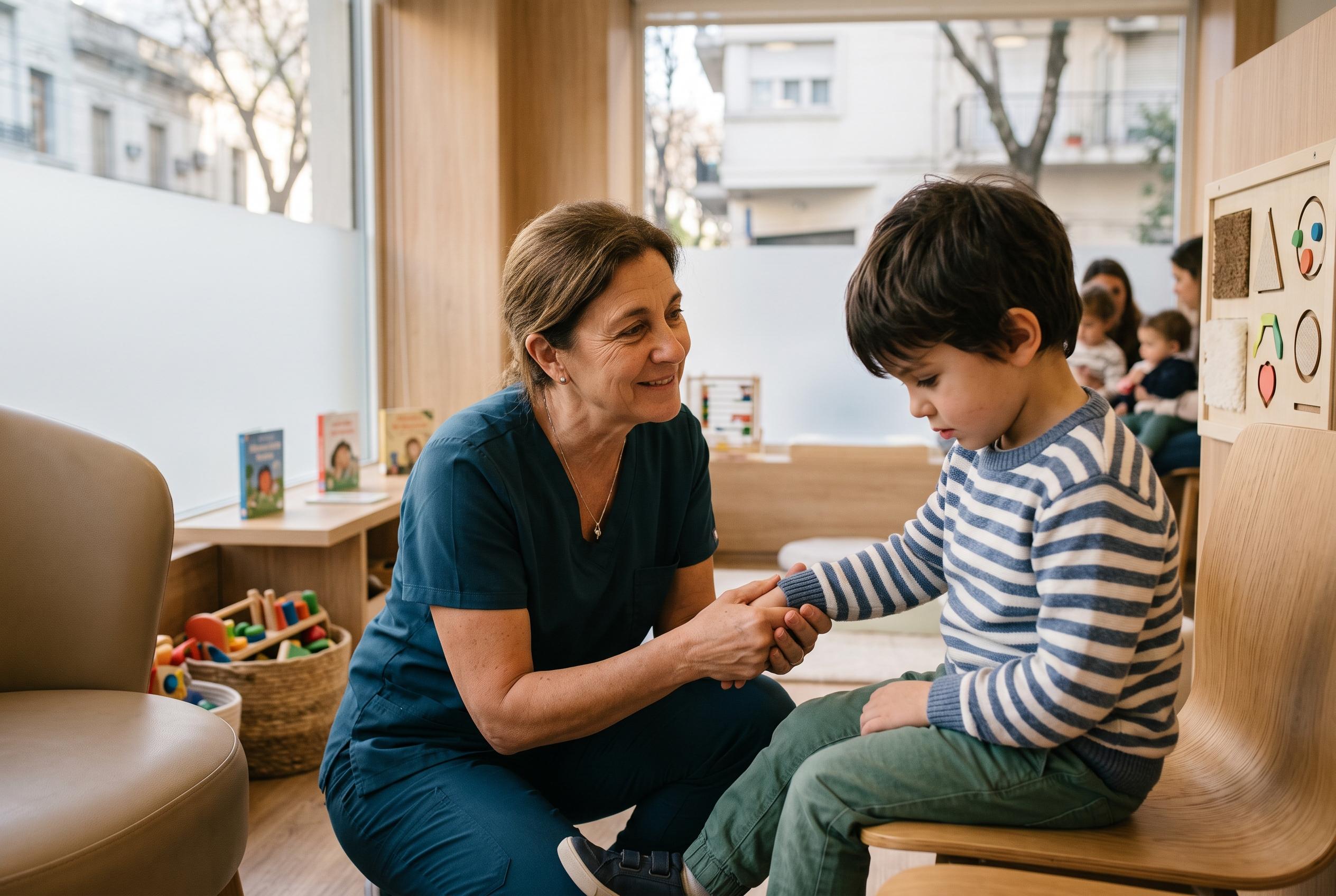

Argentine paediatrician Florencia María Sanabria advocates for comprehensive, slow evaluations of children displaying developmental issues, warning against early labelling based on outdated tools and hurried appointments.
Children who arrive in the consulting room exhausted, short on sleep and living by tightly managed timetables are too often being treated as diagnostic puzzles before anyone has checked the basics, the Argentine paediatrician and child psychiatrist Florencia María Sanabria argues. Across a run of interviews and columns in 2025 and 2026, she has warned that tantrums, irritability, insomnia, repetitive play and delayed speech are increasingly being read through an autism lens even when stress, diet, screen exposure or overlooked medical conditions may be playing a central part.
Her sharpest criticism is aimed at the speed and shape of some assessments. In an interview carried by Identidad Correntina, Sanabria said some children can be given an autism label after a consultation lasting 15 minutes, and questioned tools first developed in the 1970s and only lightly updated since. She said some evaluations still depend on toys or games that many children no longer recognise, so failing to manipulate them can be treated as a clinical sign. The same concern appears on her own website, where a three-hour Zoom course she ran on 1 May 2026 was structured around modules titled “El colapso del diagnóstico”, “Cómo se diagnostica hoy (y por qué falla)” and “Lo que los tests no pueden decir”.
What she wants in place of that, she says, is a slower and broader clinical enquiry. The interview published by 4Palabras on 25 August reported her view that brief appointments are missing “organic and routine” factors that can sometimes be addressed with simple, low-cost checks: hearing, sleep, food, weight and the pressures created by school and therapy schedules. In a December 2025 column for Paralelo32, Sanabria listed mild or fluctuating hearing loss, apnoea, mouth breathing, low iron, vitamin D deficiency, B12 abnormalities, zinc-copper imbalance, repeated ear infections, severe allergies and undiagnosed coeliac disease among the conditions she says can imitate autistic features or worsen language problems.
Sanabria’s more precise point is that late speech on its own is not autism. In the Paralelo32 article, she wrote that the diagnosis depends on persistent difficulties in social communication together with repetitive behaviours or highly restricted interests over time. She added that between 25% and 40% of children with language delay do not have autism, and cited studies associating heavy early screen exposure with poorer communication scores. She urged assessment if a child aged 12 to 15 months does not point, imitate or try to share interests, if an 18-month-old has no communicative words, or if a 2-year-old cannot combine simple words or follow basic instructions.
Her other target is the way adult ambition, she says, has colonised childhood. According to 4Palabras, many parents react to developmental worries by adding more school hours, therapies and structured activities, even when the child is already worn down or eating poorly. Speaking to Identidad Correntina, Sanabria went further, saying, “Hasta los 6 años, un niño no debería hacer nada más que ir al colegio.” She described children trying to cope on three or four hours of sleep while juggling double school shifts, treatment schedules and extracurricular demands, and said the result can be attention problems rooted in physical exhaustion, what she called “fatiga cortical”.
Nutrition also sits at the centre of her case against quick labelling. The Google Play Books author note describes Sanabria as a clinician with postgraduate training in genetics, nutrition, metabolism and neuroscience, while the course outline on her site includes a differential block on food intolerances and their “impacto en conducta, irritabilidad, regresión y alteración del lenguaje”. In the August interview, she said modern anxieties about the “perfect” plate and adult-style restrictive diets were leaving some children on very narrow menus and below weight, with those routine factors then overlooked in hurried consultations.
Sanabria has turned that position into a publishing and teaching project. Google Books lists “No todo es autismo” as a 162-page medical title published by Universo de Letras on 17 April 2026. Its catalogue description says childhood development can only be understood when clinic, genetics and neurobiology are integrated. On Google Play, Sanabria introduces herself as “médica y mamá de una nena y un nene” and writes: “El comportamiento es apenas la punta del iceberg.” The book, she says there, grew out of more than 15 years accompanying families.
That is not a rejection of autism as a diagnosis; it is a demand, rather, for a more exacting one. Her Paralelo32 piece tells families not to equate absent speech with autism and to examine the whole child, from sleep and hearing to prenatal history and play. Her course materials frame the task in equally blunt terms: “No diagnosticar solo por conducta”, “Integrar información” and “Trabajar en equipo”. In a culture that rewards instant answers, Sanabria’s argument is that some children need specialist treatment, some need proper investigation, and some may simply need less pressure, more rest and time to develop at their own pace.
Disclaimer: This content is for informational purposes only and is not intended to be a substitute for professional medical judgment, advice, diagnosis, or treatment.