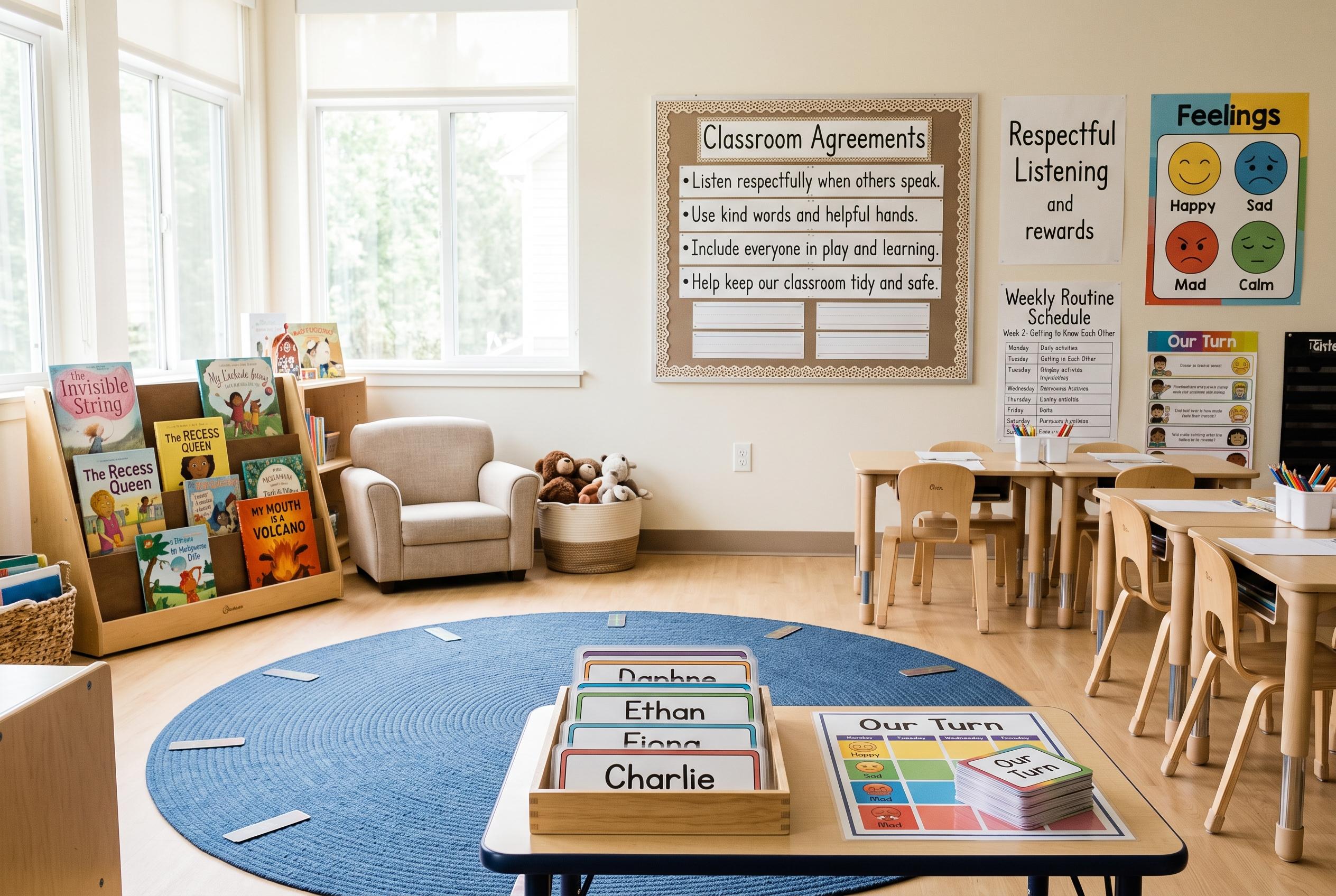

As the initial excitement fades, teachers focus on reinforcing classroom culture through trust-building activities, routines, and meaningful reading discussions to promote a safe, engaging environment for students.
By the second week of school, the mood in a classroom often changes. The first-days glow has faded, routines are no longer novel, and children begin to reveal what they really think of the room, the teacher and one another. As the lead article argues, that moment is less a discipline crisis than a trust test: pupils are deciding whether the classroom feels safe enough to take risks, make mistakes and belong.
That is why simply clamping down harder rarely works. Classroom-management guidance from TeachThought, KuraPlan and similar education resources consistently points to the same idea: clear routines, calm communication and predictable responses do more to prevent disruption than sharper reprimands after the fact. In practice, that means week two should be used to reinforce what was promised in week one, not just to restate the rules with more force.
One way to do that is to treat the classroom agreement as something to practise, not merely display. The Religion Teacher recommends establishing procedures early and revisiting them daily, while School Health suggests using door greetings, visual routines and a balance of structure and warmth to set the tone. The article’s approach follows the same logic: if a class says listening matters, then build an activity where every child must listen through to the end; if everyone’s voice matters, then design a turn-and-talk in which no one is left out. Students tend to trust what is rehearsed, not what is posted on the wall.
The reading choices suggested for this stage also reflect that shift from novelty to nuance. Books such as “Your Name Is a Song” by Jamilah Thompkins-Bigelow, “All Are Welcome” by Alexandra Penfold, “A Place for Me” by Patrice R. Jenkins and “Milo Imagines the World” by Matt de la Peña offer a way to discuss belonging, identity and assumptions without turning the conversation into a lecture. That fits with broader classroom-management advice, which encourages teachers to create engaging lessons, build relationships and reduce uncertainty before it turns into resistance.
For teachers, the practical message is simple. Week two is not the time for a new behaviour system; it is the time to prove that the classroom culture introduced in week one is real. A short read-aloud, one promise practised on a day when nothing has gone wrong, and one question that allows for silence can do more to settle a room than a stack of consequences. The goal is not tighter control. It is steadier trust.
Disclaimer: This content is for informational purposes only and is not intended to be a substitute for professional medical judgment, advice, diagnosis, or treatment.