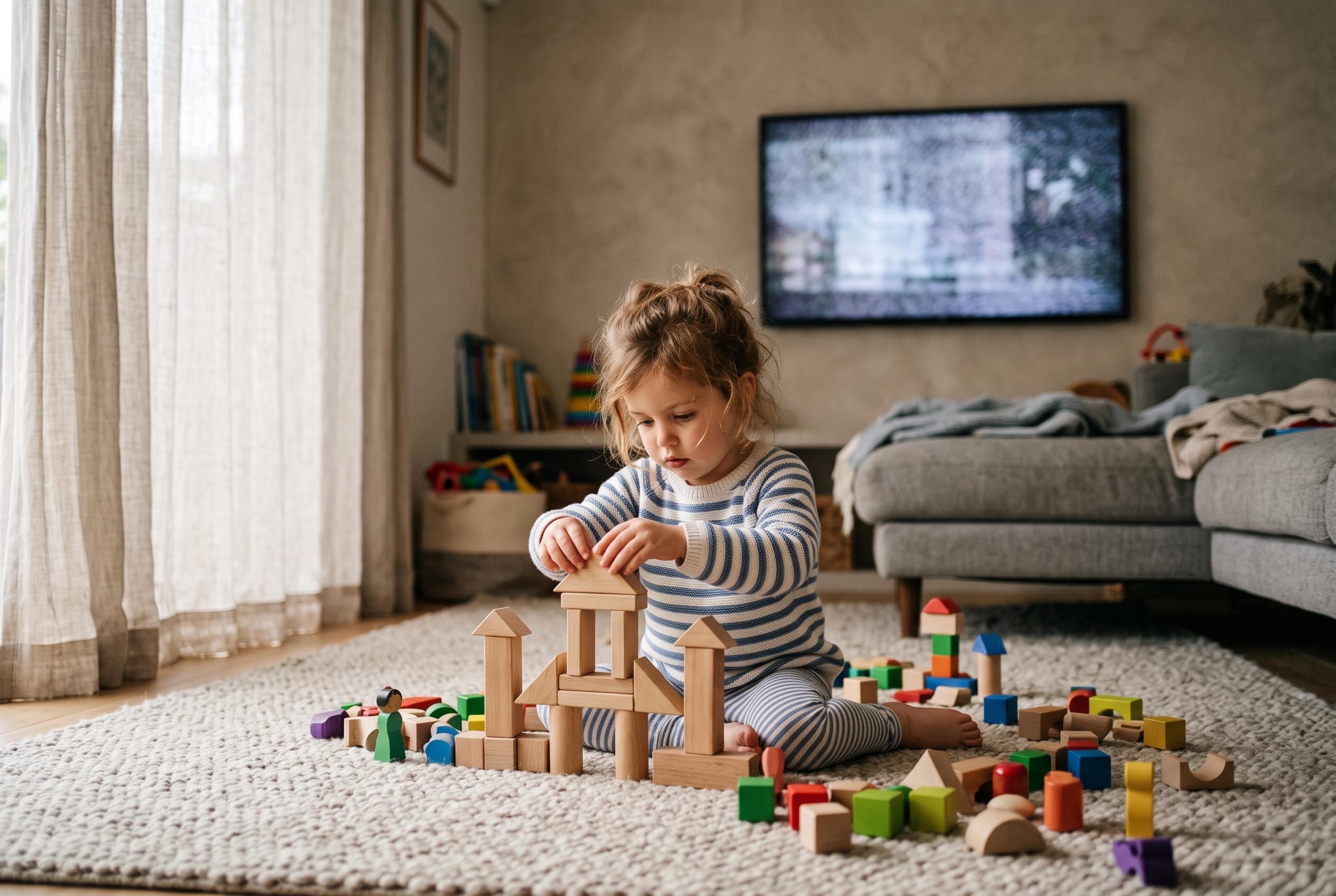

Recent research indicates that background TV can disrupt young children’s play and conversation, altering their immediate environment, though its lasting impact on attention spans is still debated.
A television left running in the background may not hold a young child’s gaze for long, but research suggests it can still change the shape of play, weakening concentration and shortening attention spans in the moment. Studies cited by The Artful Age point to a consistent immediate effect: when a set is on, children tend to stay less engaged with their toys and interact less richly with the adults nearby.
That evidence, however, is narrower than the popular claim that background television leaves a lasting mark on a child’s attention style. In laboratory work involving toddlers aged 12, 24 and 36 months, researchers found that even brief, barely noticed TV noise disrupted play. A follow-up experiment with children of the same ages showed a drop in both the quantity and quality of parent-child interaction when the television was on.
The longer-term picture is less clear. A study published in Pediatrics and summarised by PubMed found that among 107 preschoolers, higher cumulative exposure to background television was only marginally linked with weaker executive function, a term covering skills such as working memory and self-control. The authors themselves pointed to several possible explanations, including the chance that parents react to children’s behaviour by turning the television on more often, rather than television exposure causing the problem.
A much larger study in Nature examined 1,180 US caregivers of children aged two to eight and found a more complicated pattern. Background television during sleep was associated with poorer executive function across age groups, and preschoolers playing alone while the television was on also showed worse results. But for school-age children, playing with other people in the presence of television was linked with stronger executive function, a reminder that the context matters and that not every association runs in the same direction.
What the research does support is a simpler, practical conclusion: a running television changes the immediate environment in ways that can make play less focused and conversation less sustained. It does not prove that a child who grows up with background television will inevitably carry a permanent attention problem into school life. That classroom version of the story remains more assumption than evidence.
Disclaimer: This content is for informational purposes only and is not intended to be a substitute for professional medical judgment, advice, diagnosis, or treatment.