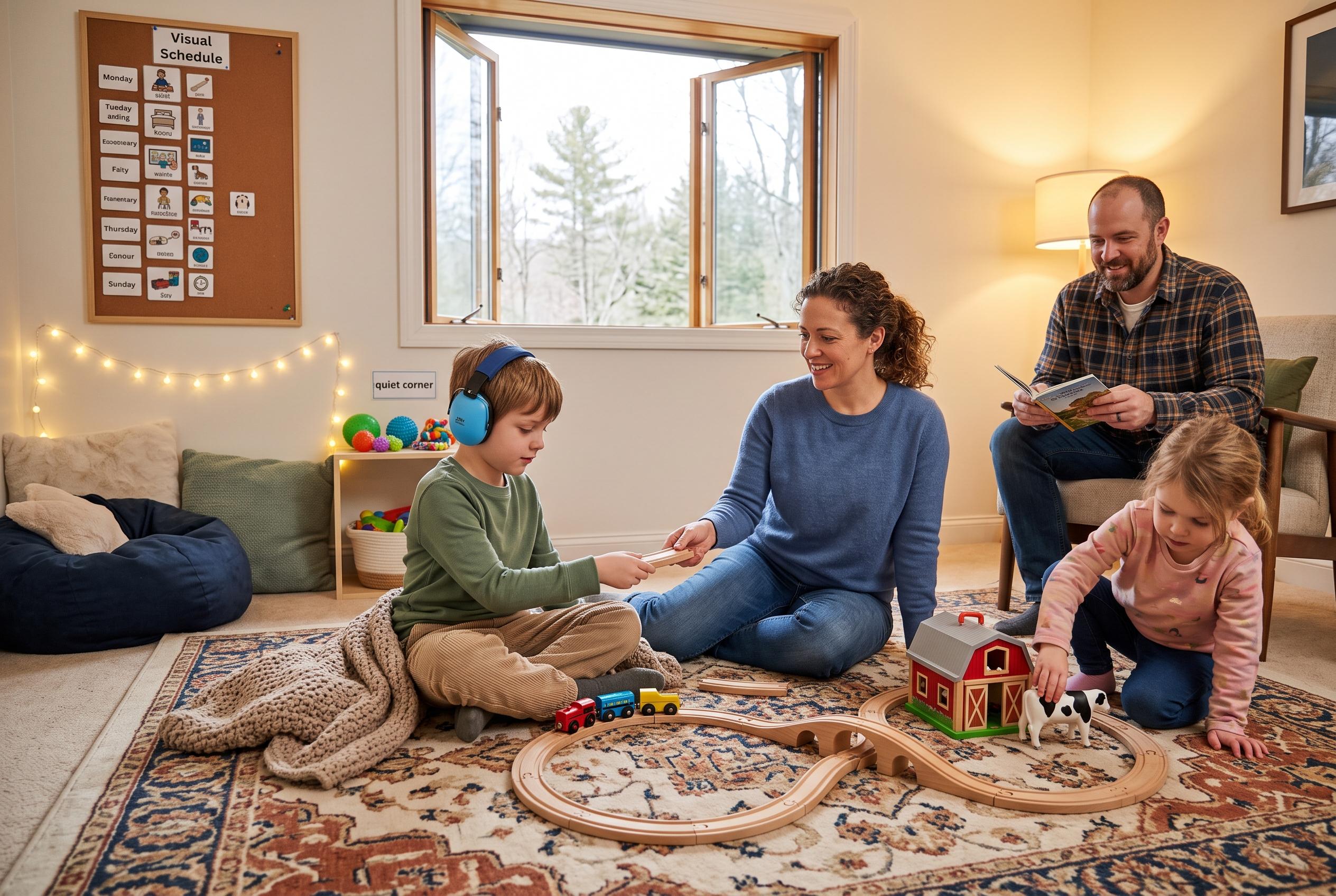

Families with autistic children navigate holiday challenges through careful planning, sensory adaptations, and familiar routines to create enjoyable and manageable experiences during school breaks.
Families of children with autism often face the same dilemma when school breaks begin: how to create a holiday that feels enjoyable without overwhelming a child who relies on routine and predictability. Parents interviewed for the Emirati report said the biggest challenges are travel, noise and crowded venues, even as they try to give their children experiences that are both fun and supportive of social and educational inclusion.
Several parents said careful planning makes a clear difference. Meryem Al Mehri, the mother of Rashid Al Asli, said pre-arranged summer programmes helped her son cope better with change. She enrolled him in a summer centre and also in craft workshops so he could build skills, learn new things and spend time with other children. She said that continuity between school and summer activities helps children stay engaged across different settings and makes the return to class easier.
Sara Al Muhairi, whose son Hamdan Al Marri follows a fixed routine during term time, said the shift that comes with the holidays can be stressful. She prefers a summer centre programme because it is lighter and shorter than the school day, allowing him to keep some structure without the same demands. Other parents said they try to avoid overcrowded places, book sessions in advance and choose activities with movement, as well as keeping familiar food on hand.
Some families said they avoid travel altogether during the busiest holiday periods. Shamsa Saif, the mother of Rashid Al Masrafi, said crowded events can make her son more anxious rather than helping him enjoy himself, so she favours local outings instead of trips abroad. She said places with sensory-friendly features, such as areas for jumping, running and sand play, are particularly helpful, and she would like to see more sports clubs offering specialist occupational therapy activities such as swimming and football.
Huda Mohammed, whose son Nasser Al Bloushi has a daily therapy routine, said she keeps that structure in place during the holidays and adds suitable activities at home and outside. She has installed a large pool and a trampoline at home, and she arranges regular outings to shopping-centre play areas, where he can jump and listen to music. She also said a visit to an interactive museum in Abu Dhabi did not work for him because the dark environment felt unfamiliar and unsettling.
Special education specialist Dr Amer Jamal said the most successful holiday is one matched to the child’s needs and ability to adapt. He advised families to plan ahead, keep part of the usual routine intact and prepare children for new places with photos, videos and simple explanations of what to expect. He also recommended sensory and movement-based activities, including water and sand play, modelling clay, drawing, cycling, walking, swinging and jumping. According to Johns Hopkins Medicine, the National Autistic Society and other autism guidance organisations, preparation, routine, sensory planning and calmer environments can reduce holiday stress and make outings more manageable for autistic children and their families.
Disclaimer: This content is for informational purposes only and is not intended to be a substitute for professional medical judgment, advice, diagnosis, or treatment.