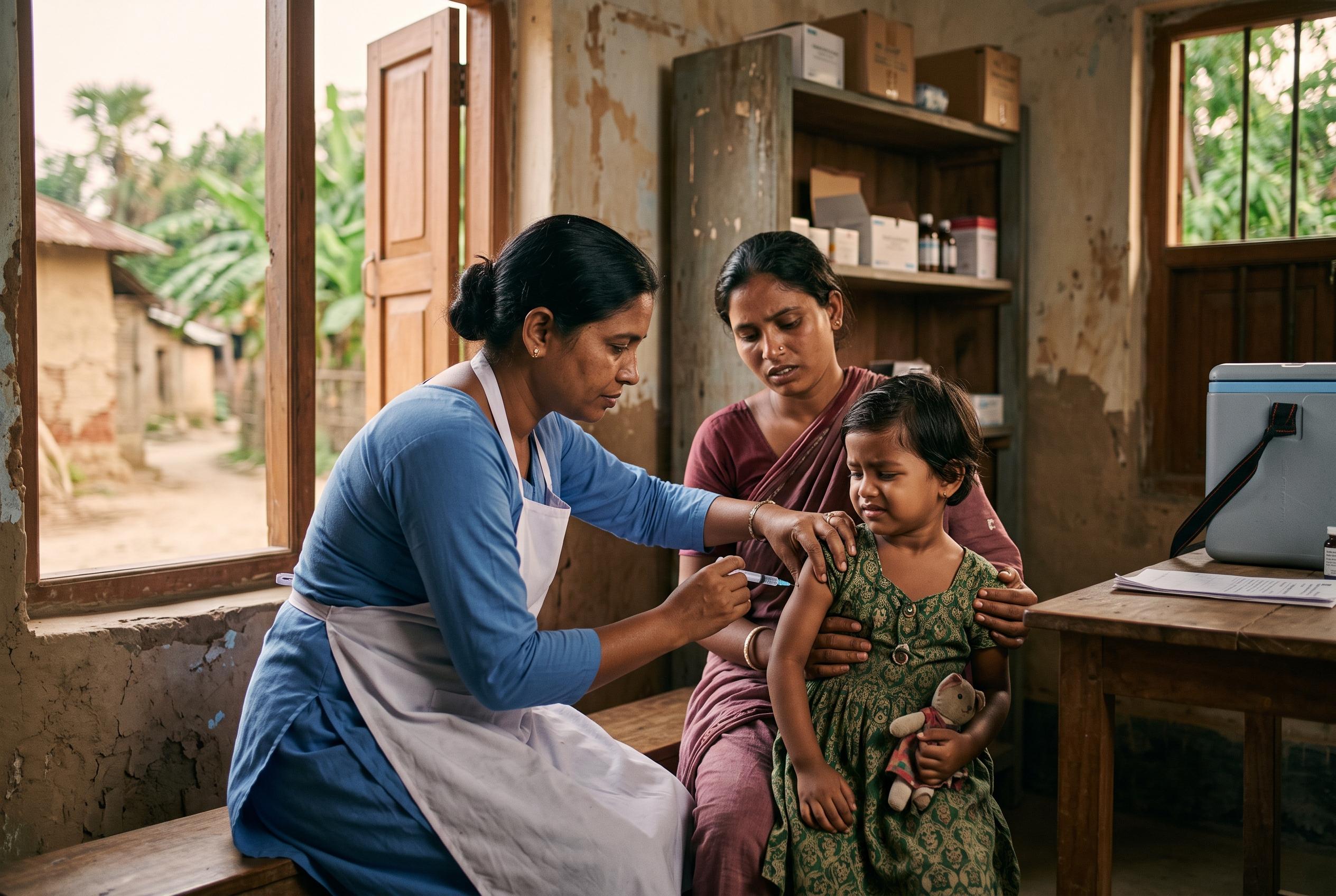

Despite months of emergency vaccination campaigns, Bangladesh faces a worsening measles outbreak with nearly 1,000 child deaths and over 180,000 cases, exposing gaps in immunisation coverage and healthcare preparedness.
Bangladesh was on the brink of recording 1,000 measles-related child deaths at the start of September despite months of emergency vaccinations, with official bulletins showing the toll rising from 983 on Wednesday to 986 on Thursday. Those same updates put the total caseload above 180,000, combining suspected and laboratory-confirmed infections recorded since 15 March.
The latest figures also show how heavily the outbreak has fallen on particular parts of the country. According to data reported by bdnews24.com from the Directorate General of Health Services, Dhaka Division alone accounted for 400 suspected deaths by Thursday morning, far more than any other region. Sylhet had recorded 152 suspected deaths, Rajshahi 92 and Mymensingh 75, while the previous 24 hours brought fresh deaths in Dhaka and Sylhet. Hospital demand remained acute: 977 patients were admitted nationwide in a single day, including 306 in Dhaka and 261 in Chattogram.
That pressure has been building for months. Associated Press reported in early April that more than 100 children had died in less than a month, with more than 900 confirmed infections among 7,500 suspected cases. By 23 May, Al Jazeera, citing AFP and Anadolu, said the death toll had reached 512, including 13 children in the previous 24 hours. The same report said hospitals in Dhaka had opened dedicated measles wards and were short of intensive care beds, an indication that the emergency was already straining urban paediatric services long before the toll approached four figures.
International health agencies say the outbreak spread with unusual breadth. In its disease outbreak notice, the World Health Organization said Bangladesh informed it on 4 April of a nationwide increase affecting 58 of the country’s 64 districts across all eight divisions. WHO said rapid response teams were activated and the response widened beyond vaccination to include hospital preparedness, isolation facilities, infection prevention and control, surveillance, weekly situation reports and efforts to maintain vitamin A supplies.
The vaccination campaign itself was ambitious, at least on paper. WHO Bangladesh said the government, supported by UNICEF, WHO and Gavi, launched an emergency measles-rubella drive aimed at protecting more than 1.2 million children aged six months to five years in 30 upazilas across 18 high-risk districts. The initial phase began on 5 April, with expansion planned for four city corporations from 12 April. Associated Press reported that the campaign was intended to widen nationwide the following month, while Al Jazeera later said UNICEF’s Bangladesh representative, Rana Flowers, had reported 18 million children reached by late May.
Even so, the public record is not entirely consistent about how quickly the campaign scaled up. WHO’s outbreak notice said Bangladesh’s National Immunization Technical Advisory Group approved a nationwide measles-rubella campaign on 30 March and that a nationwide effort began on 20 April after the first phase in priority districts. A separate WHO Bangladesh release published on 5 April described a later timetable, saying the push would go nationwide from 3 May after the initial district and city-corporation phases. Both accounts, however, make clear that officials viewed the outbreak as a national emergency from the start.
WHO and UNICEF trace the crisis to immunity gaps that had been building for several years. WHO said coverage for the first and second measles-rubella doses had slipped after a vaccine stockout between 2024 and 2025, while routine immunisation weakened and Bangladesh had not held regular nationwide supplementary campaigns since 2020. Al Jazeera reported that UNICEF linked the worsening gaps to disruption during and after the 2024 student-led uprising that toppled the government. Associated Press, meanwhile, said Health Minister Sardar Mohammed Sakhawat Husain told Parliament that mismanagement and poor vaccine stockpile decisions by previous administrations had helped trigger the outbreak.
The youngest children have been at the centre of the emergency. Al Jazeera reported that most cases were among children aged six months to five years, while WHO Bangladesh warned early in the outbreak about infections in infants younger than nine months, who are not yet eligible for routine vaccination. WHO says measles spreads easily through the air and can cause severe complications including pneumonia, brain inflammation, hearing loss, diarrhoea and blindness, with the greatest danger falling on young, malnourished and unvaccinated children.
By Thursday, the cumulative hospital figures underlined both the scale of the epidemic and the burden on the health system. bdnews24.com said 141,449 patients with suspected measles had been admitted to hospital since 15 March and 136,405 had been discharged. TBS News, citing the health services directorate’s bulletin for the previous day, said hospitalisations had already reached 140,472 by Wednesday morning, with 135,417 recoveries, showing how quickly the totals were still climbing from one day to the next.
Those daily changes suggest Bangladesh had not yet brought transmission under control by the first week of September. TBS News reported 1,034 new suspected cases and 63 new laboratory-confirmed infections in the 24 hours to 8am on 2 September. The following day’s bulletin, carried by bdnews24.com, still showed 964 people seeking treatment and 977 admissions in a single day, alongside a rise in confirmed cases to 19,527. After six months of emergency action, the central question was no longer whether Bangladesh had mounted a response, but whether that response could reach enough vulnerable children quickly enough to stop the death toll from crossing the 1,000 mark.
Disclaimer: This content is for informational purposes only and is not intended to be a substitute for professional medical judgment, advice, diagnosis, or treatment.