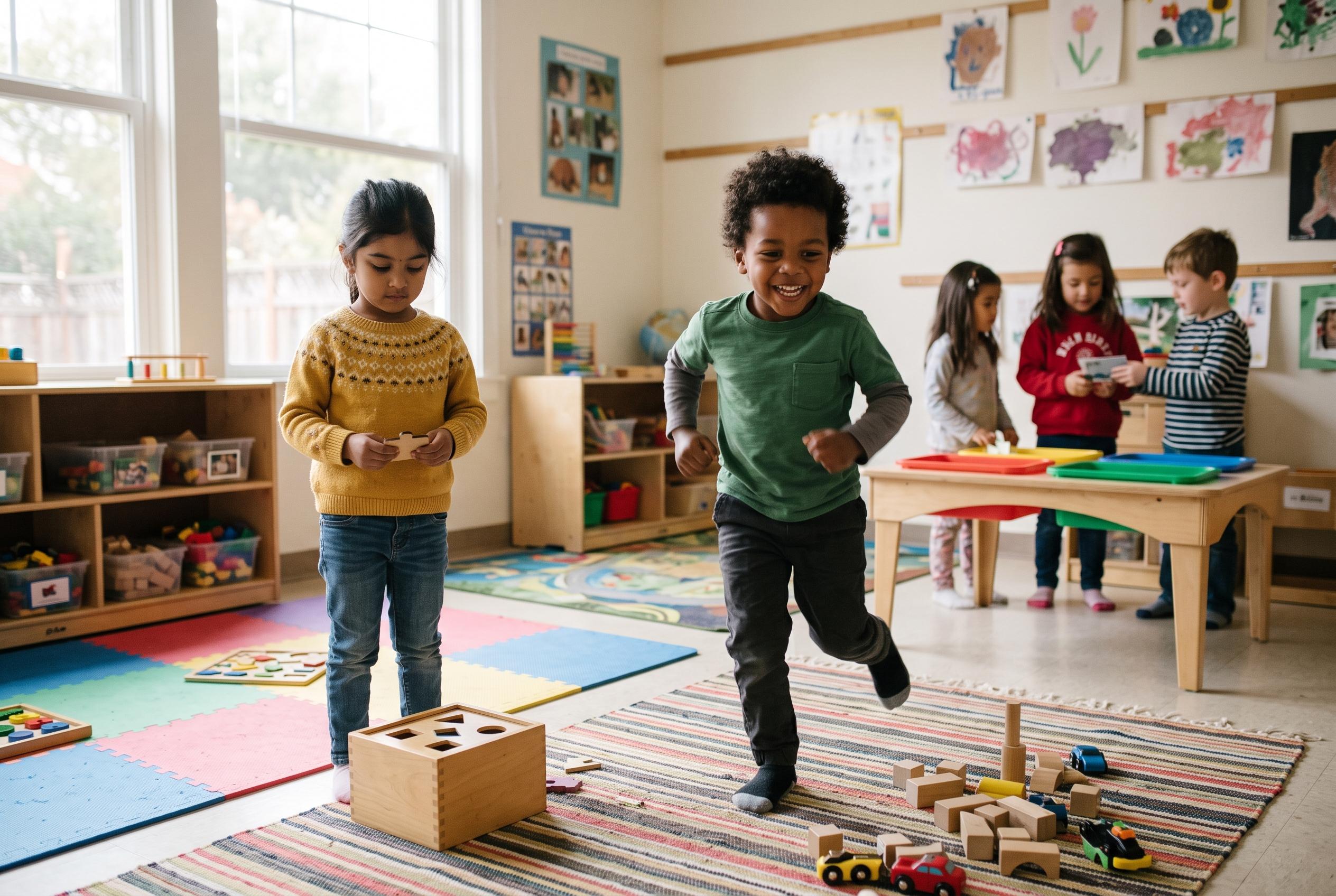

A new Italian study reveals that 30 minutes of lively play can temporarily enhance a preschool child’s speed and attention, but may also reduce their self-control, highlighting the importance of timing and engagement in early childhood activities.
A half-hour of lively play may sharpen a preschool child’s speed while briefly blunting their self-control, according to a new Italian study that found the same pattern after both a video game and a hands-on puzzle. Children were quicker at spotting targets and better on a sound-processing task immediately after playing Mario Kart 8 Deluxe or Tangram, but they struggled more when distractions were added or when a task demanded steadier motor control. (sciencedirect.com)
That makes the finding less a verdict on screens than a warning about timing. In the paper, Giovanna Puccio and colleagues argue that short, emotionally absorbing play seems to push young children towards faster, more automatic forms of attention, while temporarily leaving fewer resources for effortful control. The authors describe the shift as transient and context-dependent rather than simply helpful or harmful. Materials released by the Bial Foundation, which supported the work, make the same point: engagement appears to matter more than whether the activity is digital. (sciencedirect.com)
The researchers used a single-blind randomised crossover design with 48 typically developing children whose average age was 5.4. Each child went through three conditions: no play, 30 minutes of Mario Kart 8 Deluxe, and 30 minutes of Tangram. Afterwards, they were tested across auditory-phonological, visuospatial and sensorimotor tasks, covering skills such as phonemic awareness, visual search and aiming accuracy. The full paper says the statistical analyses were conducted under blinded conditions, and that children later reported no meaningful difference between the two games in perceived difficulty, enjoyment or post-play feelings. (sciencedirect.com)
Some of the clearest gains came when the task was simple and fast. In the phonemic-awareness test, children averaged 8.58 correct responses after no play, compared with 10 after the video game and 10.08 after Tangram. In a visual-search task with no distractors, inefficiency scores fell from 21.2 in the no-play condition to 15.0 after Mario Kart and 14.8 after Tangram, indicating faster, more accurate performance. The direct comparison between the two games was not statistically significant in either case. (researchgate.net)
Once the researchers raised the interference level, the pattern reversed. With 34 distractors on screen, inefficiency scores rose to 45.9 after the video game and 45.0 after Tangram, compared with 33.1 after no play. At an intermediate difficulty level with 22 distractors, the deterioration was weaker, but still pointed in the same direction. The authors said this suggested children found it harder to identify targets when perceptual noise was high, regardless of which kind of game they had just played. Two children were excluded from the visual-search analysis because one task had not been completed correctly. (researchgate.net)
The trade-off also appeared in movement. On an aiming exercise in which children threw a beanbag at a mat, they recorded more successful hits after no play than after either game condition. The paper says the difference between the video game and Tangram was again not significant, reinforcing the wider conclusion that the immediate effect was tied to activation and attentional arousal rather than to the presence of a screen. (researchgate.net)
For parents, teachers and nursery staff, the practical message is straightforward. The Bial Foundation’s English and Portuguese summaries say the period straight after an intense play session may not be the best moment for activities that require children to sit still, filter out distractions or exercise strong self-control. It may, however, suit tasks built around quick reactions, exploration or scanning for relevant information. As the authors put it in foundation materials, “Understanding this short-term multisensory and sensorimotor modulation is essential for guiding the integration of digital play into early childhood learning environments.” (beyondthebrain.bialfoundation.com)
The researchers also set out several reasons not to overstate the result. Their sample was small and relatively homogeneous, the study was not double-blind, and the no-play baseline always came first, which means practice effects cannot be ruled out. The article appeared as paper 101183 in Volume 23 of Computers in Human Behavior Reports in August 2026, under Bial-supported project 153/24, “Psychophysiological activation and learning (to Learn): Evidence from action-like video games to mindfulness”. English- and Portuguese-language AlphaGalileo pages carrying the release now show those items as withdrawn, but the journal paper remains available as the primary record. (researchgate.net)
Disclaimer: This content is for informational purposes only and is not intended to be a substitute for professional medical judgment, advice, diagnosis, or treatment.