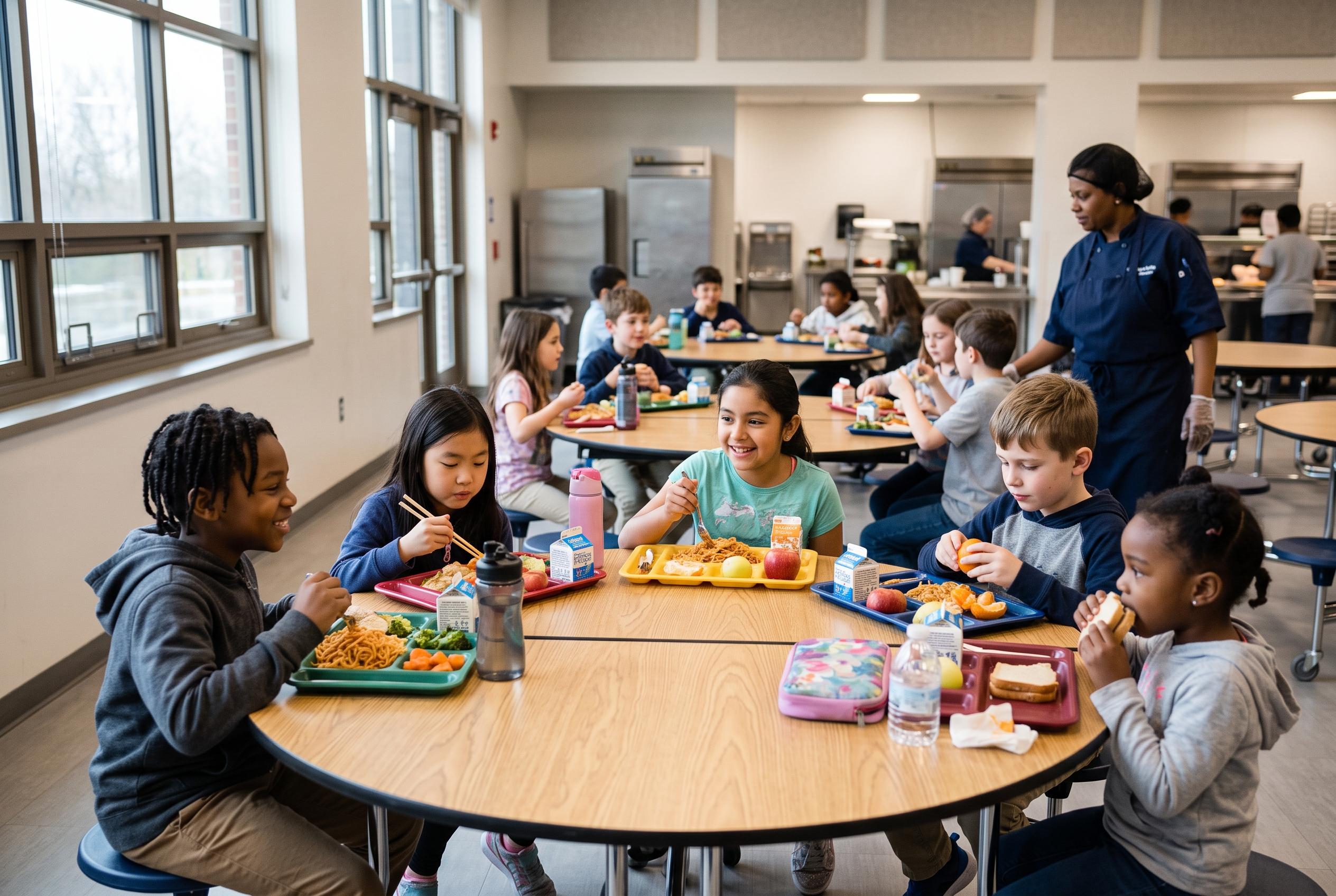

Recent federal cuts to food assistance threaten to reduce free meal access for thousands of US schoolchildren, risking a reversal of progress in hunger relief amid rising food prices and household financial pressures.
As pupils return to classrooms this autumn, the effect of last year’s federal cuts to food assistance is moving from supermarket tills into school canteens. In Illinois, Representative Raja Krishnamoorthi said new data show 47 fewer schools and 15 fewer districts are using the Community Eligibility Provision this school year, leaving nearly 24,000 fewer children in schools that serve free meals to everyone. He has asked the US Department of Agriculture to publish a state-by-state assessment of the fallout by 10 September. (ebs.publicnow.com)
The warning is not simply that families losing Supplemental Nutrition Assistance Program support may have less money for food at home. It is that they can also lose the paperwork trail that gets children free meals at school. The Centre on Budget and Policy Priorities says SNAP participation had already fallen by more than 4.5 million people between July 2025 and April 2026, with likely more than 1.5 million children affected. Because schools use SNAP and other means-tested benefits to “directly certify” pupils for free meals, fewer children on those rolls can also weaken a school’s ability to stay in the Community Eligibility Provision, the federal scheme that lets high-need schools feed all pupils without individual applications. Federal guidance says schools and districts can use CEP when at least 25% of pupils are directly certified through SNAP, Medicaid or other qualifying programmes. (cbpp.org)
That matters because CEP had been expanding. The Food Research & Action Center said on 22 July that a record 55,362 schools offered free breakfast and lunch to all pupils through the provision in the 2025-26 school year, with 27.6 million children attending a CEP school, up by 386,019 from a year earlier. Crystal FitzSimons, the group’s president, said the gains were fragile, warning that “the progress we have made on Healthy School Meals for All could unravel”. (frac.org)
Other analysts say the potential scale is much larger than the number of children who have already dropped off SNAP. The Urban Institute has estimated that at least 18.3 million students could lose access to free meals, either because they are no longer individually certified or because their school can no longer sustain universal provision. The Center for American Progress has put a price on that loss: a family with two children in public school could face about $1,890 a year for school-offered meals, or more than $2,200 if it has to provide packed meals instead. Meanwhile, the School Nutrition Association says total reported unpaid meal debt rose from about $20.3 million in 2024 to $25.3 million in 2025, and CBS’s price tracker found food prices were 21% higher in August 2026 than in January 2022. (urban.org)
Parents’ own accounts suggest there is little slack left in household budgets. No Kid Hungry said on 11 August that 59% of surveyed parents living at or below 185% of the federal poverty level said their child “wouldn’t have enough to eat” without school-day meals. The same survey, based on a national sample of 1,202 parents and a Hispanic oversample of 377 collected in May 2026, found that 89% said school meals ease pressure on the family food budget. A parent from West Virginia told the group that “if I have to skip meals so my child can get their belly full, I will”. No Kid Hungry says 14 million children in the United States are living with hunger. (nokidhungry.org)
Districts are already adjusting. Miami-Dade County Public Schools said on 23 July that only 121 schools would continue offering free breakfast and lunch to all pupils in 2026-27 after updated eligibility data showed the district no longer qualified to do so system-wide. Pupils at other schools must apply for free or reduced-price meals, although the district said all students would receive free meals for the first 30 days of the school year or until their new status is determined. After that, full-price lunch is set at $4.20 in non-CEP schools. CBS reported that the district had offered meals at no charge across roughly 400 schools during the previous four years. (news.dadeschools.net)
North Carolina officials have been warning for months about the same chain reaction. Reporting from The 74, drawing on an EducationNC conference report from March, quoted Rachel Findley of the state Department of Public Instruction saying the number of students tied into school meals through SNAP-linked certification was already falling and that “It’s going to be catastrophic for our students in North Carolina if SNAP benefits expire.” State education officials said more than 850,000 North Carolina pupils rely on school meal and snack programmes during the school year, while advocates told the conference that 81% of the state’s voters support meals for all. The discussions took place in western North Carolina, where food insecurity has been sharpened by the disruption caused by Hurricane Helene in September 2024. (the74million.org)
The Trump administration has offered a different emphasis. On 24 August, Agriculture Secretary Brooke Rollins and Health and Human Services Secretary Robert F. Kennedy Jr. launched the “Harvest to Hallways” initiative, which USDA said includes up to $70 million for school kitchen infrastructure, including a new $50 million equipment investment, up to $25 million in additional Farm to School Grants for fiscal 2026, and a separate $30 million HHS research commitment aimed at improving the nutritional quality of school meals. The announcement promoted healthier menus and local procurement, but it did not address the question advocates and some lawmakers are raising: what happens when children remain poor enough to need help, yet lose the benefit record that gets them fed at school. Krishnamoorthi put the point more bluntly in his letter, writing: “A paperwork failure by one household should not become a food insecurity problem for hundreds of children.” (usda.azureedge.us)
Disclaimer: This content is for informational purposes only and is not intended to be a substitute for professional medical judgment, advice, diagnosis, or treatment.