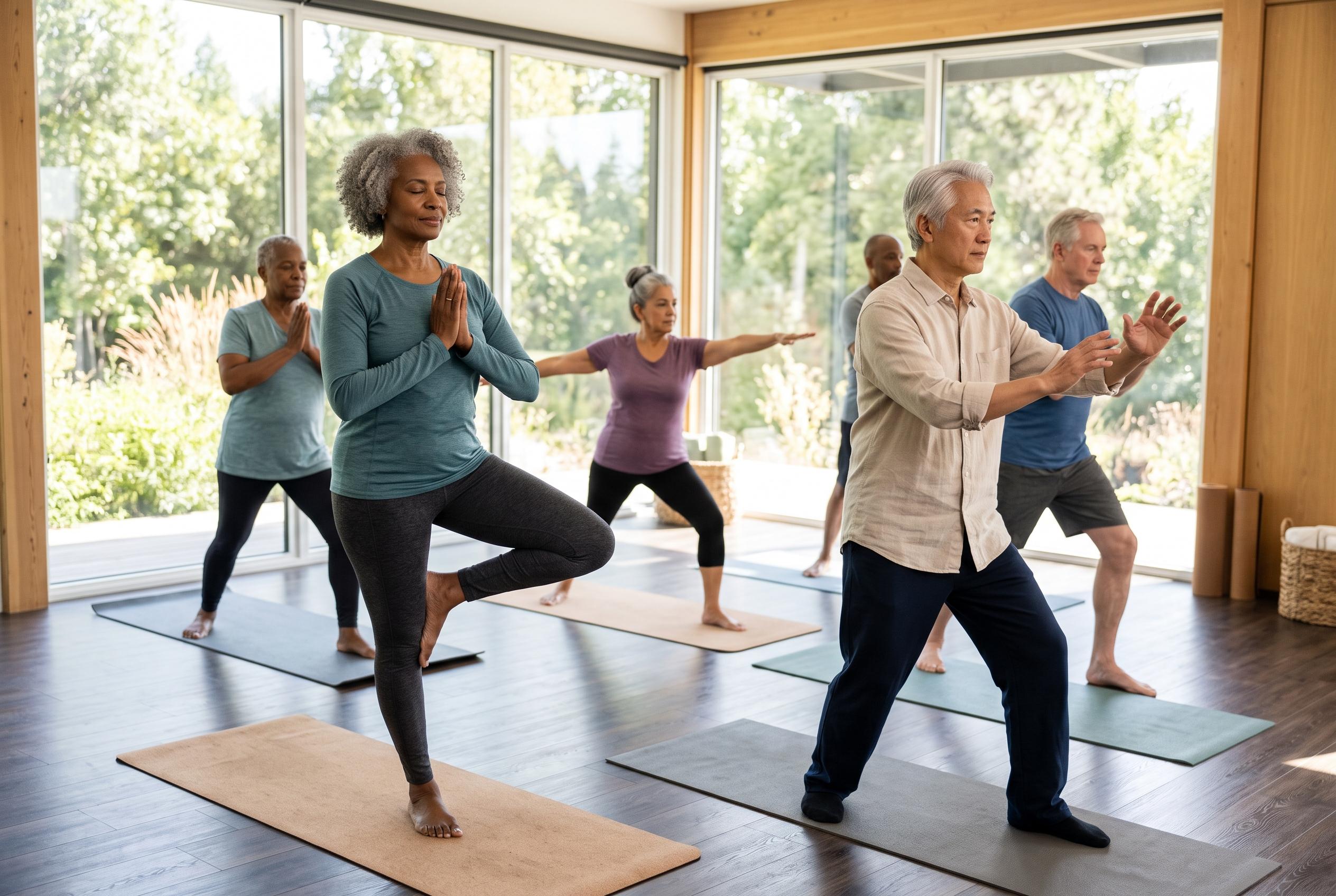

A study from Birkbeck, University of London reveals that varied and mindful movement practices, such as yoga and tai chi, may support cognitive health across adulthood, beyond just the quantity of exercise.
A new study suggests that when it comes to keeping the ageing brain sharp, the way people move may matter more than how much they move. Researchers at Birkbeck, University of London found that adults whose activity patterns included a wider mix of movement, along with mindful practices such as yoga or tai chi, tended to do better on tests of planning and physical reasoning than people whose routines were narrower or more repetitive.
The work, published in Ageing International, analysed 200 adults split evenly between younger and older groups. Instead of sorting participants into simple labels such as active or inactive, the team used a recent physical activity questionnaire and a machine-learning method called k-means clustering to identify natural patterns in the data. That approach was designed to capture real-world variation in how people exercise, rather than forcing them into fixed categories.
Participants then completed two cognitive tasks: the Towers of Hanoi, a classic planning test, and a computer-based physical reasoning task called Virtual Tools. The key finding was that variety and mindfulness in movement were linked to stronger performance on both measures. By contrast, the total amount or intensity of exercise did not consistently predict better results. The pattern fits with earlier research suggesting that different forms of activity, including strength, aerobic and coordination training, can support cognition, and that mind-body exercise may be especially helpful in later life.
Age still mattered. Older adults, on average, performed worse than younger adults on the tasks, which is consistent with the usual slowing seen in executive function and fluid reasoning. But the relationship between movement style and cognition looked similar in both age groups, suggesting the benefit of varied, attentive activity may extend across adulthood rather than being confined to one stage of life. That is in line with other studies linking physical activity, especially moderate-to-vigorous movement, with next-day cognitive performance in older adults, and with research showing that more frequent light activity in midlife and later life may help slow cognitive decline.
The findings do not prove cause and effect. Because the study was cross-sectional and relied on self-reported activity, it cannot show whether diverse movement improves thinking or whether sharper thinkers simply choose richer activity routines. Even so, the results add weight to a growing body of evidence that mind-body practices and everyday movement habits can support cognition. For parents and caregivers thinking about healthy ageing, the practical message is straightforward: walking is useful, but mixing in balance work, coordination, strength and mindful exercise may offer broader brain benefits.
Disclaimer: This content is for informational purposes only and is not intended to be a substitute for professional medical judgment, advice, diagnosis, or treatment.