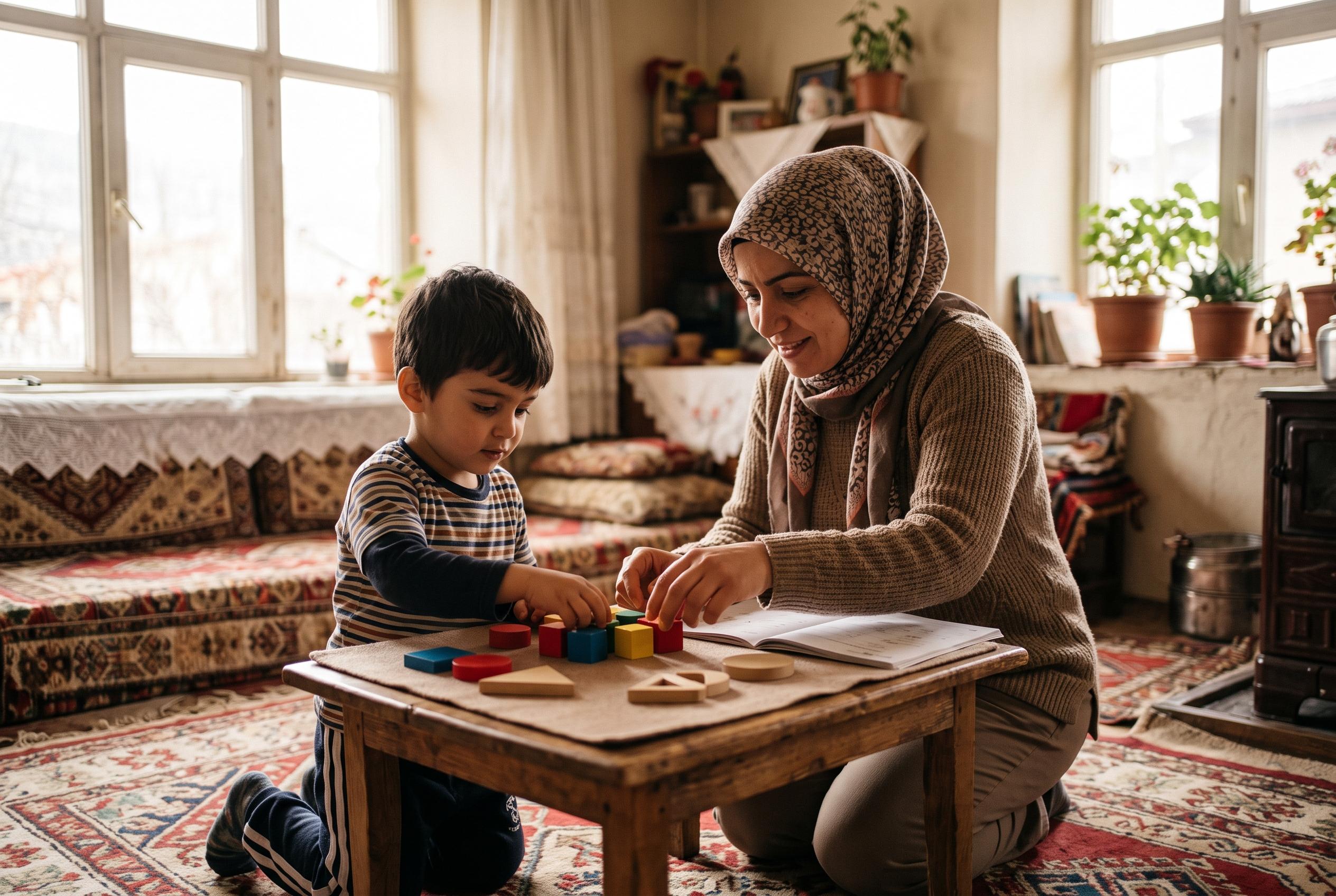

A pilot study in eastern Türkiye reveals that short, structured home-based maths activities can significantly enhance mathematical reasoning in preschoolers, highlighting the potential for parental involvement to foster early numeracy skills.
A pilot study from eastern Türkiye suggests that a short, structured home maths programme may help preschool children strengthen early mathematical reasoning, especially in measurement and data analysis. Published in Frontiers in Psychology, the research tested a Home-Based Mathematical Reasoning programme with 20 children aged 60 to 72 months, split evenly between an intervention group and a control group. The wider evidence base matters here: early maths skills are widely viewed as a strong predictor of later school success, and research also shows that home learning activities can support those skills. The new study adds to that literature by focusing not on counting alone, but on reasoning tasks such as matching, comparing, sequencing and classification.
The programme ran for five weeks and involved ten home sessions led with mothers, while children in the control group continued normal preschool education. Researchers used a randomised pre-test, post-test design and found that the two groups started at a similar level. By the end of the intervention, the children who took part in the home sessions scored higher than the control group on measurement, data analysis and overall mathematical reasoning. Within the intervention group, gains were statistically significant and the effect sizes were large, although the authors stress that the study was only a pilot and the sample was small.
The content of the sessions is notable for its practical, concrete approach. Activities included shadow matching, sorting healthy and unhealthy foods, comparing objects by size and weight, arranging events in order, and using objects to introduce number and operations. That design fits with earlier research showing that learning trajectories in early maths work best when abstract ideas are linked to hands-on experience. It also reflects a broader body of evidence that parental involvement, home learning routines and guided family activities can make a meaningful difference in early numeracy.
Still, the authors caution against reading too much into the results. The sample was tiny, the work was limited to one region, and the study was not blinded, which means the findings should be treated as preliminary. Even so, the pattern is consistent with wider research suggesting that early maths ability can have long-term consequences and that intervention in the preschool years may be especially valuable. The practical takeaway for parents and educators is straightforward: short, structured, play-based maths activities at home may help build the thinking skills children need before formal arithmetic begins.
Disclaimer: This content is for informational purposes only and is not intended to be a substitute for professional medical judgment, advice, diagnosis, or treatment.