
Montessori classrooms thrive when designed as purposeful communities where children develop independence, social skills, and self-regulation through thoughtfully prepared environments and minimal adult intervention, challenging traditional notions of classroom control.
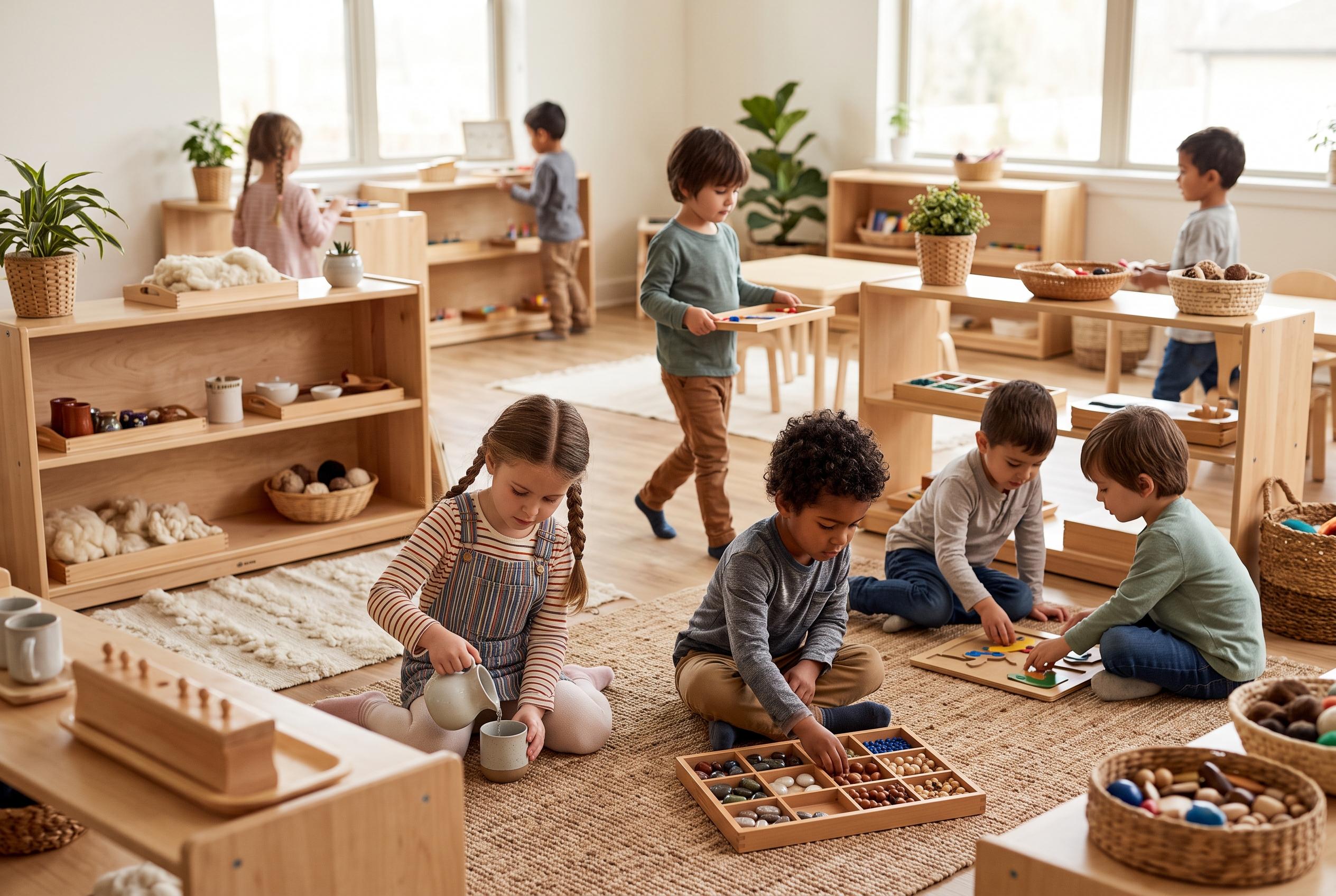
A Montessori Children’s House works best when it feels less like an adult-managed room and more like a small, ordered community. Children move purposefully, speak to one another, care for their surroundings and return to their work with growing independence. According to Montessori writings and school descriptions, that atmosphere is not accidental but the result of a carefully prepared environment, mixed-age learning and a trained adult who observes closely without dominating the space.
The idea is simple but demanding: the room belongs to the children. Furniture, materials and routines are scaled to their size and ability, so they can reach what they need, tidy after themselves and practise daily tasks without constant help. Montessori organisations describe this as a child-centred environment built to support freedom, discipline, concentration and self-direction, not as a stage for adult control.
That principle also explains why the most effective classrooms rely so heavily on practical life work and grace and courtesy. Children are not expected to absorb the habits of community by instinct. They are shown, step by step, how to carry a tray, roll a rug, wait for a turn, interrupt politely, ask to join a peer’s work and restore order after a spill. In many Montessori settings, these lessons are treated as core curriculum, because they give young children the language and the physical habits needed to live together peacefully.
Mixed-age grouping deepens the effect. Younger children watch older classmates and copy what they see; older children reinforce their own understanding by helping those who are newer to the room. Schools and Montessori bodies alike note that this arrangement fosters patience, cooperation and leadership, while also giving children a living model of how a community functions. A child who notices that paper has run out on the easel, or who quietly shows a younger classmate where a material belongs, is not simply being helpful. That child is taking ownership of the environment.
The adult’s role is therefore less about command and more about careful preparation. A guide selects the materials, sequences the work, protects concentration and teaches expectations before problems arise. Montessori observers say this matters because a classroom that depends on frequent correction, loud reminders and constant rescue will never fully settle into the rhythm the method is meant to create. The goal is not compliance for its own sake, but a room in which children increasingly regulate themselves and one another.
That is also why excessive intervention can do real damage. If an adult steps in to explain every disagreement, solve every practical difficulty or narrate every rule, children learn to wait for help instead of acting for themselves. Montessori practice places great value on letting children try, make small social repairs and handle ordinary tensions when it is safe to do so. In that sense, the classroom becomes a training ground for human relationships as much as for academic work.
What looks like calm in a strong Montessori classroom is therefore something more dynamic than silence. There may be laughter, conversation, spills, frustration and negotiation. The difference is that disturbances do not spiral into disorder. Children know the routines, understand the boundaries and have enough experience to repair small problems without derailing the whole room. That is the real sign of a functioning Children’s House: not perfect behaviour, but a community in which responsibility has gradually shifted from adult authority to the children themselves.
Disclaimer: This content is for informational purposes only and is not intended to be a substitute for professional medical judgment, advice, diagnosis, or treatment.