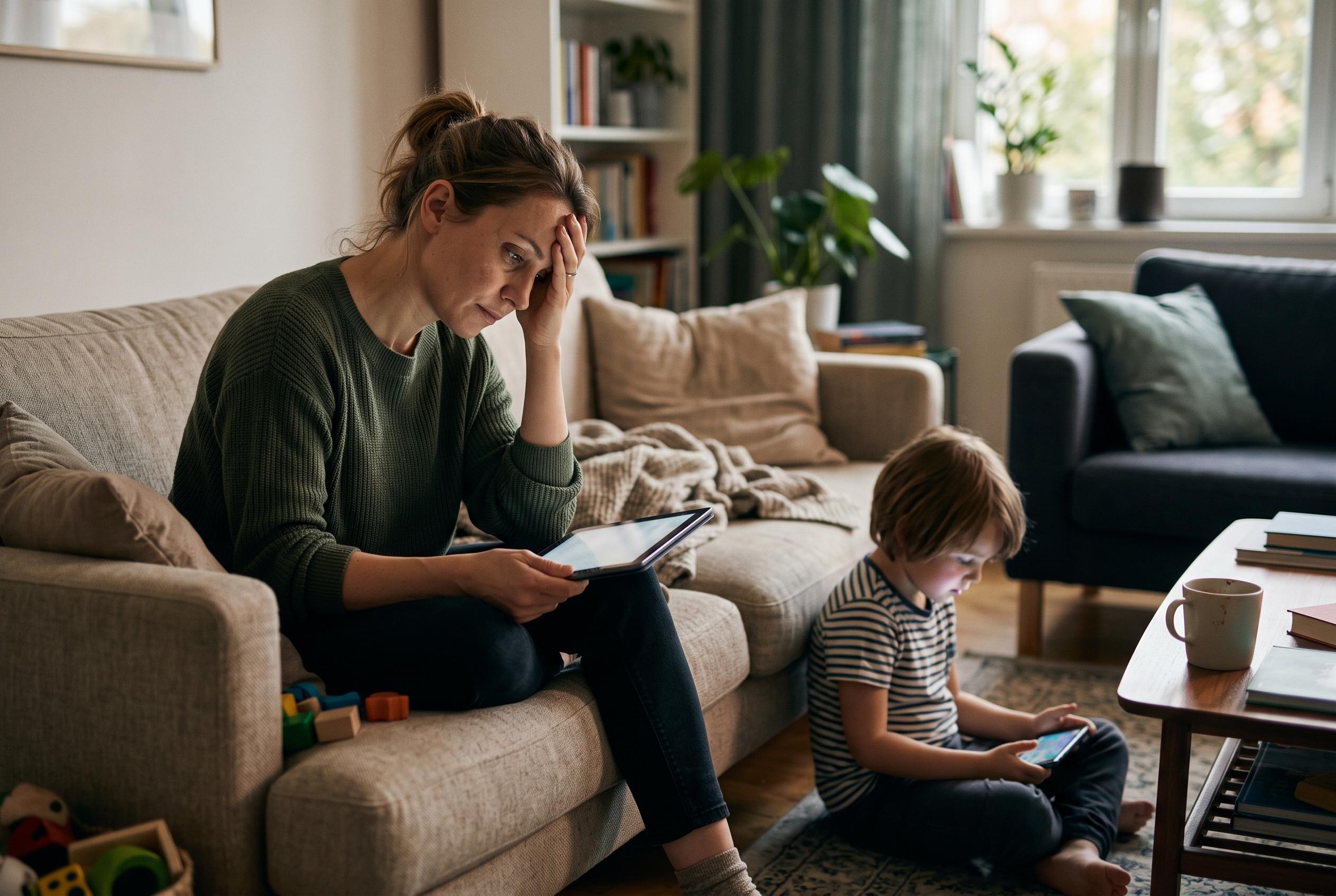

New study highlights how parental stress levels influence children’s screen use more than behaviour, prompting calls for better family support and planning strategies.
Parents often blame children’s moods or misbehaviour when a tablet ends up in small hands, but new research suggests the adult’s own stress may be the stronger force. Enid A. Moreira, Daniel M. Bagner and Shayl Griffith of Florida International University say their study of 822 parents of children aged four to eight found that caregivers under heavy personal stress were less likely to set firm limits on screen use, even when a child’s behaviour was taken into account.
The findings arrive at a time when screens are already embedded in family life. Nearly all children in the United States use screens daily, and the American Academy of Pediatrics advises that children aged 18 months to two years should avoid solo media use, while those aged two to five should have less than an hour a day. Yet most young children do not meet those guidelines, making screen management a routine source of conflict in many homes.
That pressure is not just anecdotal. Pew Research Centre reported in 2020 that 70% of parents said managing technology and social media was a major source of stress. And in 2024, the U.S. Surgeon General identified parenting stress as a public health concern, calling for more support for families and better understanding of how stress shapes daily decisions.
Moreira and her colleagues looked at three kinds of parenting stress: stress tied to the parent’s own life, stress arising from the parent-child relationship and stress linked to a child’s difficult behaviour. They found that parents who felt weighed down by their own circumstances tended to impose fewer screen rules overall. Parents who described their child as harder to manage were also more likely to hand over a screen to head off a meltdown. By contrast, stress focused on the relationship itself did not appear to make screen use more likely.
The researchers said these patterns suggest that screen time decisions are often made in the moment, when a parent is already overloaded. Their advice is to plan ahead, such as by setting screen-free times or places, banning devices at the dinner table or before bed, and limiting which apps children can use. Where possible, children can also help shape the family media plan. The point, the authors suggest, is to make the 6 p.m. tablet decision before the chaos begins.
Disclaimer: This content is for informational purposes only and is not intended to be a substitute for professional medical judgment, advice, diagnosis, or treatment.