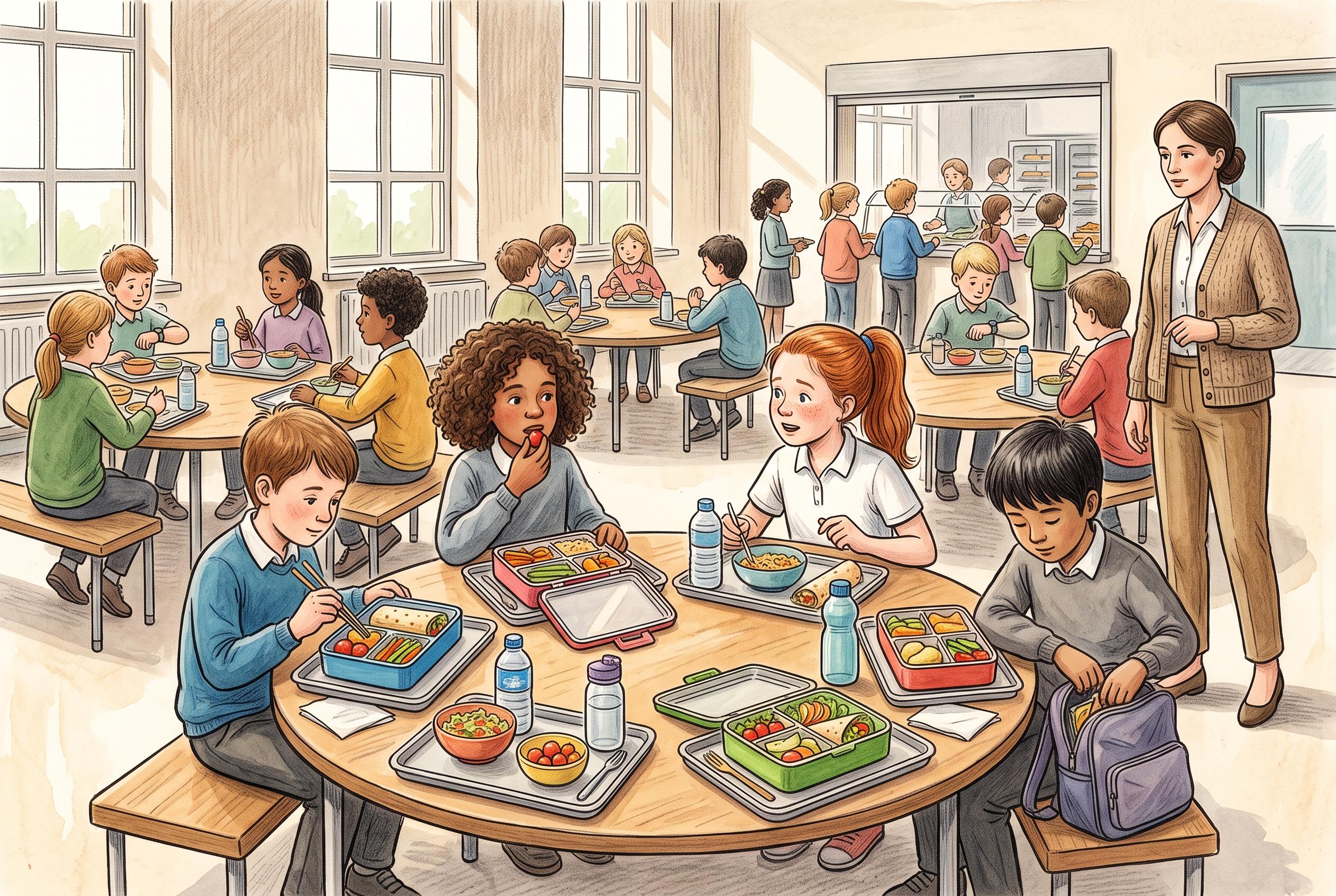

Despite the expansion of Ireland’s Hot School Meals Programme, many parents and teachers express concern over nutritional quality, insufficient time for children to eat, and the programme’s uneven implementation, raising questions about how to improve lunchtime experiences for students.
For many parents, the return to school does not mean the end of packed lunches, even in classrooms served by Ireland’s Hot School Meals Programme. Despite the scheme’s expansion, a national survey of almost 8,000 parents, teachers and suppliers found that four in five parents still send in an extra lunch, while many also look for ideas for a second snack, usually for “little break”, which the hot meals system does not cover, according to RTÉ News and the recent review commissioned by Fine Gael.
That response reflects a wider frustration with the scheme’s uneven rollout and mixed reception. RTÉ reported that 93% of respondents said the programme was operating in their primary school, but many said the food was not nutritious, did not appeal to children and was often left uneaten. Parents also raised concerns about portion size, the absence of cold meal options in some schools, the appearance of reheated food and the lack of proper cooking facilities.
Yet the biggest problem may not be what is on the plate, but how little time children are given to eat it. Primary school teacher and author Cormac O’Donoghue told The Journal that children often have about 10 minutes for lunch, and sometimes less once hand-washing, unpacking and settling down are taken into account. Younger children, slower eaters and pupils who need help opening packaging can be left with even less time.
That, O’Donoghue argues, risks turning lunch into a rushed chore rather than a proper break. He said the priority should be the quality of lunchtime, not just the number of minutes on the timetable, so that children have a calm, protected period in which to eat at their own pace and build healthier habits around food.
Some schools are already trying to take that approach. Orla Kelly, principal of John Scottus Primary School Old Conna, told The Journal that lunchtime should be treated as part of learning, not simply a pause between lessons. In her view, children need enough time and a relaxed setting to eat properly, talk to one another and build relationships. Deirdre Doyle of the Cool Food School went further, arguing that schools should place more value on food itself and create proper canteen-style spaces with plates, cutlery and a shared meal culture.
Disclaimer: This content is for informational purposes only and is not intended to be a substitute for professional medical judgment, advice, diagnosis, or treatment.