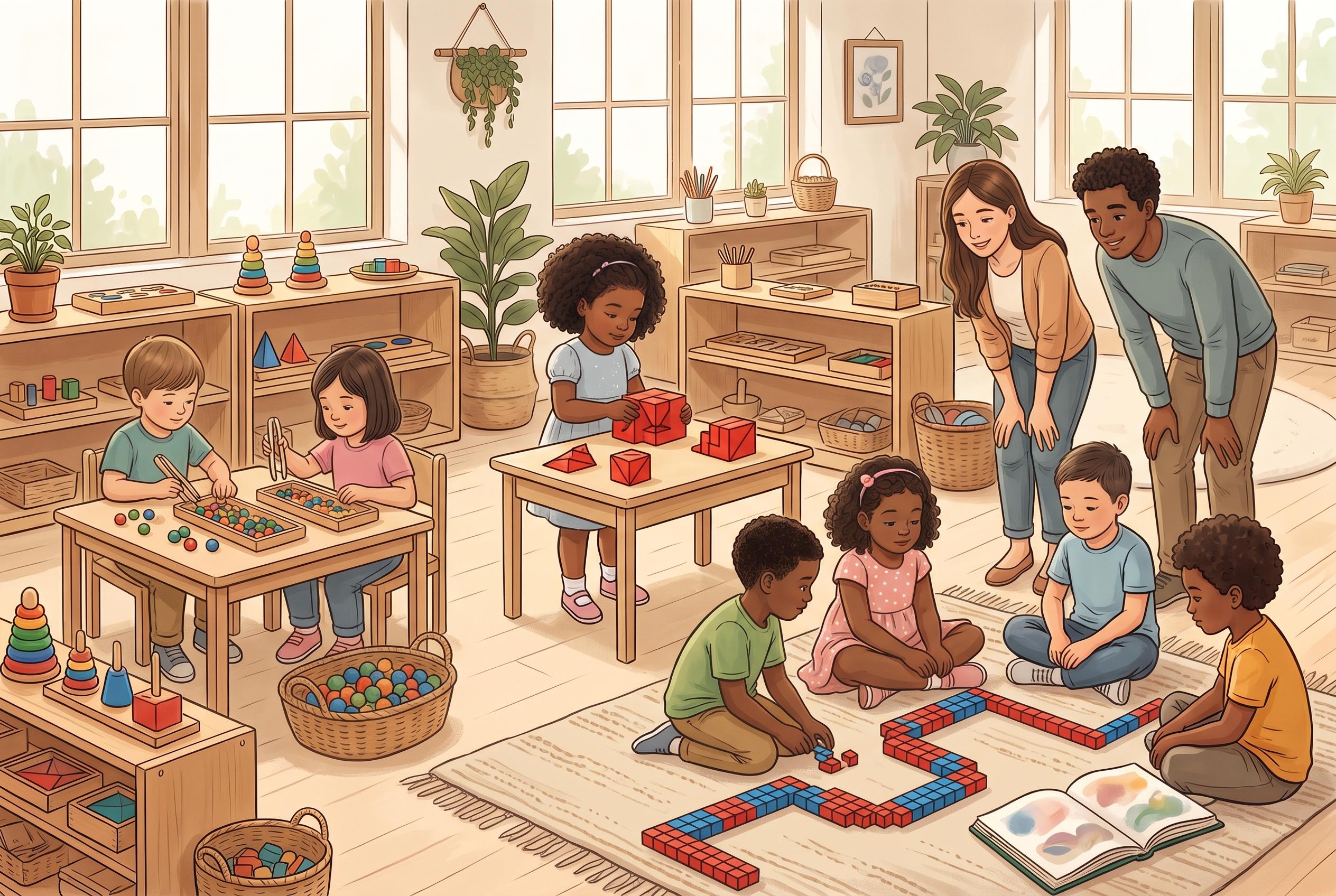

Montessori environments inspire children to take responsibility, regulate themselves, and build a community where adults act as guides rather than controllers, shaping independent and respectful learners.
A well-run Montessori Children’s House is rarely quiet, but it is often calm. Children move about with purpose, speak to one another, care for the room and settle disputes with increasing confidence. According to the Montessori Foundation, that balance of activity and order is what educators mean when they talk about a classroom becoming “normalised”: children grow more focused, independent, considerate and able to regulate themselves. The Association Montessori Internationale says that Montessori environments are deliberately prepared to support mixed-age groups, independence, self-discipline, mutual respect and care for the surroundings.
What makes that possible is not an adult who controls every detail, but one who prepares the room carefully and then gradually hands responsibility to the children. Practical tasks such as rolling a rug, carrying a tray, washing a table or returning materials to the shelf are not treated as incidental chores. They are taught as lessons in their own right, because they build competence and make the classroom increasingly self-sustaining. Returning children often take on real responsibilities, helping with opening, closing and routine care so that newer pupils can see what ownership of the space looks like.
Freedom in a Montessori setting is not the same as doing whatever one likes. The Montessori Foundation argues that community depends on explicit teaching, especially through grace and courtesy lessons: short, direct demonstrations of how to interrupt politely, wait for a turn, move around another child’s work, offer help or decline it, and protect someone else’s concentration. Guidepost Montessori says these lessons are about more than manners; they support self-control, confidence and a sense of belonging. In practice, they give children a shared language for daily life.
The adult’s role is therefore less about constant correction and more about careful modelling. Another Montessori Foundation piece on classroom management says children absorb the emotional tone of a room as readily as they learn language, so a hurried or irritated adult can create the very disorder they are trying to prevent. Strong guides speak less, intervene more precisely and use observation to decide whether a problem comes from the child, the task or the environment itself. They also protect the work cycle, understanding that concentration is central to learning.
That restraint matters because over-helping can become its own obstacle. Montessori educators often caution against stepping in too quickly, whether the issue is a fallen object, a disagreement or a social misunderstanding. When safety allows, children need space to practise ordinary negotiation: asking for a turn, refusing a request, waiting, or stating a boundary. The Montessori Foundation and other Montessori sources argue that these small exchanges are not a distraction from the curriculum; they are part of it. Children learn to live with others by living with others.
In the best classrooms, this approach slowly shifts the centre of gravity away from the adult and towards the community. Older children begin reminding younger ones how to care for the room. A child replaces paper on an easel, another wipes up a spill without being asked, and a third waits because someone else is already at work. The room may still be lively, and problems will still arise, but the group has the skills to return to equilibrium. That, Montessori writers say, is the real achievement: a children’s community that can function not because the teacher is in charge of everything, but because the children are learning to carry the culture themselves.
Disclaimer: This content is for informational purposes only and is not intended to be a substitute for professional medical judgment, advice, diagnosis, or treatment.