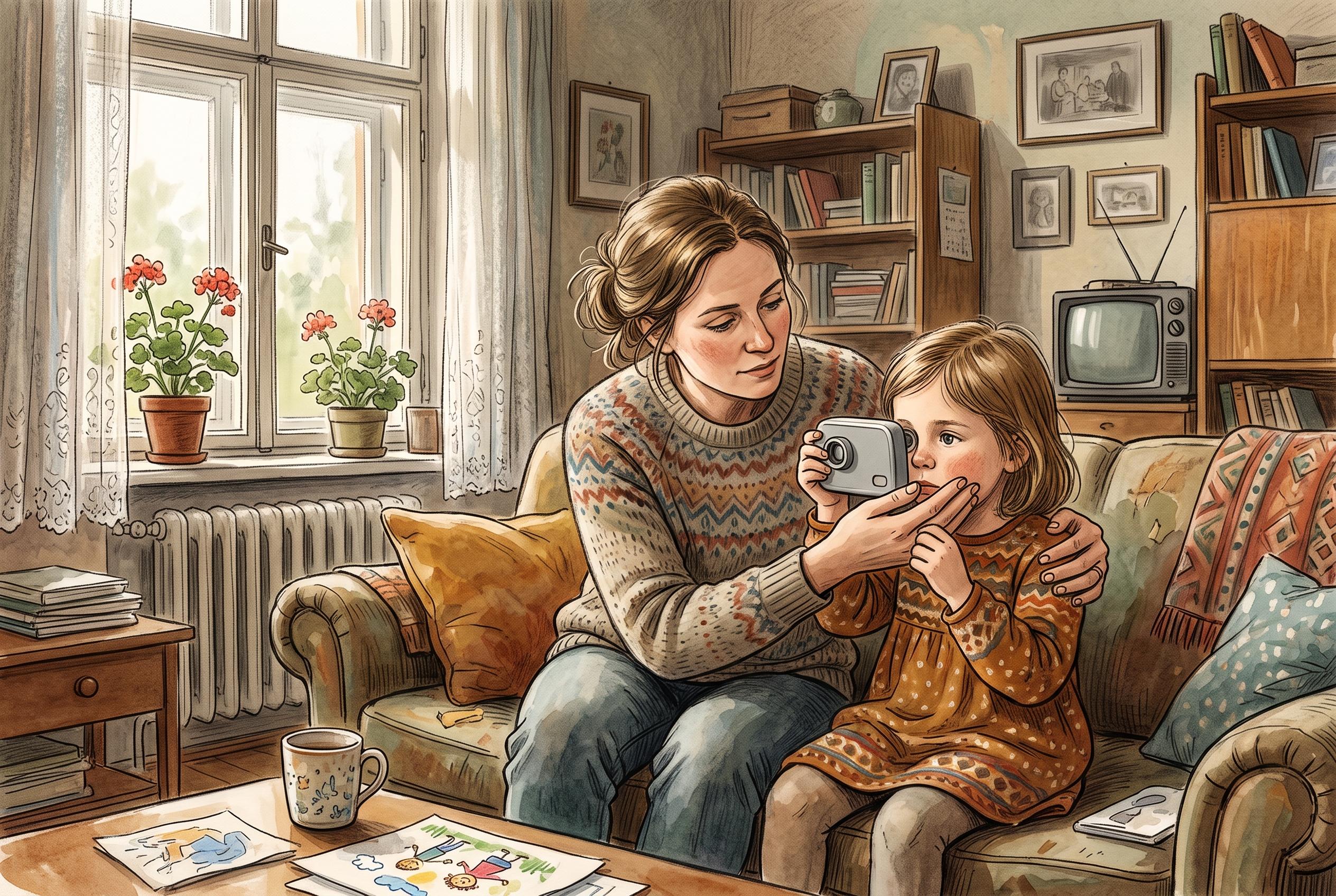

A four-year-old girl from the Czech Republic was diagnosed with significant myopia and astigmatism after her mother’s simple home test highlighted concern, underscoring the importance of early vision checks for young children.
A four-year-old girl from the Czech Republic was found to have severe short-sightedness only after her mother noticed subtle changes at home, including holding objects very close to her face and tilting her head to focus. What first looked like ordinary childhood behaviour turned out to be a serious vision problem, with an eye examination revealing 5.5 dioptres in both eyes and astigmatism. The child had shown no obvious complaints, which is exactly why eye specialists say problems in young children are often missed until they are tested. According to Cleveland Clinic, children should have eye checks early in life and again at key stages as vision develops.
The girl’s mother said she only became concerned after trying a simple at-home test with drawings on paper and covering each eye in turn. She later described the moment the scale of the problem became clear as deeply upsetting, because her daughter had appeared to be functioning normally. Experts say that is not unusual: children often do not realise they see poorly if they have never experienced clear vision. Cleveland Clinic and the American Academy of Family Physicians both note that eye alignment, focusing and visual acuity should be checked in childhood because refractive errors and amblyopia, or lazy eye, can be difficult for families to spot on their own.
In this case, the child accepted glasses straight away and began comparing the world with and without them, noticing details she had not seen before. Her mother said the experience drove home an important lesson: parents should not wait for a child to complain, because many children simply do not know that their sight is abnormal. That warning matches advice from optometrists and paediatric eye specialists, who say a comprehensive eye examination before school can help catch problems that may otherwise go unnoticed during routine checks or vision screenings.
Specialists quoted in the Czech report said the timing matters because the visual system develops rapidly until about age seven, and untreated problems can lead to lasting loss of sharpness. Andrea Janeková, an eye doctor at Oční centrum Praha, said small children may not understand that their sight is impaired, while signs such as squinting or narrowing the eyes can be clues for parents. Kristýna Štěbetáková, an optometrist with Alensa, added that children often have eye problems without saying anything about them. International guidance also stresses that screening must be done carefully, because some significant refractive errors are easy to miss in standard school checks.
Disclaimer: This content is for informational purposes only and is not intended to be a substitute for professional medical judgment, advice, diagnosis, or treatment.