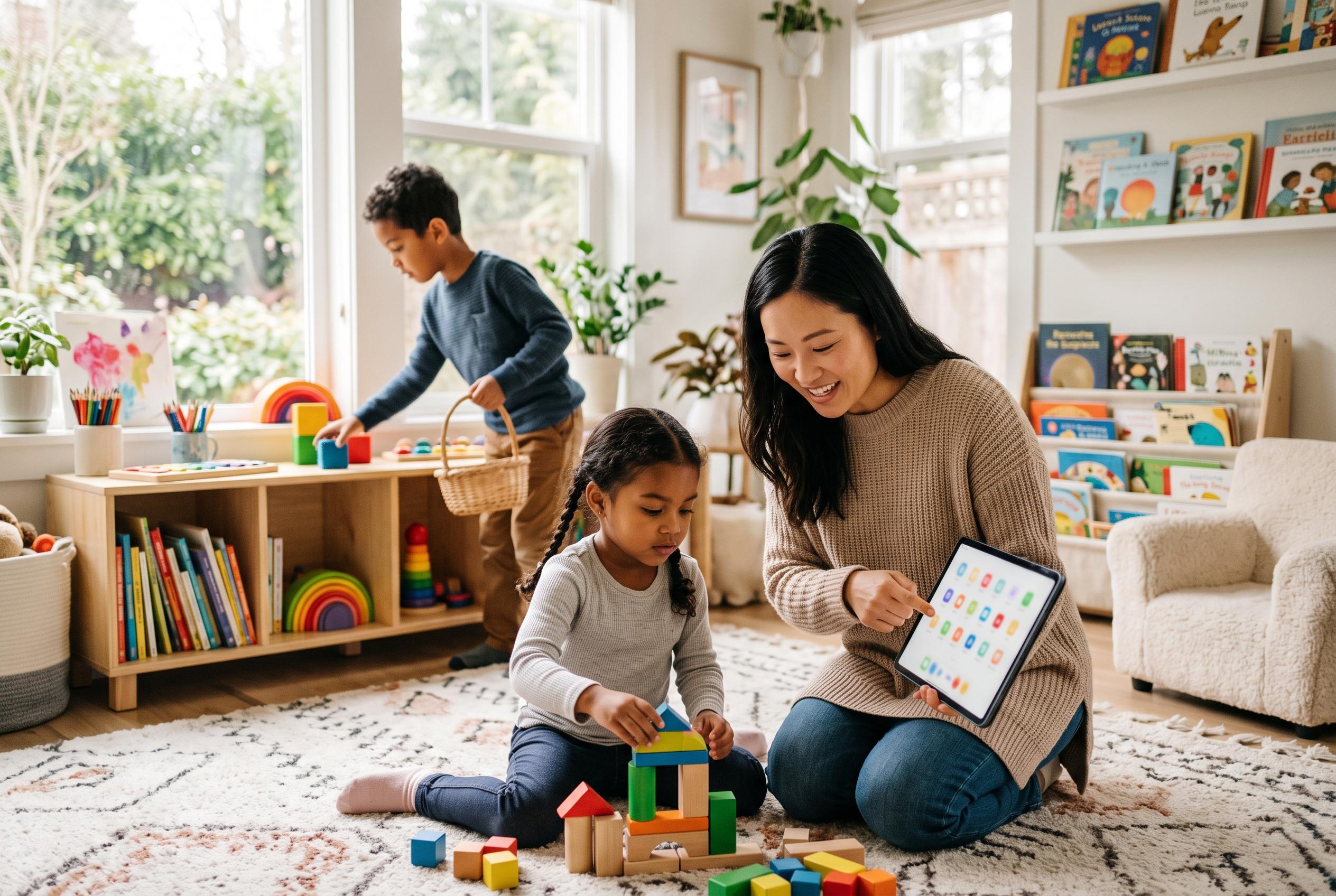

Experts suggest combining educational apps with physical play, such as scavenger hunts and modelling, to boost children’s understanding of maths, reading and spatial reasoning beyond the digital realm.
Educational apps can give children a useful starting point in maths, reading and spatial reasoning, but many of those lessons stay abstract unless they are reinforced away from the screen. The Editorialge piece argues that pairing app-based learning with hands-on play helps children turn digital ideas into something they can see, touch and remember. That matters because young learners often grasp a concept more fully when movement, texture and real objects are involved.
One of the simplest ways to make that connection is through a scavenger hunt for letters and shapes. A child who has just traced an “S” or identified a circle on a tablet can search the house for matching objects, such as a clock, a plate or a book title. Related ideas from The Child Unplugged and LearningMole show that this kind of activity can also be adapted for numbers and shape names, making it a flexible option for parents who want to extend early literacy and geometry lessons without adding pressure.
Play-Doh and clay are another useful bridge between screen and real life. The Editorialge article suggests that modelling letters, animals or simple structures can strengthen fine motor control while improving three-dimensional thinking. Learning Corner and LearningMole go further, showing how clay can support letter recognition, sound work and simple word-building, while also helping children practise the physical actions involved in forming shapes and letters.
Matching games, role-play and sorting activities can do similar work. Instead of tapping pairs on a screen, children can flip index cards and organise them by memory. After an interactive story app, they can act out characters with costumes or toys, which helps with comprehension and empathy. For children using logic or coding apps, a sensory bin filled with beans or rice can bring sorting rules into the physical world, encouraging them to classify objects by colour, size or pattern.
The article also highlights practical activities that bring maths and science into everyday routines. In the kitchen, children can mix baking soda and vinegar, measure ingredients or count spoonfuls while learning about cause and effect, fractions and volume. Outdoors, chalk number lines and hopscotch-style counting games link movement with sequence, while paper grids and toy figures can turn simple coding lessons into a directional game. Offline.kids adds that outdoor puzzles and map-based challenges can build observation, strategy and quick thinking too.
Taken together, the advice reflects a wider point from the related material: screen time can introduce a concept, but physical play helps lock it in. The strongest learning often happens when a digital lesson is followed quickly by a short, concrete task that uses the same idea in a different form. For parents and caregivers, that means the best educational app may be the one that leads a child back into the room, the garden or the kitchen.
Disclaimer: This content is for informational purposes only and is not intended to be a substitute for professional medical judgment, advice, diagnosis, or treatment.