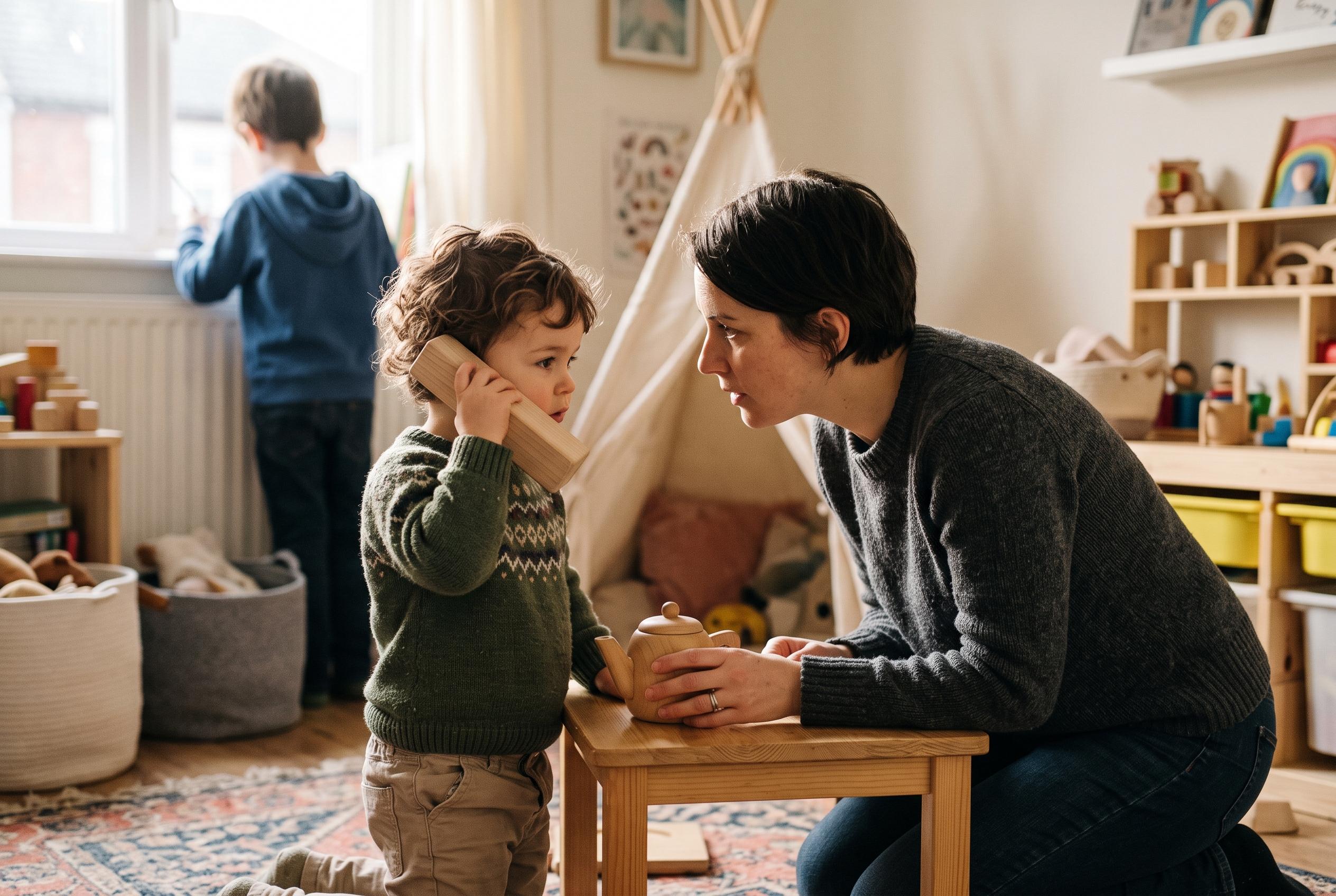

Research indicates that one-to-one parent-child play fosters richer symbolic pretend play in toddlers, with the presence of an older sibling potentially acting as a distraction, according to a recent study in Frontiers in Psychology.
Researchers studying toddler pretend play say the presence of an older sibling can change how much symbolic play a child produces, with mother-only sessions appearing to support richer play than three-way family interactions. In a small study published in Frontiers in Psychology, the team compared home-based video sessions in which toddlers played either alone with their mothers or with their mothers and an older sibling.
The study followed 20 families with children aged 19 to 31 months, all of whom were typically developing and monolingual Hebrew speakers apart from one bilingual child. Each family completed two 10-minute free-play sessions over videoconference, using familiar toys at home. The researchers coded how long symbolic play lasted, how often it occurred, how varied it was, whether the toddler initiated it, and how complex it became. Symbolic play included acts such as using one object to stand for another or treating a toy as though it had properties it did not really have.
Across every measure, toddlers did better in the mother-child setting than in the mother-child-sibling setting. Overall symbolic play was markedly higher in dyadic play, and the same pattern held for duration, frequency, variety, initiative and complexity. The authors say the findings suggest that one-to-one play with a parent may create the best conditions for early pretend play to develop, while the addition of a sibling may introduce distractions, competing demands or less direct adult support.
The difference was not limited to pretend acts themselves. The children also spent more total time playing in the mother-only sessions than in the three-person sessions. Two toddlers showed no symbolic play at all in the sibling condition, but the main pattern remained when the researchers re-ran the analysis using conservative assumptions. They also reported that the results held after adjusting for multiple comparisons, although the smallest effect was for complexity, which was also the least reliably coded measure.
The authors caution that the sample was small and limited to mothers, so the results should not be taken as the final word on family play. They note that sibling interactions may still offer other benefits, including exposure to richer conversation and more varied social situations. Even so, they argue that parents should make room for occasional one-to-one symbolic play, especially if the goal is to support the kind of pretend play linked to language and social-cognitive development.
Disclaimer: This content is for informational purposes only and is not intended to be a substitute for professional medical judgment, advice, diagnosis, or treatment.