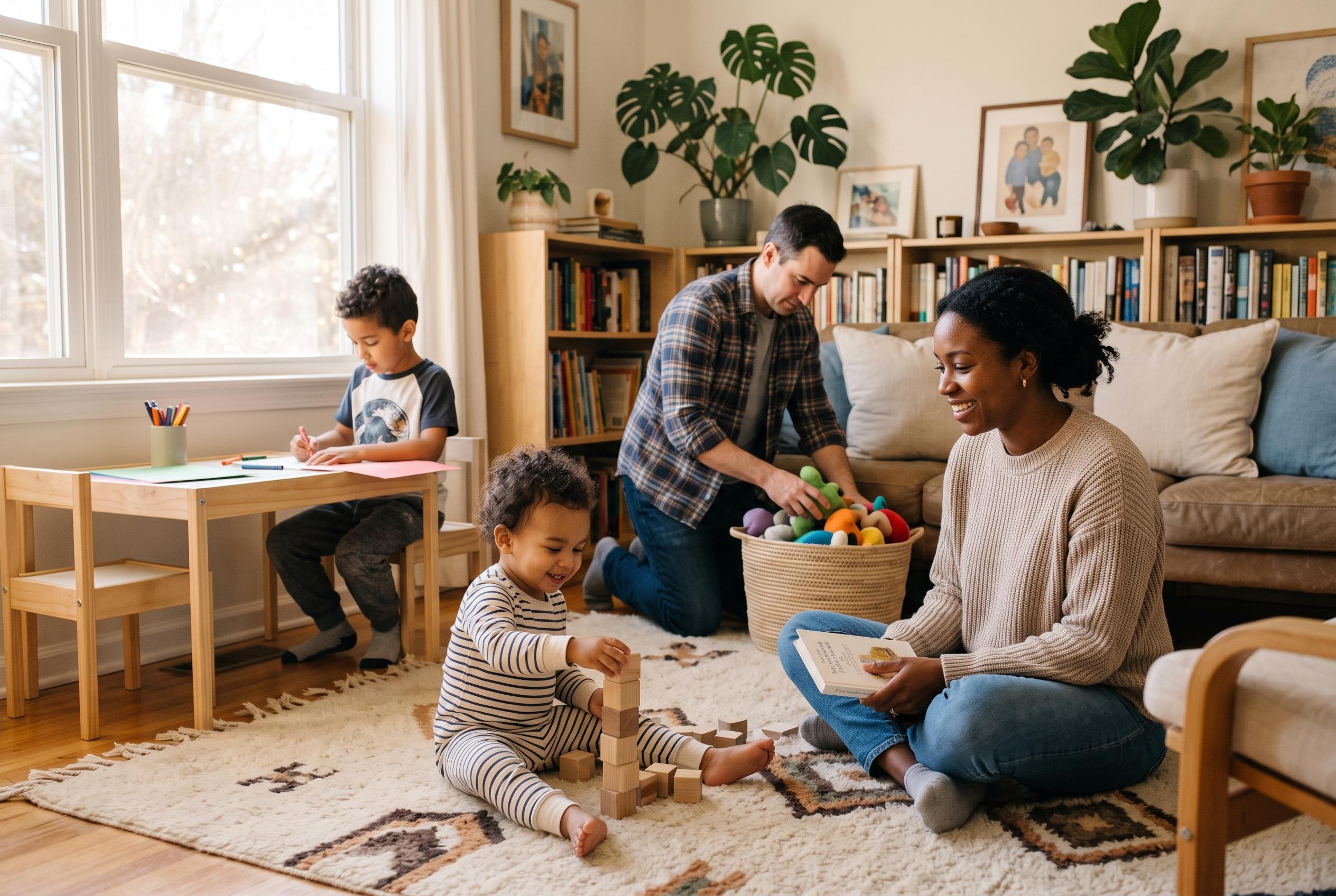

Families designing preschool days at home are prioritising adaptable routines that blend structure with flexibility, supporting children’s curiosity and security amidst the realities of family life.
Families trying to build a workable preschool day at home are often looking for the same thing: a routine that keeps children engaged without making the day feel rigid. The sample schedules shared by The Educators’ Spin On It show that there is no single right answer. Some children move through a fairly structured sequence of meals, play and learning blocks, while others follow a looser rhythm shaped by siblings, school runs and parental work demands.
What the examples do share is a clear sense of balance. The site’s guidance suggests making room for meals and snacks, active play, time outdoors and learning activities that keep young children curious. That approach is echoed by Teaching Littles, which recommends a structured routine built around circle time, stories, art and sensory play. In practice, that can mean short activity blocks rather than long lessons, especially for preschoolers whose attention spans are still developing.
The schedules also show how much family life shapes the day. In one example, a child’s morning is built around time with siblings, followed by a special education pre-K placement and hands-on learning later in the afternoon. Another family starts early, fitting in reading, building toys, colouring, outdoor play, quiet time and school pick-ups around older children’s schedules. One parent is more direct: “I wing it”, a reminder that for many households, flexibility matters more than a perfect timetable.
Other sample routines point to the value of predictability. Veritas Academy’s preschool schedule, like examples from Pre-K Pages and Palm Grove Montessori Academy, includes familiar touchpoints such as arrival, circle time, snacks, learning centres, rest and outdoor play. Spark Academy in Morton, Illinois, goes further by highlighting a predictable routine built around rotating enrichment blocks across several developmental areas. Learning Care also describes preschool days as a mix of structured and independent learning, with opportunities for physical, literacy and creative activity.
Taken together, the schedules suggest that a successful at-home preschool day does not need to mirror a classroom. It needs enough structure to give children a sense of security, and enough flexibility to make room for the realities of family life. For parents and carers, the most practical routine is usually the one that can be repeated, adapted and lived with.
Disclaimer: This content is for informational purposes only and is not intended to be a substitute for professional medical judgment, advice, diagnosis, or treatment.