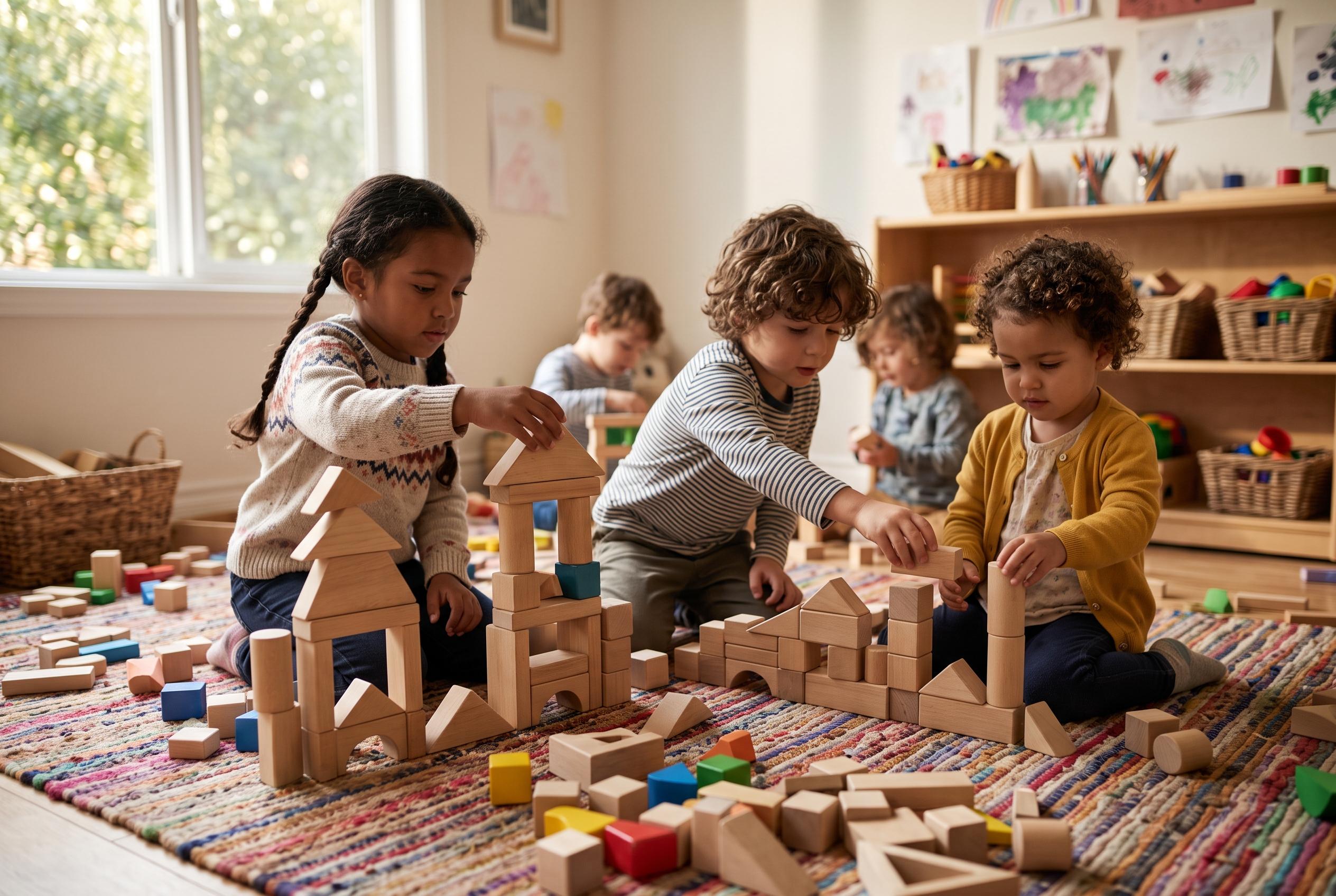

Research shows that simple activities like block-building can enhance young children’s spatial thinking, with implications for early maths development. Experts emphasise the importance of open-ended play and adult support to foster these essential skills.
For young children, a set of wooden blocks can be more than a toy. Turning a piece over, rebuilding a tower or widening a base helps them practise how shapes fit together, how balance works and how objects occupy space. Research from the University of Delaware and Temple University suggests that those skills matter: three-year-olds who copied block structures more accurately also tended to do better on early maths tests.
The finding is useful, but it should not be overread. It does not mean children need long sessions with the same toys, or that regularly changing playthings somehow damages spatial development. The study showed an association between block-building and maths performance, not a proof that one causes the other.
What makes block play so valuable is the kind of thinking it asks for. A child has to notice what sits above or below, whether edges line up and which way a block needs to face. That is a form of spatial reasoning, the mental skill involved in understanding location, direction, shape and movement.
Evidence from Florida International University points in the same direction. Researchers there used eye-tracking to study how children aged three to seven solved mental rotation tasks, in which an object has to be imagined from another angle. Most children appeared to use a holistic strategy, mentally rotating the whole object rather than examining it piece by piece, and those children solved the problems more quickly. The study adds to the idea that young children are already practising spatial thinking long before formal schooling begins.
Other research suggests that less can sometimes be more when it comes to toys. In a 2018 study published in Infant Behaviour and Development, toddlers given four toys played with each one for longer and explored them in more varied ways than when they were offered sixteen. That does not mean every child needs a bare shelf, but it does support the idea that a smaller number of choices can encourage deeper play.
Adults can help by joining in without taking over. The FIU researchers recommend using words such as under, around, bigger, farther and corner so children can connect what they see with language for spatial relationships. A parent might ask which block belongs underneath an arch or what could make a tower steadier, while still leaving the building decisions to the child.
That balance matters, because direct instruction is not always the key factor. A 2019 study in Frontiers in Psychology found that, among mother-child block-building pairs across four U.S. ethnic groups, the time mothers spent building structures that matched the examples was linked with children’s performance at age four. But verbal instruction and adult initiation were not independent predictors, and by age five that link was no longer significant. The more sensible reading is that shared engagement can help, without constant correction.
Blocks are not the only route into spatial learning. Research published in Frontiers in Education in 2025 found that an origami-based programme improved spatial vocabulary and reduced maths anxiety in schoolchildren, while longer in-person lessons also boosted spatial visualisation and geometry. Folding paper is different from preschool play, but it relies on the same broad habits: following spatial language, anticipating how a fold will land and changing one shape into another.
For parents and caregivers, the practical message is straightforward. Keep a manageable number of open-ended toys within reach, including blocks, puzzles, tangrams and paper for folding. If a child is absorbed in rebuilding an arch or studying why a tower keeps falling, there is usually no need to rush the moment along. Sometimes the best support is simply enough time to try again.
Disclaimer: This content is for informational purposes only and is not intended to be a substitute for professional medical judgment, advice, diagnosis, or treatment.