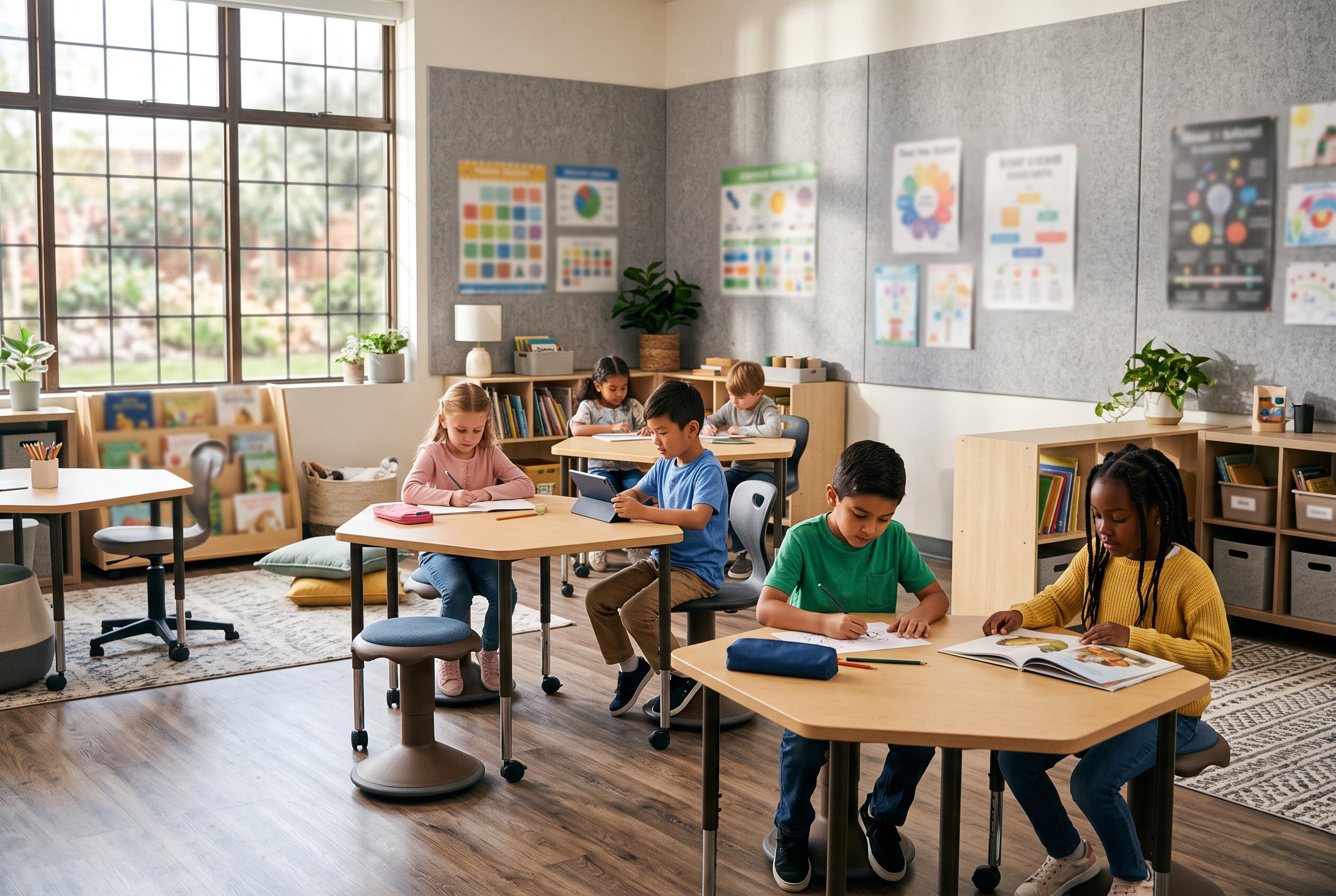

Effective classroom organisation and design, from seating plans to visual displays, play a crucial role in minimising disruptions and promoting positive behaviour, complemented by strong relationships and clear expectations.
Classroom disruption is not only a matter of discipline; it is often a matter of design. The most effective management, according to guidance from the U.S. Department of Education’s What Works Clearinghouse, starts before a pupil misbehaves: with the layout of the room, the clarity of routines and the ease with which children can move, find materials and stay focused. The aim is not to create a tightly controlled space, but one that makes good behaviour easier and unnecessary disruption harder.
That begins with sightlines and seating. Teachers need to be able to see every pupil from the places where they normally teach, while pupils should be able to see the board or main teaching area without twisting, leaning or repeatedly turning round. Seating plans should be matched to the task, not treated as permanent. Rows may suit direct instruction and independent work, while pairs or small groups may support discussion and collaboration. The important question is what arrangement best helps the particular class, not which layout looks neatest.
Movement matters just as much. The Institute of Education Sciences has highlighted the value of setting up the room for success, including reducing distractions and making transitions smoother. Clear pathways to the door, bins, pencil sharpeners, book areas and turn-in trays can prevent bottlenecks that quickly turn into low-level conflict. High-traffic resources should be spread out rather than clustered together, so that legitimate movement does not create a gathering point for chatter and distraction.
Good organisation also depends on predictability. Pupils should know where to collect paper, where to place finished work, what to do when they enter and what happens when they finish early. The CDC says clear, consistent expectations help promote positive, pro-social behaviour, while teacher-delivered reminders and modelling can reinforce those expectations over time. When routines are visible and taught well, teachers spend less time repeating basic instructions and more time teaching.
Visual clutter is another factor. Research cited in education guidance has found that heavily decorated classrooms can distract younger children and reduce learning gains, which suggests that more wall space filled does not automatically mean a better environment. Displays should serve a purpose: supporting current learning, reinforcing key ideas or helping pupils reference information independently. The area around the board or screen deserves particular care, because competing visual noise can make it harder for children to focus on what matters most.
Technology adds a modern layer to the same challenge. Laptops, tablets and phones can make it easier for pupils to appear engaged while doing something else entirely. Clear rules for logging in, charging, screen position, headphones and device storage help remove ambiguity. As the CDC and other classroom-management guidance note, prevention works best when expectations are explicit and reinforced consistently, rather than improvised lesson by lesson.
There are also times when environmental changes are not enough. The Crisis Prevention Institute stresses the importance of strong relationships, patience and understanding each child’s needs, while research in the Journal of School Psychology suggests that targeted reinforcement can sharply reduce disruptive conduct in pupils with serious emotional difficulties. That is a reminder that classroom setup is only one part of the picture. Some children need individual support, some schools need better behaviour systems, and some situations require specialist help rather than another seating plan.
Even so, a teacher can often prevent many problems by walking through the room as a pupil would. Can a child enter without confusion, collect what they need without crossing through another group, know what to do when they finish and ask for help without derailing the lesson? Those small questions reveal whether the room is organised around learning or around correction. The best classrooms do not eliminate all disruption, but they do make the right behaviour the easiest behaviour.
Disclaimer: This content is for informational purposes only and is not intended to be a substitute for professional medical judgment, advice, diagnosis, or treatment.