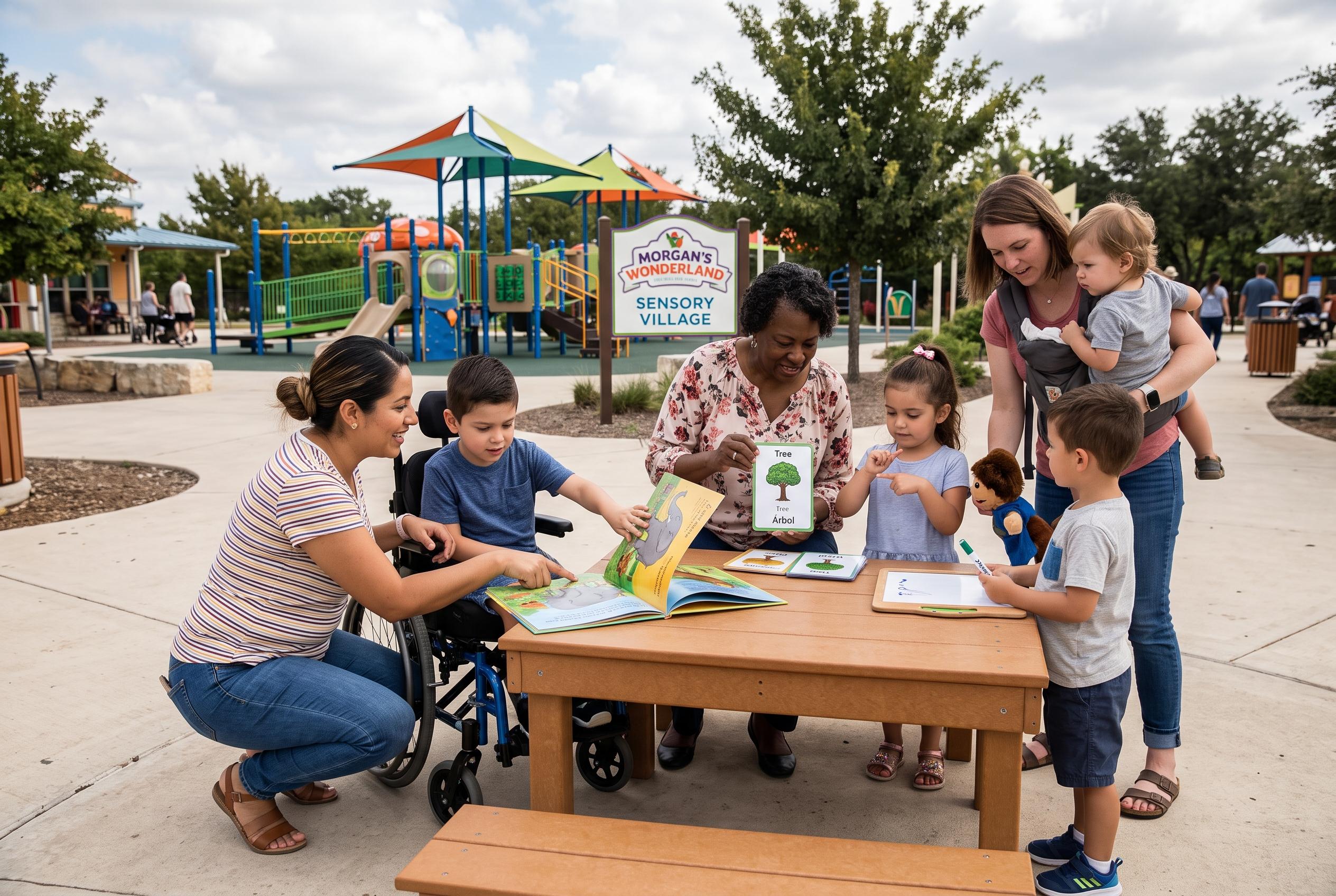

A school trip to Morgan’s Wonderland becomes a dynamic literacy lesson, blending amusement with language development for children and their caregivers, supported by innovative programmes that promote cross-linguistic skills and family engagement.
At Morgan’s Wonderland, a school trip became something more than a day out. For the young children and caregivers arriving through the Tortuga Bay Pavilion, the visit offered fresh sights, new words and another chance to practise the back-and-forth exchanges that help children build early language skills.
The outing was organised through Northside Independent School District’s Even Start family literacy programme, which combines early childhood education, adult learning and family activities. According to the programme’s description, the idea is to strengthen both parent and child literacy at the same time, with home visits, classes and shared activities that help adults turn everyday moments into teaching opportunities.
That approach was on display at the amusement park, where teachers coached caregivers on how to ask open questions, introduce new vocabulary and prompt children to explain what they were noticing. Instead of treating literacy as a lesson confined to a classroom, the programme used the park itself as a setting for conversation, observation and curiosity.
Brenda Faz-Villarreal, who coordinates Even Start, told Texas Public Radio that the field trips let parents move from demonstration to practice. She said the programme shows caregivers how to speak with their children, then gives them a place to try those skills in real time. Adriana Sanchez, a family and community liaison with the programme, pointed to one mother who had not previously read or written but eventually felt confident enough to place a pizza order in English. Sanchez said that kind of progress matters because it can carry over into tasks such as calling emergency services, enrolling a child in school or sharing health information.
Researcher Yu Chen of NYU Grossman School of Medicine said novel experiences are especially useful because they draw children in and give adults more chances to introduce ideas that do not come up at home. Chen also described these exchanges as “serve and return” interactions, the repeated exchanges between adults and children that support language and cognitive growth. In her view, outings can also encourage more abstract discussion, the kind that helps children move beyond naming objects to explaining, predicting and comparing.
Chen said children’s knowledge can transfer across languages, too. When a child grows up hearing Spanish at home, the vocabulary and reading skills built there can support later English learning, a process researchers call cross-linguistic transfer. She said better reading comprehension in Spanish often tracks with stronger reading comprehension in English, which gives bilingual families a practical advantage rather than a barrier.
The limits are real, though. Chen noted that families do not all start with the same resources, and access to books, transport, time and enrichment opportunities can shape how often these conversations happen. She also said literacy programmes work best when they respect family culture and communication styles, rather than assuming every household looks the same.
For parents such as Hillary Tobar, who moved from Coahuila, Mexico, and has five children, the programme has provided both encouragement and confidence. Tobar said she still does not know every word, but she keeps trying. That persistence, educators say, is part of the lesson: early literacy can begin anywhere adults and children are together, so long as there is something to notice, something to say and enough time to take turns.
Disclaimer: This content is for informational purposes only and is not intended to be a substitute for professional medical judgment, advice, diagnosis, or treatment.