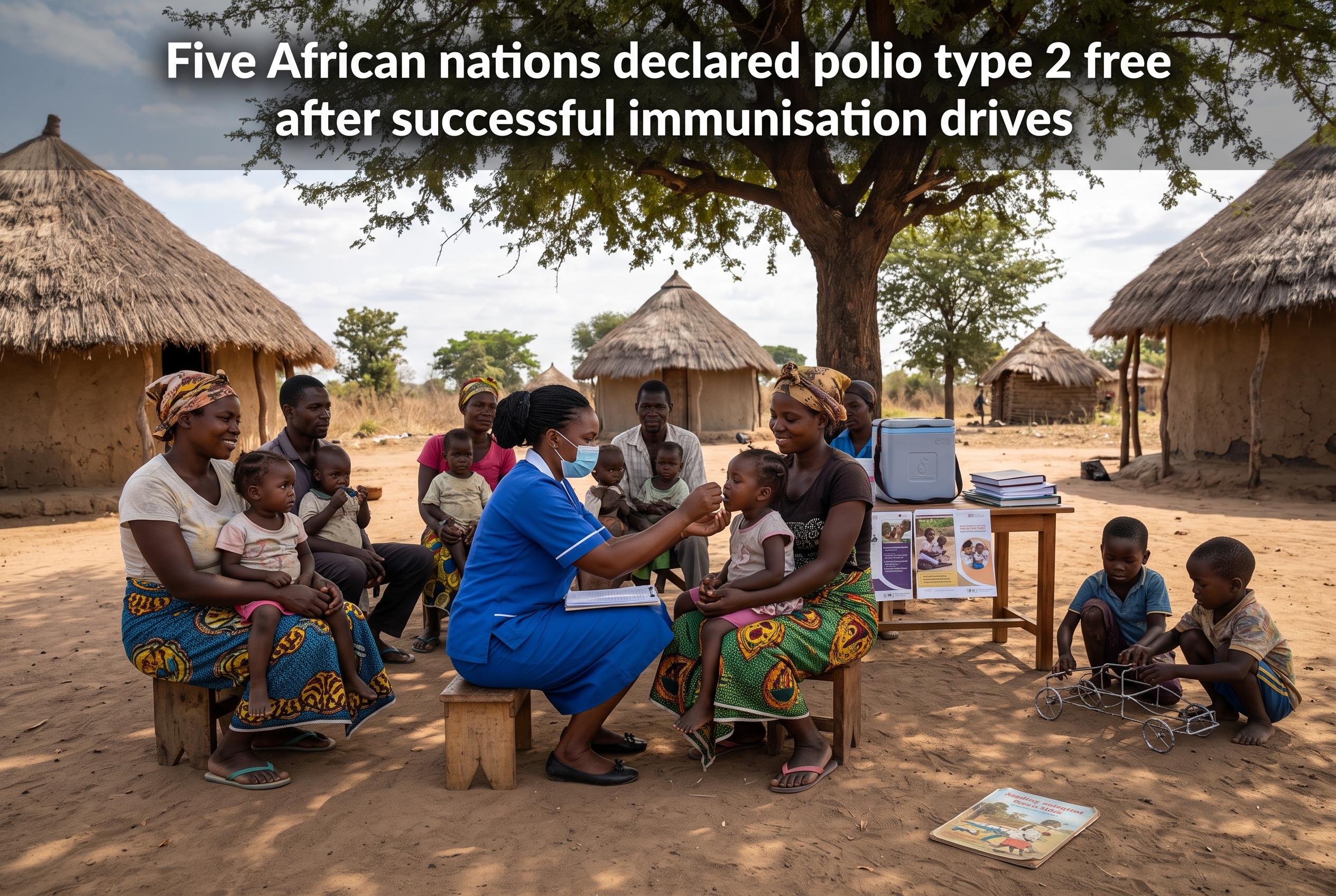

Five African countries have been officially declared free of active poliovirus type 2 outbreaks, marking a significant milestone in the continent’s ongoing fight against polio. The achievement highlights the importance of continued vigilance and high immunisation coverage to maintain this progress.
Five African countries have been declared free of active poliovirus type 2 outbreaks after health authorities and independent assessors found transmission had been interrupted, a development the World Health Organization says marks a significant advance in the continent’s effort to protect children and edge closer to eradication.
The closures cover Burundi, Ghana, Guinea-Bissau, the Republic of Congo and Uganda. According to the WHO regional office for Africa, independent technical reviews carried out between January and June 2026 examined surveillance data, laboratory results, epidemiological evidence, vaccination campaigns and levels of immunity before concluding that the outbreaks had ended.
WHO Regional Director for Africa, Mohamed Janabi, said the result reflected sustained national leadership and close cooperation among governments, communities and international partners. But he warned that the achievement should not be mistaken for a final victory, stressing that vigilance, surveillance and high vaccination coverage still matter if the virus is to stay away.
The countries reached the milestone through different paths. In the Republic of Congo, health officials stepped up surveillance and ran repeated immunisation drives after the virus was detected, with the last case reported in December 2023. Burundi, which declared an outbreak in March 2023, intensified routine immunisation, epidemiological investigations and environmental surveillance with support from the Global Polio Eradication Initiative. Uganda, where poliovirus was detected in May 2024, strengthened coordination between national and local health authorities as part of its response.
Ghana paired outbreak control with stronger laboratory capacity, while Uganda also upgraded its diagnostic system earlier this year, helping both countries identify poliovirus faster and improve their response to other vaccine-preventable diseases. In Guinea-Bissau, vaccination campaigns were directed at underserved communities, and surveillance was tightened after no detections were reported there since July 2021. WHO says the same technical assessments that closed these outbreaks also pointed to common success factors: rapid detection, community participation, strong government backing and repeated, high-quality vaccination campaigns.
Health officials say the danger has not passed. The risk of importation or renewed spread remains, particularly in countries near places where the virus is still circulating. WHO and its partners are urging governments to keep surveillance systems strong and ensure every child is reached, including in border, remote and mobile populations. The recent detection of poliovirus in Madagascar after a previous outbreak had already been closed is being cited as a reminder that interrupted transmission can be reversed if coverage slips.
The broader response to polio has also strengthened health systems across Africa. Countries have expanded acute flaccid paralysis surveillance and environmental testing, improved laboratory networks and used geospatial tools to find missed settlements and track population movement. UNICEF regional directors Etleva Kadilli and Gilles Fagninou said the progress belonged first to governments, communities and frontline workers, while Gavi’s Thabani Maphosa said the gains would help countries respond better to other infectious threats as well. Support for the polio campaign has come from donors including Canada, the European Investment Bank, the Gates Foundation, Germany and the United Arab Emirates.
Disclaimer: This content is for informational purposes only and is not intended to be a substitute for professional medical judgment, advice, diagnosis, or treatment.