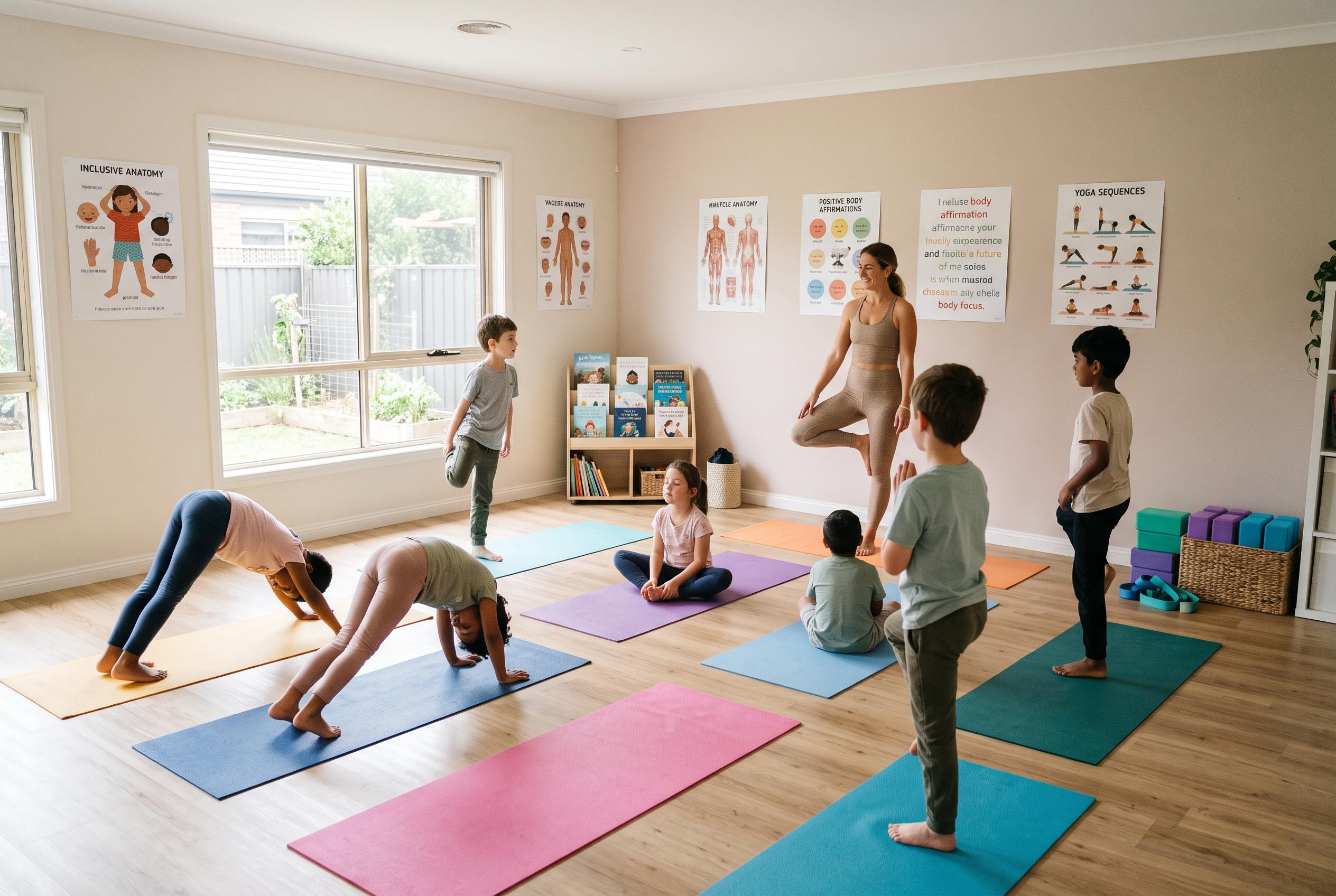

Recent studies reveal that yoga alone has limited impact on children’s body positivity, highlighting the importance of supportive teaching methods that emphasise reflection, choice, and safety to foster a healthier relationship with the body.
Yoga may be a powerful tool for children’s wellbeing, but it does not automatically build a healthy relationship with the body. A 2026 systematic review of 11 studies involving 1,082 children and adolescents found that yoga on its own tended to produce small, uneven changes in body image. The same review suggested stronger results when movement was paired with reflection, psychoeducation and group discussion.
That distinction matters because children do not arrive at a class free of outside pressures. They bring with them advertising, social media, teasing, beauty standards and the wider habit of ranking bodies by size, shape and flexibility. Without careful teaching, a yoga session can end up echoing those pressures rather than easing them.
Researchers have already identified several approaches that appear more effective for young people’s body image. A separate review published in 2022 found that psychoeducation, peer support and cognitive dissonance-based programmes helped improve body image in children and adolescents. A 2025 review in the paediatric population also suggested yoga may support body esteem and body satisfaction, especially among adolescents with disordered eating, although the findings were mixed and the authors called for better, more inclusive research.
For teachers, the practical lesson is that the class culture matters as much as the poses. Praise that focuses on appearance, competition over who can go deepest, and one ideal body type shown again and again can all undermine the intended message. By contrast, language that emphasises sensation, choice, cooperation and rest can help children experience yoga as a space for agency rather than comparison.
That means offering real options, not token ones, and making it clear that stopping, adapting or resting is part of the practice. It also means being honest that body positivity does not require every child to love their body every day. Respect, curiosity and safety are often a more realistic starting point, and one that may be more useful in the long run.
Disclaimer: This content is for informational purposes only and is not intended to be a substitute for professional medical judgment, advice, diagnosis, or treatment.