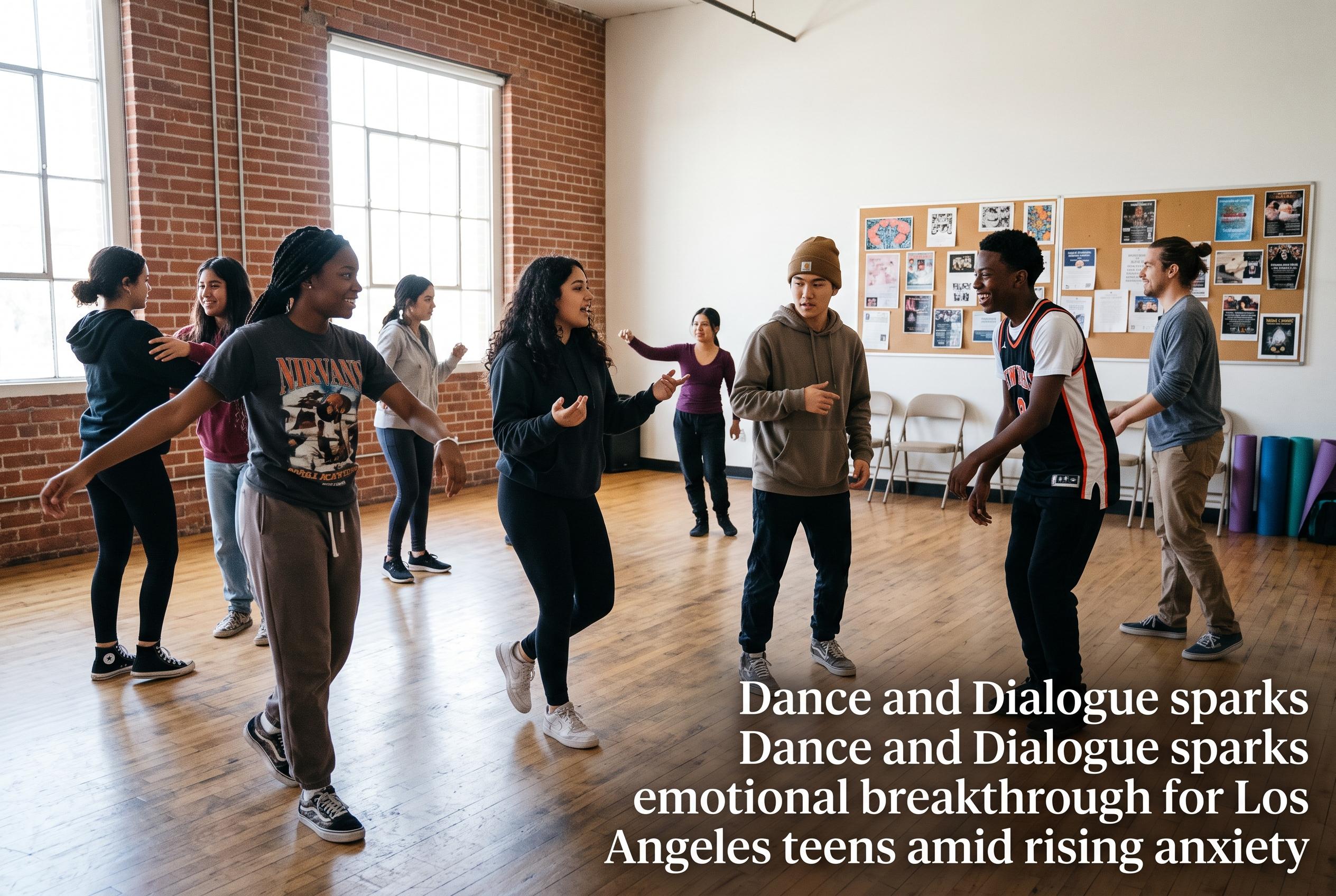

A programme combining dance with guided conversations is helping Los Angeles teenagers build trust and confidence, offering a safe space to discuss difficult topics amid rising mental health challenges post-pandemic.
At the Pasadena Boys and Girls Club, a summer dance class is being used as a route into something bigger than choreography. Students in Dance and Dialogue, an arts programme based in Los Angeles, are learning how movement, storytelling and shared activity can help them build trust, confidence and easier conversations about difficult subjects. For Pasadena High School junior Emilia Marie Cabrales, the breakthrough came only after she had joined in an exercise called “Telegroove” and spoken more openly with classmates about personal experiences.
Dance and Dialogue, which was founded in 2012 and offers free arts-based education across school and community settings, says its work is built around creative expression and social-emotional learning. The organisation runs in-school residencies, after-school enrichment, mentoring and family workshops, and LA Dance Chronicle has described it as serving roughly 10,000 teenagers and young people a year. In practice, that means dance is paired with guided discussion so students can explore feelings, relationships and self-awareness without the formality that can make school support services feel distant.
That approach comes at a time when schools are grappling with rising anxiety among teenagers. EdSource reported that California has committed billions of dollars to mental health staffing, yet many students still prefer informal, social settings when talking about stress. The pressures intensified after the pandemic, when isolation and heavy screen use affected social development and anxiety and depression rose sharply among children in the state. For students who have never felt comfortable walking into a counsellor’s office, a dance studio can feel like a safer first step.
Inside the eight-week residency, instructors build each lesson around a theme such as listening, then layer in increasingly complex movement. The progression might start with simple rhythm exercises and end in hip-hop sequences, giving students time to relax before asking them to share more of themselves. Ricka Kelsch, the programme’s executive director, said the aim is to help young people find language, or movement, for feelings they cannot yet put into words. Emilia said that mixing serious conversation with play made opening up feel less intimidating, while fellow Pasadena High student Destinee Veal said the programme helped her realise she was more talkative than she had thought.
For many participants, the real value is not only artistic improvement but the chance to connect. Students in the programme described team exercises, shared stories and collaborative dance tasks that pushed them beyond the habit of keeping to themselves. Emilia said the experience gave her a chance to make new friends and better understand her own feelings, adding that it mattered for young people to have space to unwind and become less afraid of knowing one another.
Disclaimer: This content is for informational purposes only and is not intended to be a substitute for professional medical judgment, advice, diagnosis, or treatment.