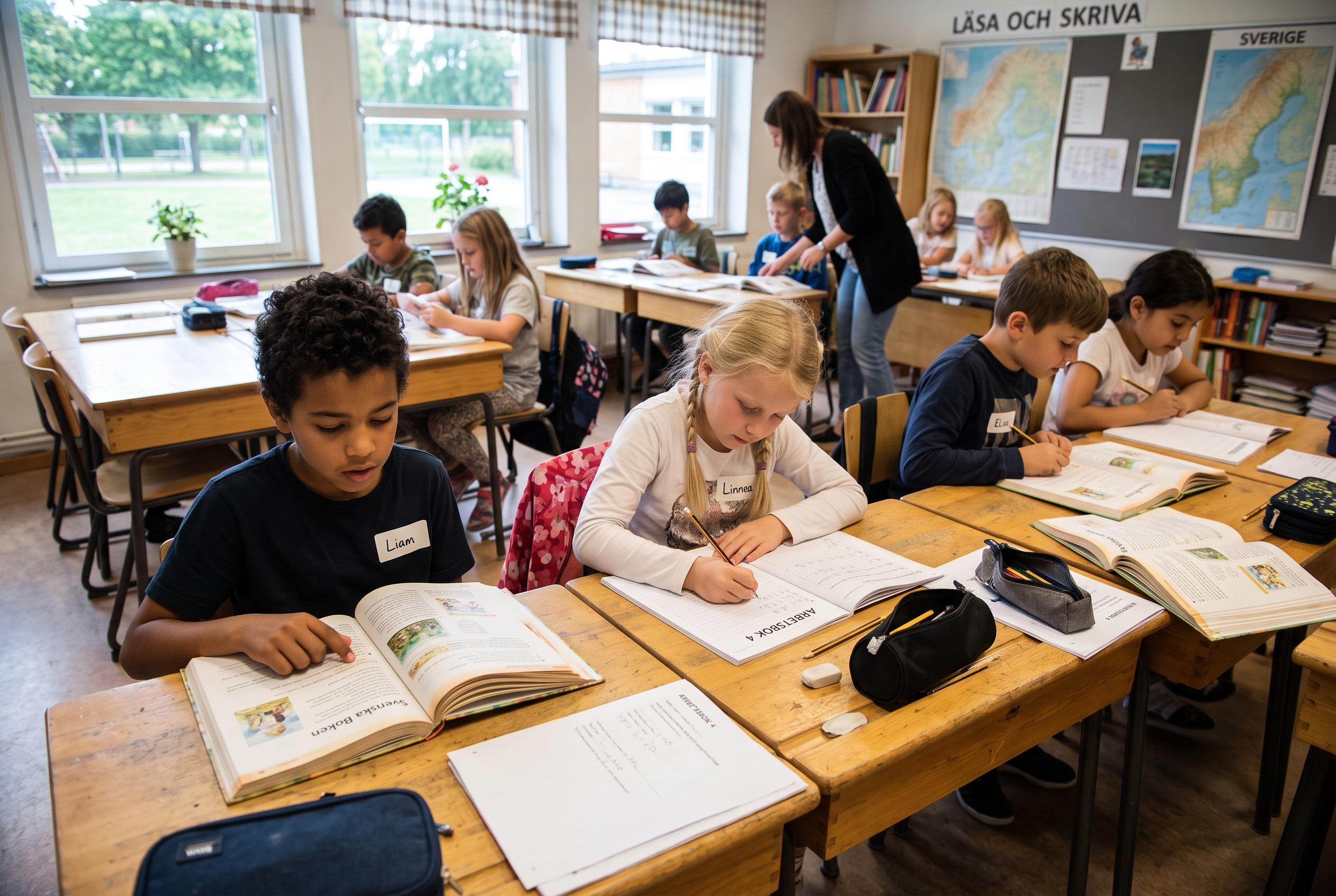

Swedish policymakers are re-emphasising print in schools, responding to growing evidence that traditional books support deeper learning and recall, especially for younger students, amid ongoing debates about digital versus print reading methods.
For years, Swedish school policy has leaned hard into digital tools. Now the pendulum is swinging back. The government is pushing for more paper, more textbooks and a more restrained use of screens, especially for younger pupils, as debate over how children learn best has intensified.
The shift reflects a broad body of research suggesting that pupils often do slightly better when they read printed text than when they read the same material on a screen. A 2018 review in Educational Research Review, which analysed 54 studies, found a small advantage for paper, particularly with factual texts and under time pressure. Other studies, however, have found little or no difference in comprehension, which is why researchers caution against treating the issue as a simple choice between books and devices.
What seems to matter is not just the medium but the task. Reading on a screen tends to encourage skimming, while paper can make it easier to build a mental map of a text and remember where information appeared. Studies also suggest that pupils sometimes believe they have understood digital reading better than they actually have, possibly because they move through text more quickly and mistake speed for mastery.
The latest research also shows that digital reading habits can influence how much effort pupils put in. In one study published in 2015, pupils who read on paper were more likely to take notes and spend longer studying, while comprehension differences were small. A 2024 study found that screen reading led to shallower processing and weaker understanding, reinforcing the idea that the device itself can shape how deeply information is absorbed.
But the case for paper is not universal. Research on narrative texts has sometimes found no meaningful gap between screen and print, and some reviews suggest that the size of the paper advantage has narrowed over time. That means the conclusion depends heavily on the type of text, the design of the digital material and the purpose of the reading.
In classrooms, screens can still offer clear benefits. They can enlarge text, read content aloud, translate material and provide built-in support for pupils with dyslexia or other reading difficulties. Digital tools can also deliver immediate feedback and adapt the level of difficulty, which can be useful in subjects such as mathematics and language learning. A widely cited 2021 meta-analysis of children’s learning found that paper generally produced better comprehension, but it also underlined how closely results depend on how digital material is used.
The distinction between school use and leisure use is important. Much of the concern about screens and children focuses on social media, games and other off-task use, not teacher-led learning. Even so, connected devices bring distractions that paper books do not. Swedish data from Pisa 2022 found that moderate use of digital tools for learning was associated with better maths results than either very low use or very heavy use, but the relationship was weak and did not prove cause and effect.
For younger children, the evidence points more clearly towards traditional reading aloud. Research suggests that regular shared reading, where adults pause to explain words and discuss the story, supports vocabulary growth and language development. Digital stories can help when used interactively with an adult, and they may be especially helpful in multilingual groups, but they work best as a supplement to conversation, play and read-aloud time rather than a replacement for them.
The overall picture is not that screens are bad and books are good. Rather, the research suggests that printed text is often the better choice when the aim is deep, sustained reading and recall, while digital tools are strongest when the goal is accessibility, adaptation and interactive practice. For schools, the real question is not whether to choose screen or book in every case, but which tool best serves the lesson at hand.
Disclaimer: This content is for informational purposes only and is not intended to be a substitute for professional medical judgment, advice, diagnosis, or treatment.