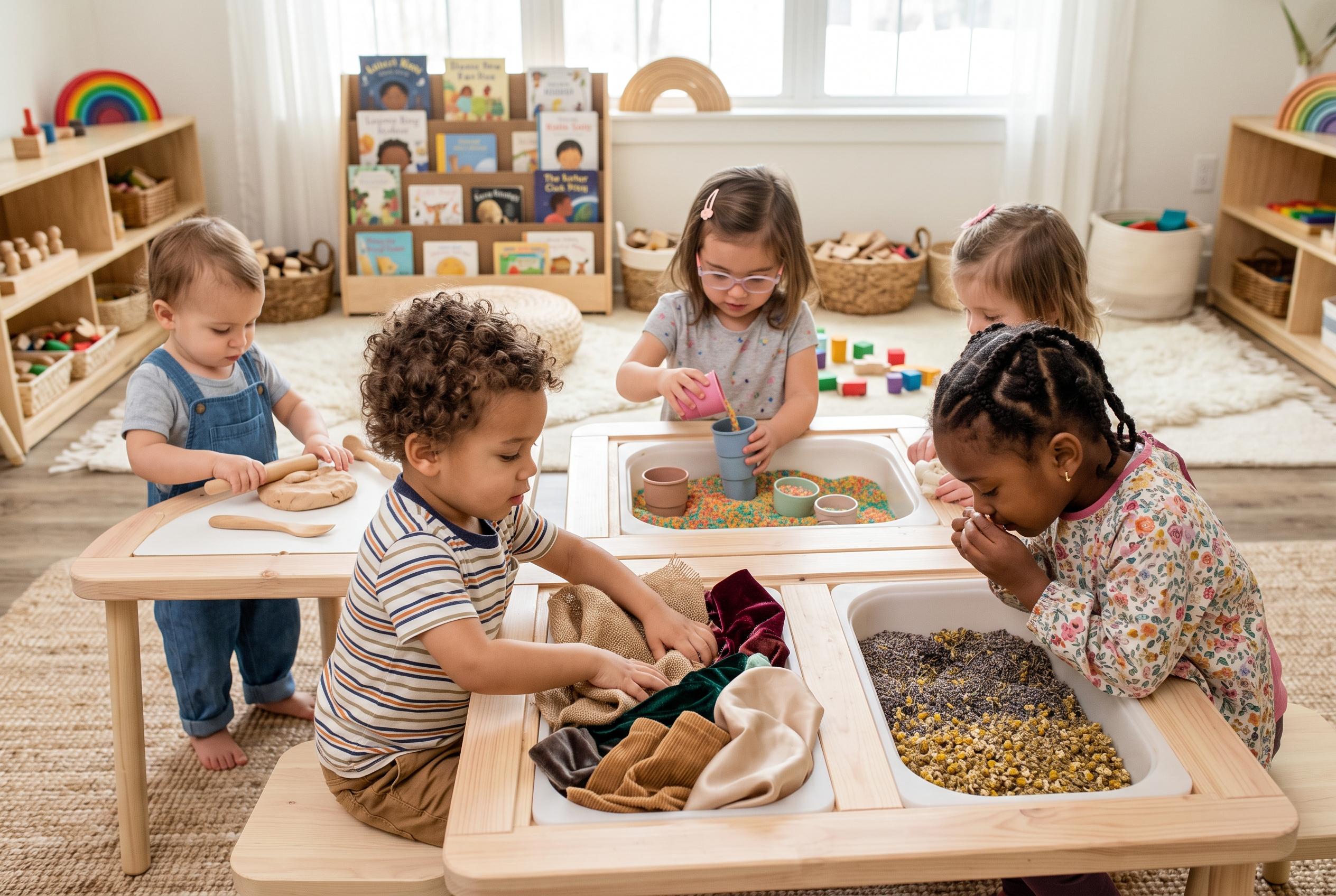

Engaging children in tactile, auditory, and olfactory activities fosters vital cognitive, language, and social skills, highlighting the importance of simple, participatory play for early childhood learning.
Children do not begin by memorising facts; they begin by handling the world. A toddler lifting a peach, listening to a rattling cart or wrinkling their nose at a lemon is building an early understanding through touch, sound, smell, sight and taste. In practical terms, that means the best learning at home is often the least polished: dough to squeeze, water to pour, buttons to sort and objects to compare by feel and weight. According to Cleveland Clinic, that kind of sensory play can support language, movement and thinking skills, while also helping children build body awareness and balance.
What matters most is not whether an activity looks educational, but whether it asks a child to participate. Hands-on play encourages children to experiment with texture, volume, cause and effect and problem-solving, which is why simple kitchen tasks and messy table-top activities can be so valuable. Temple Emanuel Early Childhood Centre described one example this year in which children made an “edible dirt” mixture, turning a simple craft into a full sensory exercise that engaged several senses at once.
Parents can also learn a great deal by noticing how children respond to sound. Singing, repeating animal noises and listening to stories aloud all help connect hearing with language and memory. Cleveland Clinic says auditory play can support speech development, while the Children’s Museum of Sonoma County notes that sensory activities help children strengthen communication and social-emotional skills as well as physical coordination.
Taste and smell are just as important, and often more revealing than adults realise. A child asking why toast smells different from bread, or why herbs change in the pan, is already making early scientific connections. Cooking together offers a low-cost way to encourage that curiosity, because it naturally combines smelling, tasting, watching and touching. Montessori Art says tactile learning also helps children understand change, space and cause and effect, particularly when they are allowed to explore materials directly.
There is also value in quiet, focused moments. Sensory learning is not only about stimulation; children need time to process what they have taken in. A calm corner with shells, stones or pinecones can help them slow down and notice detail. A rich sensory experience is strongest when several senses work together, and when adults leave space for reflection afterwards. The Artis Foundation says active, hands-on engagement is especially effective for children who learn best by doing rather than listening passively, while Harbour Child Care says sensory play can deepen memory and problem-solving.
The most useful test for any toy, outing or game is simple: does it invite a child to touch, notice and think? If it does, it is probably doing real educational work. Children do not need elaborate equipment to learn this way. They need time, a little encouragement and adults willing to slow down and pay attention with them.
Disclaimer: This content is for informational purposes only and is not intended to be a substitute for professional medical judgment, advice, diagnosis, or treatment.