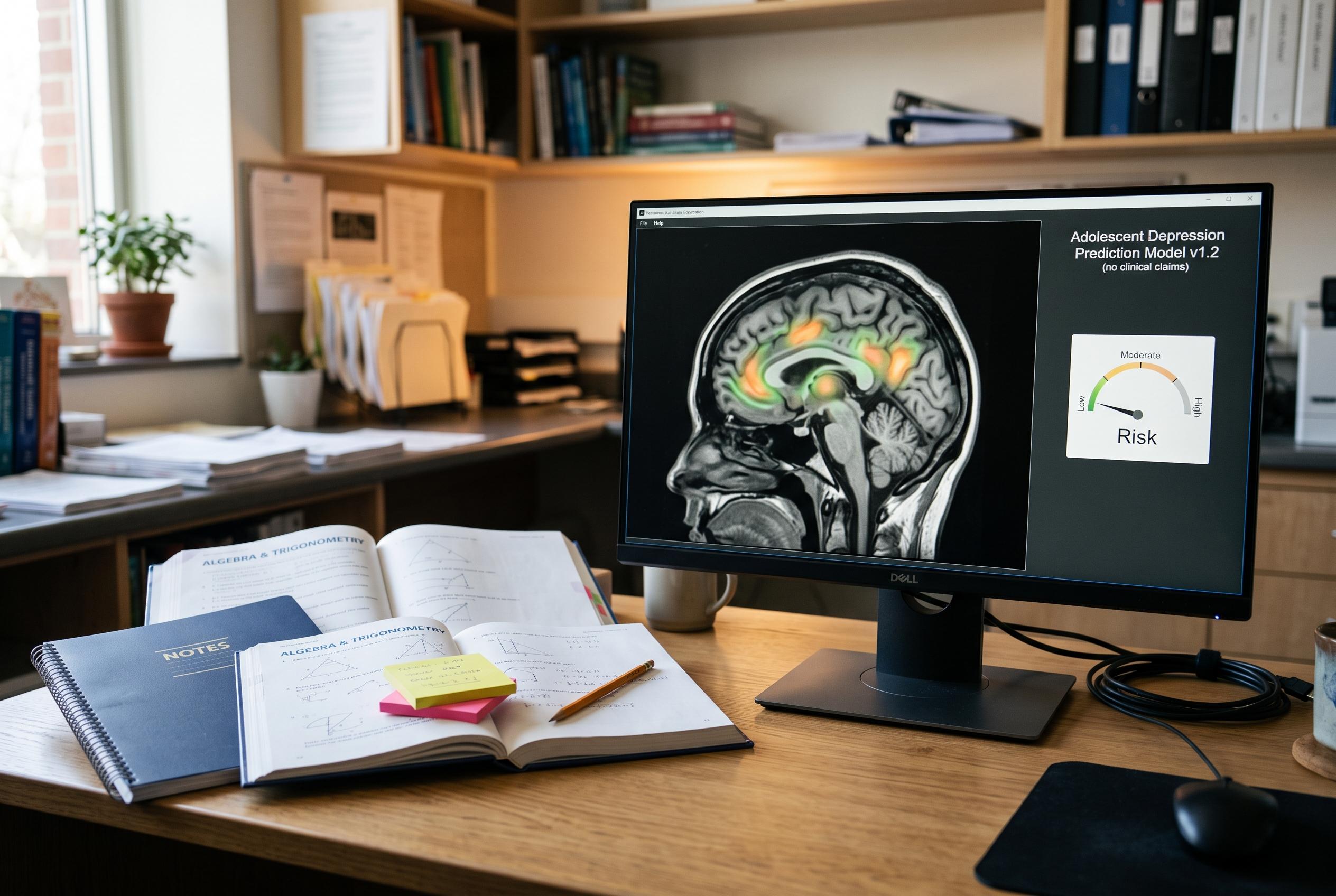

Emerging research suggests that machine learning applied to MRI data could enable early identification of teenagers at higher risk of depression, but challenges remain before clinical adoption.
Researchers are exploring whether artificial intelligence could one day flag a higher risk of depression years before symptoms become obvious, using brain scans that track how teenagers respond to emotional cues. The work is still experimental, but it reflects growing interest in whether machine learning can spot subtle biological patterns that conventional analysis may miss.
The approach centres on MRI scans taken while participants viewed happy, neutral and angry faces. By comparing how the brain processed those expressions, researchers trained models to distinguish patterns linked with later depressive symptoms. The key idea is not that a computer can diagnose depression on its own, but that it may be able to identify people who could benefit from closer monitoring or earlier support.
That broader direction is already visible in the scientific literature. A recent study published through the UK Biobank used machine learning and deep learning to analyse structural MRI data from 987 people with major depressive disorder and 3,934 controls, finding significant associations with depression status. Another study in European Psychiatry used diffusion-tensor imaging to build a model aimed at predicting major depressive disorder, underscoring the effort to find measurable brain-based markers of risk.
Other research has pointed in the same direction for related forms of depression. A PubMed-indexed study on anxious depression used multimodal neuroimaging and machine learning to separate anxious from non-anxious major depressive disorder, reporting an area under the curve of 0.802, a measure of how well a model distinguishes between groups. Researchers say such results are encouraging, but they also show how much work remains before any model could be used reliably in routine care.
The limits are significant. MRI scans are costly, the signals vary from person to person, and a model trained on one population may not perform well in another. Privacy is another concern, because brain data are highly sensitive. Most importantly, a higher risk score is not a diagnosis and should not be treated as proof that someone will develop depression.
Still, the field is moving quickly. A 2024 analysis of children in the Adolescent Brain Cognitive Development study suggested that multimodal neuroimaging could help predict later depression risk, especially in young people with a parental history of depression. A 2025 review of more than 11,000 children in the same cohort found that behavioural and social factors often carried more predictive weight than MRI alone, which is pushing researchers towards models that combine brain scans with wider health and life data.
For now, the promise is real but unfinished. Artificial intelligence may eventually become one tool for identifying vulnerability earlier, but researchers still need larger studies, independent validation and longer follow-up before such systems can be trusted in clinics.
Disclaimer: This content is for informational purposes only and is not intended to be a substitute for professional medical judgment, advice, diagnosis, or treatment.