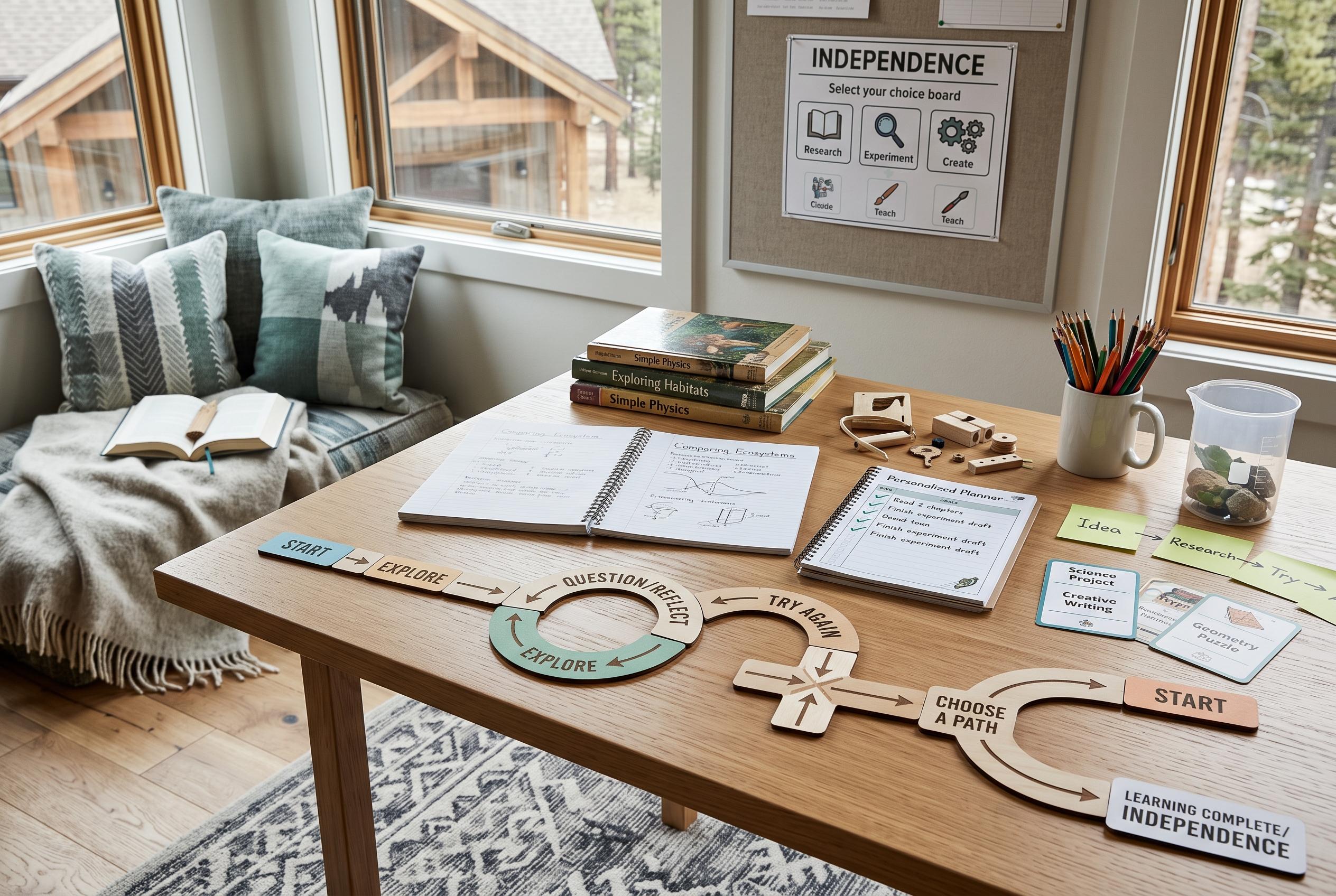

At Alpine Valley School, the path to student independence is recognised as a complex process that includes periods of restlessness and responsibility, challenging traditional linear notions of learning progression.
Parents at Alpine Valley School are often told that a child’s sudden complaint that school is “boring” is not a setback but a familiar turning point. In self-directed education, enthusiasm can give way to restlessness before deeper engagement begins, and staff say that shift is usually part of the process rather than evidence it is failing. That view fits wider thinking on self-directed learning, which places growing autonomy, goal-setting and reflection at the centre of the educational journey, according to the University of Waterloo’s Centre for Teaching Excellence and other education frameworks.
The school describes a path that often begins with a burst of excitement. Children arriving at a self-directed setting may relish the freedom, explore the campus, test boundaries and learn how the community works. Then comes the harder stretch: the novelty fades, they start asking what there is to do, and they may seem disengaged. Research-based models of self-directed learning often describe a similar move from dependence towards interest and involvement, suggesting that discomfort can accompany the shift from being guided to taking ownership of learning.
From there, Alpine Valley School says many students reach a stage of accountability. A rule broken, or a peer’s misstep witnessed through the school’s discipline process, can prompt a child to recognise that they are responsible for how they use their time and how they act inside a shared community. That emphasis on self-assessment and ownership mirrors the four-step learning process outlined by the University of Waterloo, which includes evaluating one’s own progress. It also aligns with models that describe learners moving from curiosity to initiative, then to persistence.
Later, some students begin to see themselves not just as participants but as custodians of the community. They may run for elected roles, help chair meetings, or take on work that keeps the school running. The school says this stage often brings a stronger sense of belonging and a more deliberate approach to decision-making. Other frameworks describe a comparable rise from active involvement to independent, self-directed learning, where students set goals and manage their own progress with less prompting.
The school also stresses that the journey is not linear. Children may move backwards as well as forwards, and those arriving after difficult experiences in conventional schooling may need time simply to recover their confidence before any of the stages fully appear. Staff say the process often takes around two years to settle, a timeline that echoes broader research showing that self-direction develops gradually and is strengthened when educators support learners’ movement towards independence. For parents, the message is to be patient, stay observant and treat even the awkward phases as meaningful work.
Disclaimer: This content is for informational purposes only and is not intended to be a substitute for professional medical judgment, advice, diagnosis, or treatment.