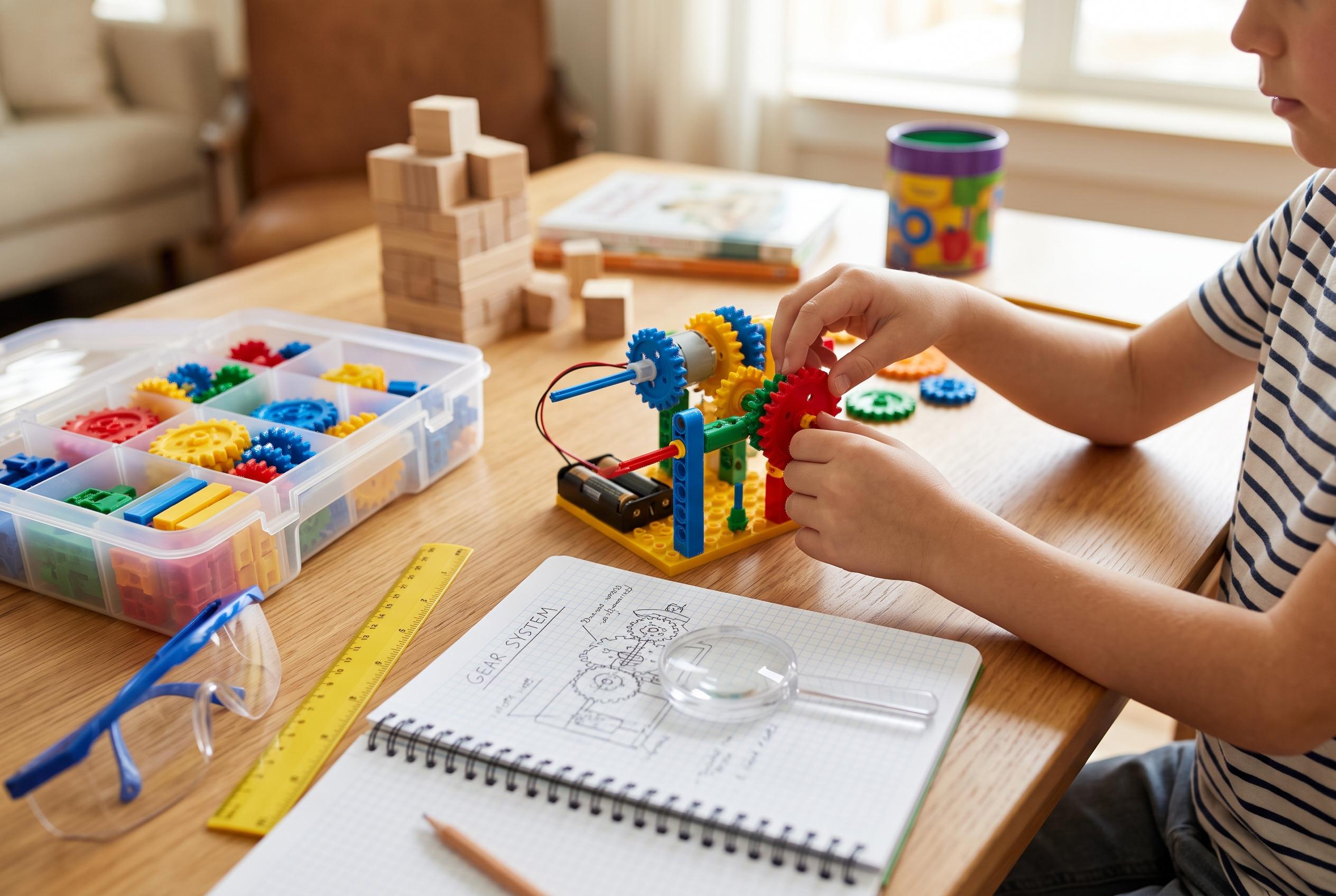

Experiential activities in STEM foster critical thinking, resilience, and creativity, equipping children with essential skills for tackling real-world challenges.
Hands-on STEM learning gives children something textbooks alone cannot: a chance to see ideas work, fail and improve in real time. According to educational guides from Educba, Duck Learning and the Smithsonian Science Education Centre, activities that involve building, testing and redesigning help children connect abstract concepts to everyday experience and build curiosity early on.
That matters because STEM is not just a collection of school subjects. Science, technology, engineering and mathematics overlap in the way children observe, predict, measure and solve problems. A child stacking blocks, comparing shapes or adjusting a toy ramp is already practising the kind of thinking that later supports coding, design and scientific inquiry.
The power of this approach lies in feedback. When a tower falls, a bridge sags or a simple mechanism will not move, children can see what changed and try again. The Franklin Institute has argued that this sort of learning-by-doing strengthens problem-solving and critical thinking, while the Smithsonian Science Education Centre says hands-on work helps make science more engaging and easier to understand.
Failure is part of the lesson. In well-designed STEM play, a mistake is not a dead end but information. Children learn to ask what happened, what can be adjusted and what to test next. That process builds persistence and helps them become more comfortable with uncertainty, a skill that matters far beyond science class.
Open-ended projects are especially useful because they allow for more than one right answer. A child asked to build the strongest bridge, for example, may choose a different design, material or layout from another child and still succeed. That flexibility supports creativity as well as reasoning, and it mirrors the way real-world problems often require trade-offs rather than perfect solutions.
Age-appropriate tools also make a difference. Younger children often benefit from large blocks, sorting games and simple cause-and-effect toys, while older children may be ready for circuits, robotics or coding challenges. Reviews of hands-on STEM learning from Duck Learning, SCIL India and STEM Spark Lab all point to the same conclusion: the best activities invite children to act, compare, test and explain, rather than simply watch.
For parents and caregivers, the most effective support is usually light-touch. Ask what a child thinks will happen, what changed after a test or how they might improve a design. Everyday tasks such as cooking, gardening and planning a route can also become small STEM lessons. Over time, these experiences help children build confidence, patience and a habit of solving problems with curiosity rather than frustration.
Disclaimer: This content is for informational purposes only and is not intended to be a substitute for professional medical judgment, advice, diagnosis, or treatment.