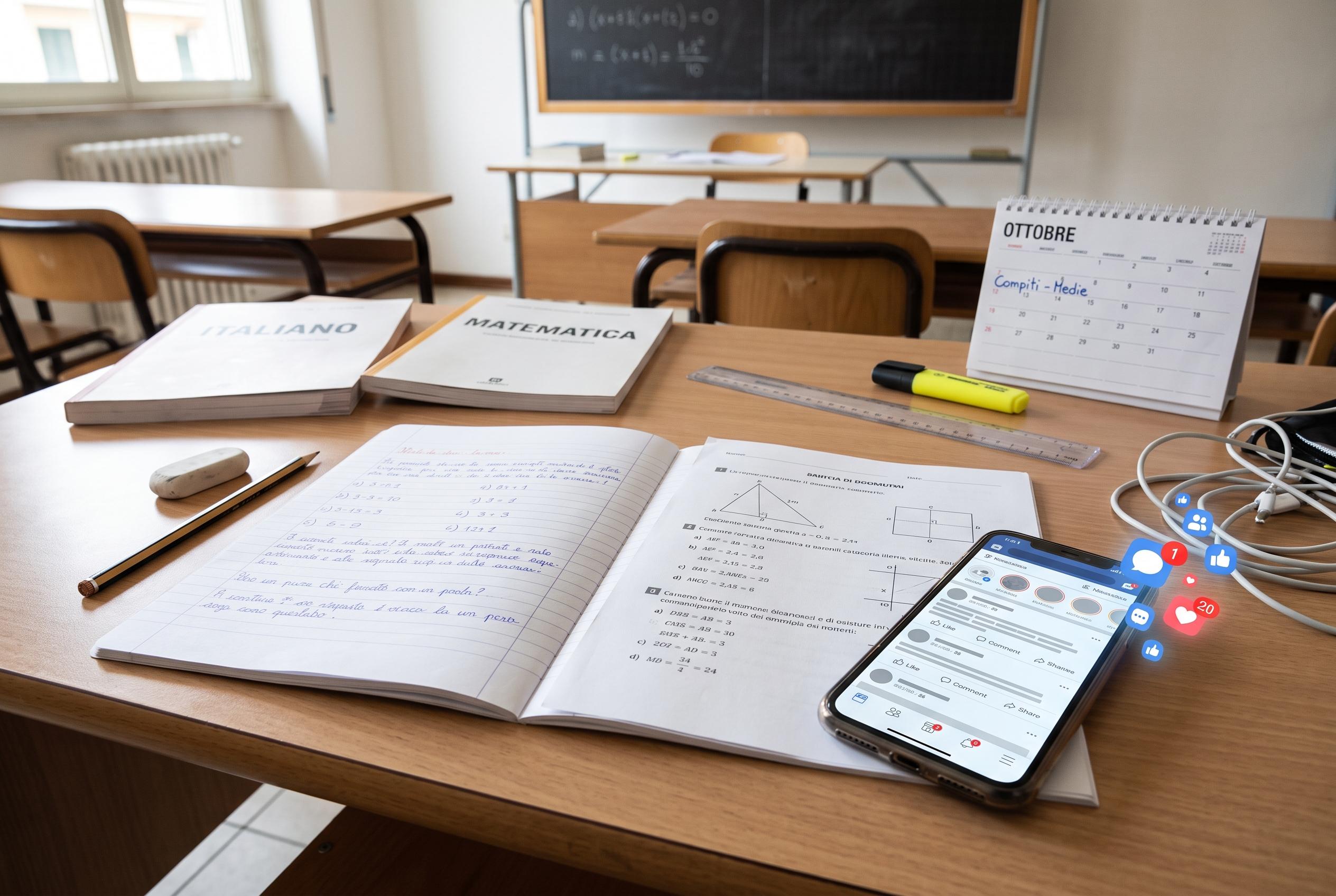

Research from Italy reveals that children who open their first social media account in early secondary school tend to perform worse in school than those who wait until later adolescence, highlighting potential academic risks associated with early digital engagement.
A new study suggests that children who create their first personal social media account in early secondary school go on to perform worse in maths and their native language than classmates who wait until later adolescence. The gap appears by the time pupils reach the equivalent of Year 9 and is roughly equal to six months of schooling, according to researchers from the University of Milano-Bicocca and the University of Brescia, whose work was published in Nature Human Behaviour.
The EYES UP study examined 5,227 pupils from 28 schools in northern Italy, drawing on survey responses about digital habits and official standardised test results in Italian, mathematics and English. According to the University of Milano-Bicocca, the project also found that students who opened a profile in their first year of secondary school were more likely to repeat a year and less likely to achieve top marks by the end of lower secondary education.
Researchers used a difference-in-differences approach, a statistical method designed to compare how similar groups change over time and isolate the effect of one variable. In this case, the key difference was the age at which pupils created a personal account on social media. The study found that those who started earlier scored about 0.2 standard deviations lower in maths and Italian, while no clear penalty emerged in English. The authors suggested that exposure to English-language content online may partly offset the downside in that subject.
The findings point to social media itself, rather than technology generally, as the more important issue. Separate analysis of early computer use found no comparable decline in academic results, and the association with smartphones alone was weaker. The researchers said frequent checking of phones and platforms, especially during homework time or before bed, appears to be one of the main ways attention is disrupted.
Chiara Respi, the study’s corresponding author, said waiting until age 13 or 14 for a first personal account could bring real educational benefits, but she added that any age limit should be paired with digital education for families and schools. The University of Milano-Bicocca said the study also found boys were more affected than girls, although the broader message was that early social media use is linked to weaker school outcomes at a stage when habits are still forming.
Disclaimer: This content is for informational purposes only and is not intended to be a substitute for professional medical judgment, advice, diagnosis, or treatment.