
An exploration of how play and interaction in early years foster essential cognitive, social, and emotional skills, challenging traditional academic-focused approaches and highlighting innovative classroom practices.
In early childhood, learning rarely looks like the tidy sequence adults expect. A child may be building with blocks, acting out a story, asking a sideways question or simply watching another child before joining in. As Vaishali Sharma argues in the lead article, those moments are not distractions from education; they are often its substance. The challenge is that they are harder to measure than letters recited or sums completed. According to the American Academy of Paediatrics and HeadStart.gov, play is central to healthy development, supporting imagination, confidence, language, physical growth and social skills.
This matters because early schooling has often been organised as though young children were miniature older pupils, expected to demonstrate narrow academic outcomes before they are ready. Yet the developmental task of the foundational years is broader. Children are learning how to communicate, regulate emotions, solve problems, cooperate and represent ideas in many forms. The University of Delaware’s New Directions Early Head Start notes that play supports science, mathematics, literacy and social-emotional growth, while the Institute of Education Sciences has said play-based learning also strengthens language and maths outcomes.
Sharma draws on John Dewey to argue that education should grow from experience, not simply transmit information. She also invokes Lev Vygotsky, whose work places social interaction at the centre of cognitive development. That is why a quarrel over a toy, a pretend game or a child’s negotiation with a peer can be pedagogically meaningful. These are moments when children practise turn-taking, perspective, language and self-control. The Center for Early Education and Development says purposeful play supports physical, cognitive and social-emotional development, reinforcing the case for treating such activity as serious learning.
The article also places these ideas within an Indian tradition of child-centred education. Gijubhai Badheka and Tarabai Modak both challenged rigid school-like approaches to the early years, instead emphasising freedom, stories, affection, play and the child’s world. That emphasis echoes in the National Curriculum Framework for the Foundational Stage, which, as Sharma notes, gives play, interaction and exploration a central place. The policy direction is promising, but the harder task is making sure those principles shape daily classroom life rather than remaining confined to official documents.
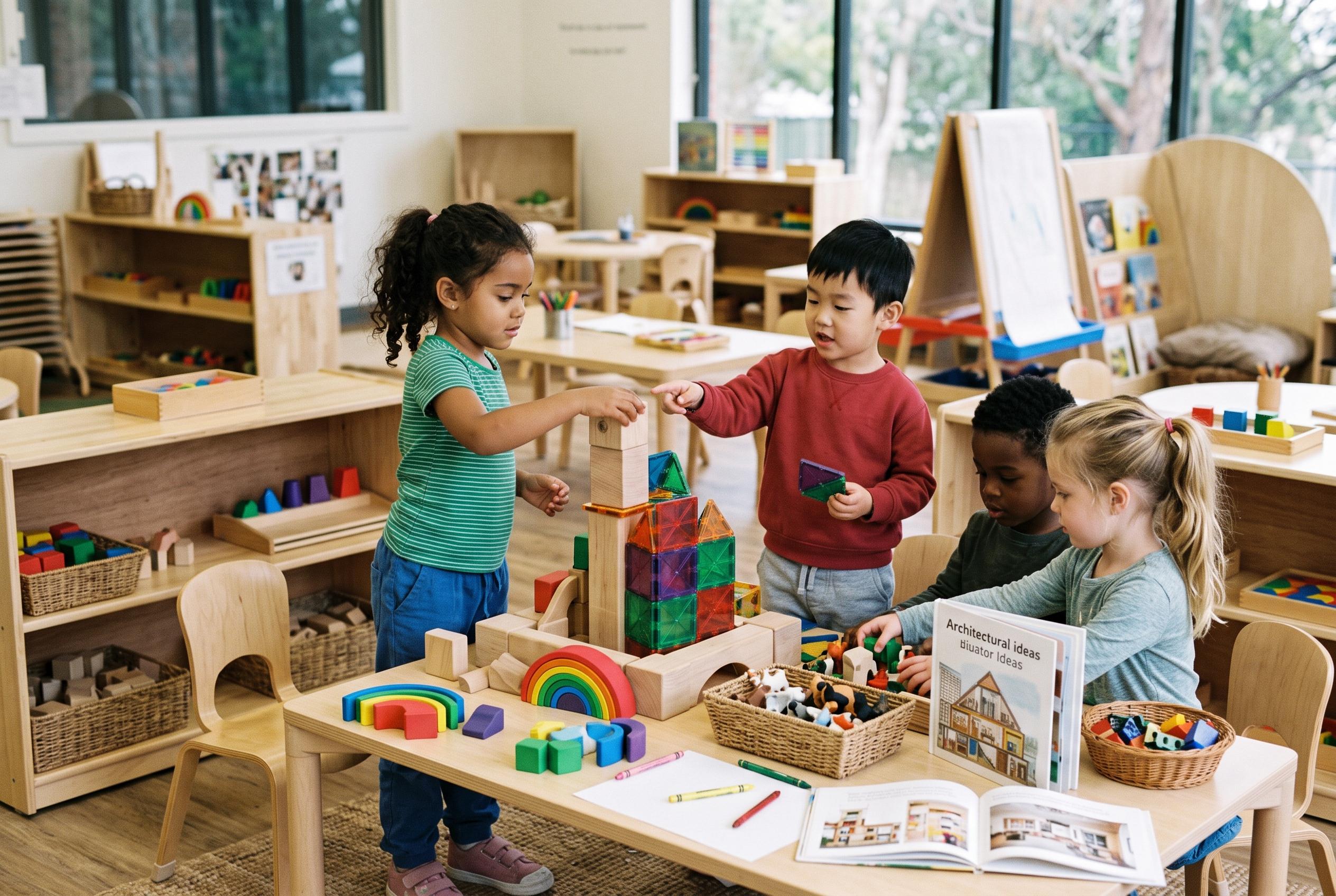
What follows is a different vision of the classroom. It is not built around how much content can be delivered, but around how much thinking, movement, conversation and experimentation it can invite. Materials should be reachable. Children’s work should be visible. There should be room for drawing, building, dramatic play, reading, observation and quiet attention. A block should be free to become a house, a bridge, a vehicle or something unnamed. In that sense, the room itself becomes part of the teaching.
That kind of setting also changes the teacher’s role. Free play does not mean adults step back and do nothing. It means they observe closely, decide when to intervene and know when to let children work out a problem themselves. Sharma is right to argue that this is not a lighter form of teaching but a more demanding one. It requires judgement, patience and the ability to notice what a child is trying to understand, not just whether the child has produced the expected answer.
The same applies to language. A child’s question may seem off-topic, yet contain serious thinking beneath it. The best response is not always to provide the answer at once, but to help the child pursue the question, observe more closely and return with new ideas. In that sense, early education should protect curiosity. It should treat uncertainty not as failure, but as the start of inquiry.
That is also why discipline in the early years cannot be reduced to commands. Children need boundaries, but they also need help naming feelings, asking for turns, joining play and recovering from conflict. A classroom that only says “don’t hit” has done too little. One that helps a child say “I am angry” or “Can I play?” is teaching social life, not merely enforcing order.
The larger argument is simple: early childhood education should not be judged only by visible academic performance. Children can learn letters through language play, maths through construction, science through observing the natural world and social understanding through negotiation. If schools are serious about the foundational years, they must also be serious about the environments, relationships and teaching practices that allow that learning to happen. Sharma’s central point stands: a block is never just a block when a child is using it to think.
Disclaimer: This content is for informational purposes only and is not intended to be a substitute for professional medical judgment, advice, diagnosis, or treatment.