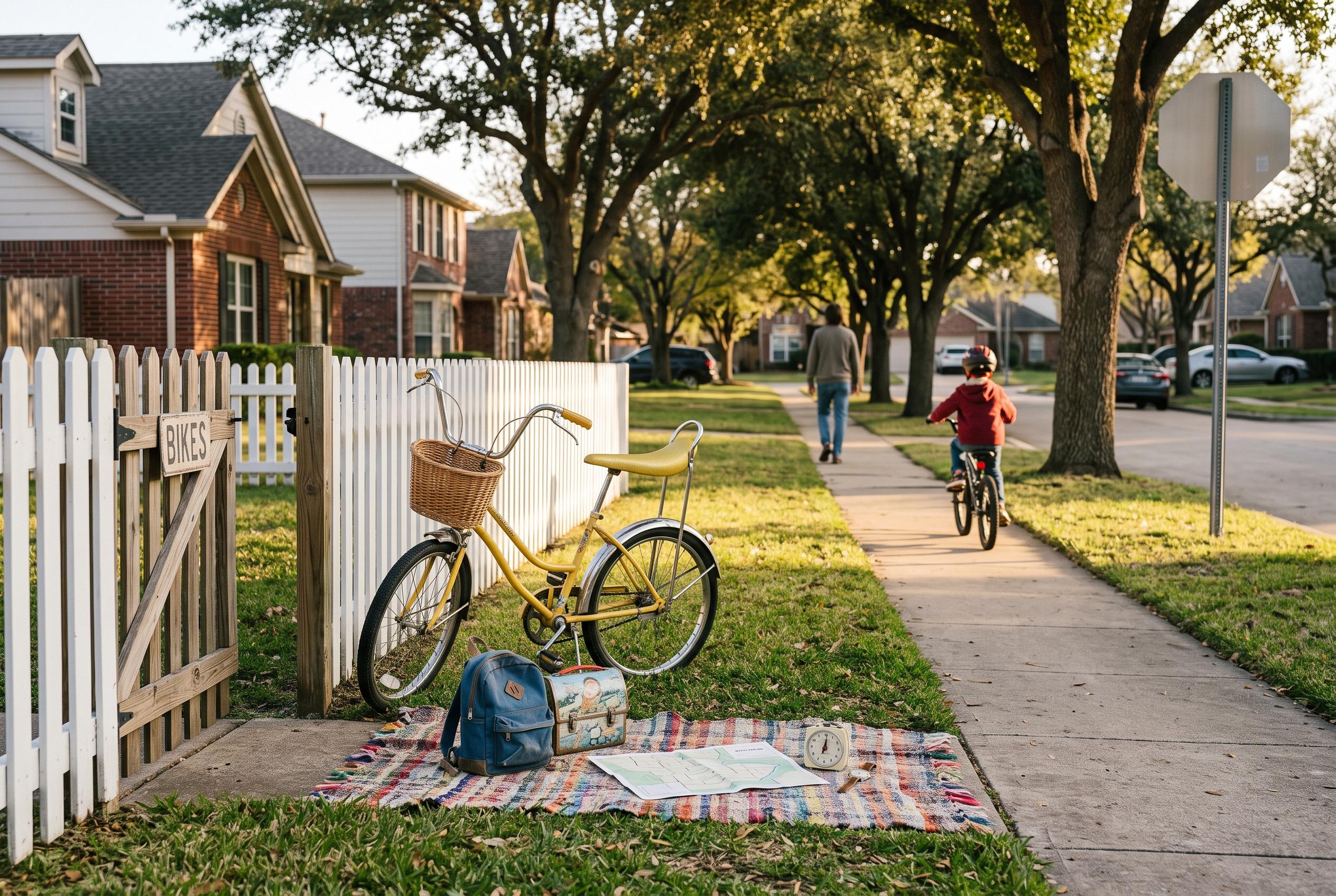

A shift towards greater outdoor freedom for children marks a significant change in American parenting, with recent laws and cultural movements advocating for increased independence to improve mental health and emotional well-being.
What was once a defining feature of American childhood is quietly returning: the expectation that children can spend time outside, on their own, and come back when it is time for dinner. For years, that kind of freedom was pushed aside by tighter supervision, more organised activities and rising anxiety about safety. Now, according to recent reporting and child-development research, a growing number of parents are reconsidering whether constant oversight has gone too far.
In the 1980s, many children were expected to solve small problems without an adult stepping in. They played in the street, stayed out until the lights came on and learned to manage minor conflicts on their own. A counselling guide on parenting past and present describes that era as one shaped by far less intervention, while today’s families are more likely to organise play, monitor movement and build daily routines around school, transport and safeguarding concerns.
The shift away from independence did not happen overnight. As parents became more aware of mental health, child protection and the risks of unsupervised time, childhood became increasingly structured. By contrast, modern parenting has often leaned towards oversight, with many families feeling pressure to fill every hour and anticipate every problem. A recent Psychology Today article argued that rigid parenting scripts can fail because children’s needs are often more complex than a prepared response allows, which has added to the case for a more flexible, less controlling approach.
That debate has helped create space for a revival of unstructured play. In 2026, the American Academy of Pediatrics reaffirmed the importance of free play for executive function skills such as impulse control, emotional regulation, planning and goal-setting. Researchers including Peter Gray have long argued that a decline in free play has tracked with higher levels of anxiety and depression among children, while a Harris Poll this year found that many children aged eight to 12 would rather spend time with friends in activities not organised by adults.
The change is also political. Utah was among the first states to codify a parent’s right to allow reasonable independence, after cases in which families were investigated for ordinary childhood activities such as walking home or playing in a park. Virginia later passed its own Reasonable Childhood Independence bill, and a bipartisan proposal introduced in Congress in May 2026 seeks to encourage states to protect childhood independence rather than penalise it. Supporters say the laws do not force parents to change how they raise their children; they simply reduce the risk of being treated as negligent for permitting normal age-appropriate freedom.
At the same time, the wider culture is moving in a similar direction. Jonathan Haidt’s work on childhood and phones has fed a broader push to cut back on screens and make room for real-world play, while recent coverage has pointed to parents choosing shorter screen time, more outdoor activity and less overscheduling. Psychology Today has also described the rise of so-called “beta moms” – a more balanced style of parenting that tries to combine support with independence and ease the pressure of perfection.
The result is not a full return to 1980s childhood. Most families are approaching independence in stages, starting with a familiar park, a short walk or a bike ride to a friend’s house, then gradually widening the boundaries. Parenting mentor Susan Groner has urged parents to think in terms of a leash that lengthens over time, not a permanent hold. That may be the clearest sign of the comeback: not a nostalgic replay of the past, but a modern attempt to trust children a little more and hover a little less.
Disclaimer: This content is for informational purposes only and is not intended to be a substitute for professional medical judgment, advice, diagnosis, or treatment.