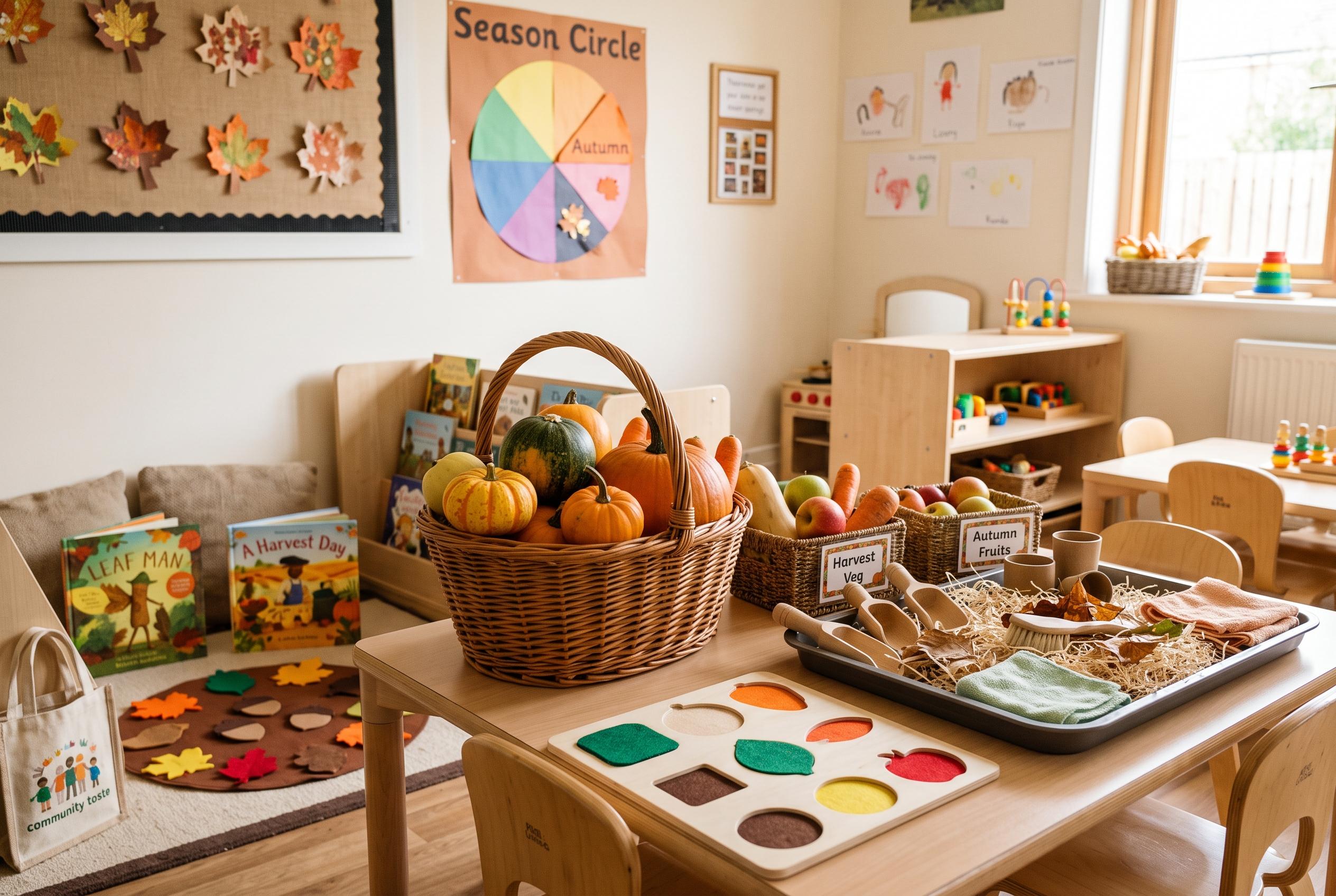

Harvest Festival activities in nurseries and pre-schools are shifting towards inclusive, hands-on experiences that connect children with food, seasons, and community, while supporting key areas of early childhood development.
Harvest Festival can give early years settings a simple but powerful way to connect children with food, seasons and community. In nurseries and pre-schools, it works best when it is treated not as a one-off craft theme, but as a chance to build real experiences around autumn produce, shared stories and practical learning.
The strongest harvest activities are often the most hands-on. Children can explore pumpkins, apples, leaves and seeds through tasting, sorting, printing, peeling and pouring, all of which support sensory development and fine motor control. Resources from Twinkl also point to the value of songs, rhymes, story stones, word mats and sequencing activities, which can be used to support literacy, maths and understanding the world in ways that suit both adult-led sessions and continuous provision.
There is also a clear link to the Early Years Foundation Stage. Harvest lends itself naturally to communication and language, physical development, mathematics, expressive arts and design, and understanding the world. A child counting seeds, making patterns with conkers or comparing the weight of vegetables is not simply joining in a seasonal activity; they are also building early learning habits through play. Parenta says these moments can be especially useful for observation and planning because they reveal concentration, language and curiosity in a natural setting.
Inclusivity matters just as much as creativity. Some families will not celebrate Harvest Festival for cultural or religious reasons, so many settings now frame the topic as an exploration of autumn and seasonal food rather than a religious event. The same approach helps children with allergies, sensory needs or special educational needs, who may benefit from alternatives such as sensory trays, non-food materials or carefully adapted tasting activities. Twinkl’s early years resources reflect that wider approach by offering a range of options, from counting and word-based tasks to games and sequencing work.
For settings that want to involve families, simple ideas are often the most effective. A single item brought in from home, a short tasting table, or a windowsill cress pot can create a shared experience without adding much work for staff. Some nurseries also use harvest as a chance to collect for local food banks, turning a seasonal theme into a practical lesson in kindness and community. Parenta argues that these kinds of activities are most valuable when they are rooted in real life, because that is what helps the learning last beyond the season itself.
Disclaimer: This content is for informational purposes only and is not intended to be a substitute for professional medical judgment, advice, diagnosis, or treatment.