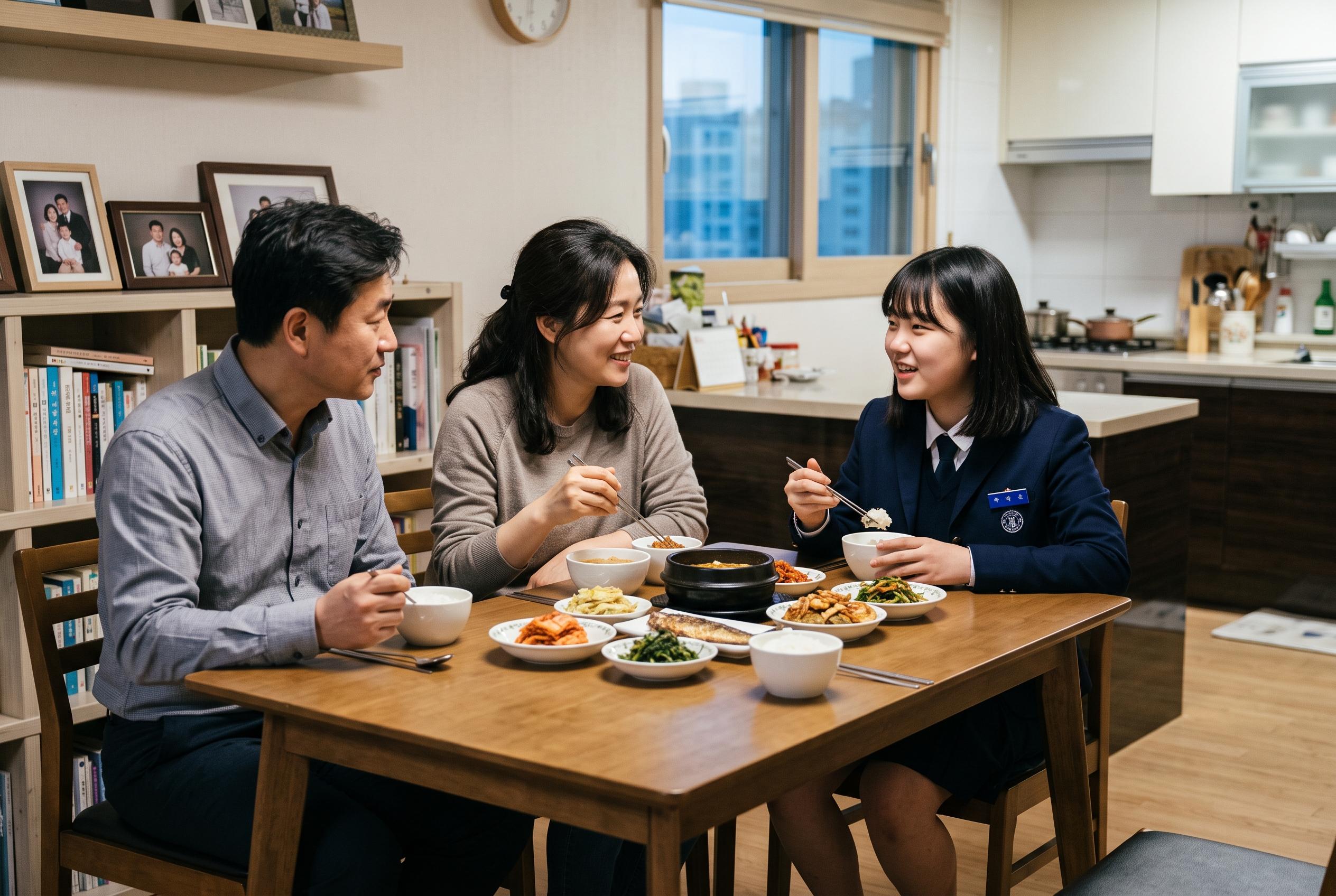

A dramatic decline in shared family dinners among South Korean secondary pupils correlates with increased stress and anxiety, driven by demanding schedules and ‘time poverty,’ according to new data from the Korea Disease Control and Prevention Agency.
Among South Korean secondary pupils, the family dinner table is disappearing fast. Data cited by Seoul Shinmun from the Korea Disease Control and Prevention Agency show that the share of students who ate with their parents every day fell from 66.3% in sixth grade to 19.2% by third year of high school, as academic pressure and dual-income households pushed family routines apart.
The decline is steepest as children get older. The proportion eating with parents fewer than four days a week rose from 14.7% in sixth grade to 60.9% in third year of high school. Over the same period, the share of students who spent no more than 30 minutes a day talking with or being with their parents increased, while those managing at least two hours together dropped sharply, suggesting that the issue is not only food but time.
Researchers at the KDCA linked that shrinking shared time to what they describe as “time poverty”: families with working parents and teenagers absorbed by entrance-exam preparation struggle to overlap their schedules. The agency’s longitudinal study found that pupils who ate with parents fewer than four times a week in early adolescence were not simply from poorer households; they were more likely to come from higher-income and dual-earner families, underscoring that busy lives, rather than income alone, are driving the change.
The mental-health findings are striking. In an analysis of 3,986 teenagers followed for five years, the KDCA said that each extra day a week of shared meals was associated with a 12% lower chance of severe stress later on, a 9% lower chance of feeling depressed and an 8% lower chance of high anxiety. Earlier international research has pointed in the same direction: studies indexed in PubMed and academic journals have associated regular family meals with fewer depressive symptoms, less substance use, better emotional wellbeing and stronger family connectedness, with some evidence that girls may benefit particularly.
Disclaimer: This content is for informational purposes only and is not intended to be a substitute for professional medical judgment, advice, diagnosis, or treatment.