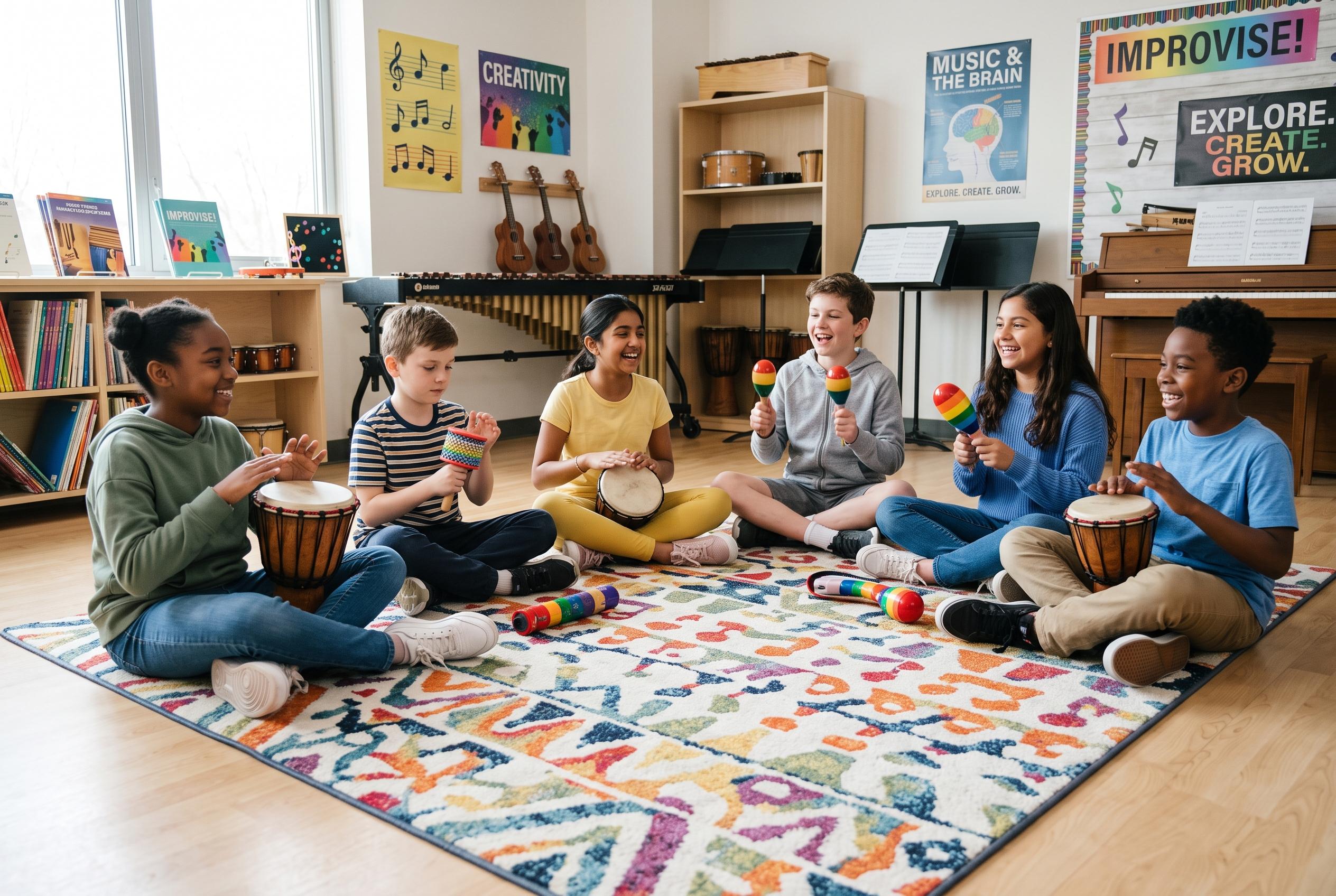

Research indicates that children as young as nine possess nascent neural networks for improvisation, challenging assumptions that creative skills only develop with age and training. Findings suggest arts engagement supports brain health and wellbeing from an early age.
Research into children’s musical improvisation suggests the brain may be more creative, and more reward-driven, than many adults realise. In an interview with the Greater Good Science Centre’s “Science of Happiness” podcast, Karen Barrett of the University of California, San Francisco, described how work with young pianists points to a form of creativity that appears to emerge even before years of formal training have a chance to shape it. The study focused on children aged nine to 11 and used functional magnetic resonance imaging to compare improvised playing with a memorised scale.
Barrett said the project grew out of earlier work on professional jazz musicians, in which improvisation was linked to reduced activity in parts of the brain associated with self-monitoring and increased activity in regions tied to a player’s own artistic expression. That earlier pattern has been echoed in other research on improvisation, including EEG and fMRI studies of trained musicians that found distinct neural activity during spontaneous performance compared with rehearsed playing. Taken together, those findings suggest that improvisation is not simply memorised skill delivered under pressure, but a different mental state altogether.
The child study added another layer. According to the research published in Scientific Reports and indexed by PubMed, improvisation in children was associated with deactivation in auditory, limbic and parietal regions, alongside changes in prefrontal and temporal areas involved in self-generated behaviour and cognitive control. The researchers also found stronger engagement of reward systems during improvisation than during scale playing, which they interpreted as evidence that the brain’s foundations for creativity may already be present in late childhood. Another version of the findings, shared in the related summary, describes these patterns as part of a “nascent” creativity network that may later develop into the adult circuitry seen in experienced improvisers.
Barrett argued that this matters beyond music. Her view is that the arts are not a luxury or an optional extra, but a useful way to exercise the brain and support wellbeing. The broader message, she said, is that people often inhibit themselves with the idea that they must already be good at something before they can enjoy it. Her takeaway is simpler: creativity can be rewarding in itself, whether it comes through music, drawing, painting or stitching, and the brain appears to benefit from the act of making as much as from the finished result.
Disclaimer: This content is for informational purposes only and is not intended to be a substitute for professional medical judgment, advice, diagnosis, or treatment.